



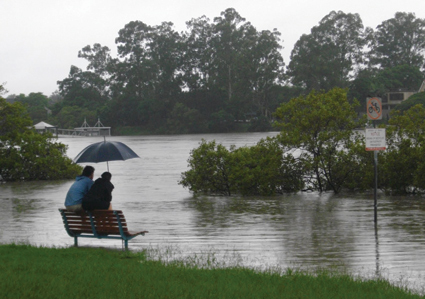
It never rains: Brisbane, January 2011
Poetry, said Auden, makes nothing happen. Usually it doesn't, but sometimes a poem gets quoted in a national argument because everybody knows it, or at least part of it, and for the occasion a few lines of familiar poetry suddenly seem the best way of summing up a viewpoint. Just such an occasion has occurred recently in Australia. By the time the heavy rains first hit Queensland early this year, the theory of Catastrophic Anthropogenic Global Warming (CAGW, to borrow the unlovely acronym) was ceasing to exercise unquestioned thrall in the minds of Australia's progressive voters. But spokespersons for the Green party clung on to it, encouraged by the fact that the theory, in its Climate Change form, was readily applicable to any circumstances.
Before the floods, proponents of the CAGW view had argued that there would never be enough rain again, because of Climate Change. When it became clear that there might be more than enough rain, the view was adapted: the floods, too, were the result of Climate Change. In other words, they were something unprecedented. Those opposing this view — those who believed that in Australia nothing could be less unprecedented than a flood unless it was a drought — took to quoting Dorothea Mackellar's poem "My Country", which until recently every Australian youngster was obliged to hear recited in school. In my day we sometimes had to recite it ourselves, and weren't allowed to go home until we had given evidence that we could remember at least the first four lines of the second stanza, which runs like this.
I love a sunburnt country,
A land of sweeping plains,
Of ragged mountain ranges,
Of droughts and flooding rains.
I love her far horizons,
I love her jewel-sea,
Her beauty and her terror —
The wide brown land for me.
The first four lines of the stanza are the bit that everybody knows, partly because they are so addictively crafted, and partly because they fit the national experience of what Australia's geography and climate are actually like. In any household, the seniors (known in Australia as "the wrinklies") remember the droughts and the flooding rains of their childhood. I myself remember the Maitland floods of the early 1950s. The whole of the central seaboard of New South Wales was under water. I can remember rain you couldn't see through: right there in my southern suburb of Sydney, the creek flooded the park, and the lake in the park spilled into the bottom of our street, prompting the construction of a galvanised iron canoe in which three of us sailed to what would have been certain death if the contraption had floated for more than a few seconds.
All three of us are old men now, of differing achievements and views, but none of us would be easily persuaded that the recent floods were a new thing. They come and go in long cycles, spaced apart by droughts. When white explorers first set off to cross the country's vast interior, they didn't have to go very far before they encountered the sort of parched terrain that would eventually convert them into corpses suitably posed for Sidney Nolan. There was nothing wrong with the weather, only with their expectations. As any Aboriginal might have told them had they known how to ask, the Australian climate is simply like that. For Queensland, this has been one of several floods in a hundred years, and not even the worst. Though the fashionable propaganda about the unprecedented nature of the inhospitable weather has been largely the product of inner-city intellectuals who rarely see the inland except when they fly over it on their way to another city, the truth is that even a city-dweller will catch on to the facts if he or she lives long enough. First it never rains, but then it pours. Hence the expression, perhaps; and hence Dorothea Mackellar's poem, certainly.
Younger people can less easily call up the past, and usually younger journalists are the worst people of all to grasp an historical context, but this time the lore handed down by the "the wrinklies" has done its work. Even the most dedicated of warmist journalists — the ones who will go on preaching the doctrine until they expire, all undaunted that a more general doomsday never arrived — are against the Greens on this issue, the Greens having perhaps failed to realise that if they absurdly oversell the forthcoming catastrophe then they threaten the careers of those who fancy themselves to be selling it by the right amount. As to that, the warmist argument should always have looked shaky in Australia — which produces only a tiny percentage of the world's total greenhouse gas emissions, and could therefore hope to reduce global warming only by a tiny percentage of a tiny percentage — but there were large reservoirs of credulity to greet it, perhaps because Australia is blessed with an intelligentsia which, almost without a dissenting voice, is united by the conviction that the high standard of living they enjoy is the product of the West's contempt for the world's poor.
We could quarrel forever about whether this display of concern is genuine or feigned. Let it suffice for now to say that the virtual entirety of the country's higher media, with the ABC at the apex, could usually be relied upon to blame Western industrial society if something untoward happened to the weather in, say, Bangladesh. But this time the bad weather was happening at home, and the reality principle suddenly got a look-in, because there were too many people in possession of a folk memory about those droughts and flooding rains. Even by his erstwhile admirers, Green Party Senator Bob Brown was thought to have gone over the top by saying firstly, that man-made global warming had caused the floods, and secondly, that the coal mining industry should pay the bill. This absurdity proved too much. Even the coal miners' union thought he was talking nonsense.
More importantly, the journalists won't wear it either. They have been quoting Dorothea Mackellar's poem in their articles. The famous lines about the droughts and flooding rains get quoted from memory in every television discussion. You can appreciate how unusual this is, only if you realise the completeness of the shut-out that previously obtained. Until the rains came, the voice of Professor Tim Flannery had been loud in the land. More moderate professors, who said that there might indeed be some man-made global warming, but not a lot, were heard only occasionally. Professor Flannery was heard all the time, and always predicting that the major cities would run out of water. The nice thing about him was that he was without guile and therefore ready to say that a certain city would run out of water in some verifiable time: say, two years. Two years later, abundant rain would be falling on that city. But he always had an explanation, and the media always liked his story best, because it was a story about Australia eventually and inevitably running out of water, even though what appeared to be water might currently be seen to be falling out of the sky. Then an awful lot of it fell on his head at once and he was finally seen to be short of credibility.
Some of Australia's noisier warmists — Clive Hamilton is an especially piercing example — pronounce the necessity of suspending democratic rights, so that citizens can be punished for sinning against Gaia. Flannery is less poisonous than that, but he was nevertheless running a business. The features pages loved his message about impending disaster. A real disaster, however, makes real news, and, dangerously for him, brings less servile commentators on the case, ready to quote poetry at him. He hasn't had to face that sort of thing before, but now he must, and so must all those who share his convictions, including, especially, the Greens. It was Green pressure that stymied the construction of dams. Probably, from now on, dams will come back into favour, in recognition of the fact that the climate of the sunburnt country, in all her beauty and her terror, is still the way it always was. After the First World War, the desirability of up-river flood control was already well understood. Indeed Australia pioneered such engineering, and the Tennessee Valley Authority borrowed the idea from Australia, not the other way about.
If, from now on, dams are built instead of desalination plants — which in recent years have been proved to yield a fraction of the water at a multiple of the cost — then we will be able to tell that sanity has returned to at least one section of the vast area covered by the pretensions of the climatologists. But it's quite likely that, in general, their view will continue to be dominant. Though the idea that there is consensus on the subject among climate scientists has become harder to push now that so many other scientists have joined the discussion, the media, on the whole, would probably rather stick with a high-concept drama than report a debate. So we can't tell yet whether common logic has prevailed. But we can be sure that poetry has benefited.
It might be said that "My Country" is not very good poetry, but it would be said in error. Dorothea Mackellar knew exactly what she was doing when she wrote it. Born in Sydney in 1885 and raised as a city dweller of fine family, she knew the inland only as a privileged young lady usually did, as a place for holidays. But on the family farms at Gunedah she took it all in, the terror along with the beauty. Indeed she might even have found the terror rather beautiful, as we Australians tend to do. At the age of 19, she wrote the poem when she was on a genteel tour of England. First published there in the Spectator in 1908, the poem is an address to the charms of the old country, telling it that although she appreciates its sylvan virtues, her soul is ruled by the new country's rough edges. The argument is carried out with a firm but subtle command of rhetoric and a sense of form unusual in a poet so young: it's one of those works that you wouldn't dream of calling mature until you found out it was precocious. Certainly, there is no reason for Australia's intellectuals of today to patronise her — she, after all, had by far the superior education.
Leading a productive life that didn't end until 1968, she was still in action when I was standing beside my desk reciting her most celebrated lines in the hope of being given what was then called an "early mark". (I imagine it still is, but I doubt if you have to recite poetry to get one.) Her work added up to several volumes and nobody except scholars has read all of it recently. But the same is true for Wordsworth, and an awful lot of ordinary people have been remembering that chunk from the second stanza of "My Country". Some of them might go on to read the rest of the poem. They will be well rewarded. Listen to this:
Core of my heart, my country!
Her pitiless blue sky,
When sick at heart, around us,
We see the cattle die —
But then the grey clouds gather,
And we can bless again
The drumming of an army,
The steady, soaking rain.
Ideally, you might say, poetry should never be that relevant to current circumstances. If it is, it's the equivalent of a picture postcard, is it not? Yes, but there are picture postcards that help define an era. Another question: can poetry ever be at its best when evoking something so large as an entire country? Well, if Shakespeare hadn't thought so, he would never have given that speech to John of Gaunt in Richard II, Act II, Scene I, the speech that ends with "This blessed plot, this earth, this realm, this England."
There might possibly be a Romanian equivalent. But there is no doubt at all that Mackellar's masterwork is in the same ball-park, if not quite in the same league. The more cerebral poets, along with the stricter critics, have always hated the very suggestion that poetry might mainly depend on the catching of a mood. But it almost always does, and patriotism is a mood too. It's a raw emotion and easily perverted, and a nation with too much of it is bound to cause trouble, but a nation entirely without it is lost indeed. This year, at a moment of real crisis, Australia discovered, or rediscovered, that it was in possession of a simple-seeming work of art that could help it to feel proud of itself, even in adversity. Pride comes from facing facts, and in Australia the facts are that the climate will starve you or wash you away, unless you build something. Banning certain categories of light-bulb will never be enough. Such measures imply the desirability of a return to some kind of benevolent natural state. There is a natural state all right, but any benevolence is our idea. The blue sky is pitiless.


- Cultural Climate Change
- Opposites meet in the land of Scrugletopia
- The Battle Against The Philistines Never Ceases
- Can Macron Save France — Or Is He Its Undertaker?
- Home from home for the Bolshevik elite
- Why France Is Revolting Against The Ancien Regime
- How The EU Elite Paved The Way For Populism
- A Decent Woman Betrayed By Her Gruesome Twosome
4:03 AM
4:03 AM
4:03 AM
2:03 AM
12:03 AM
12:03 AM
12:03 AM
11:03 PM
5:03 PM
3:03 PM