



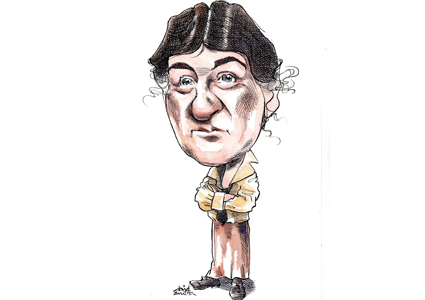
Willa Cather seems to have missed every critical boat that set sail during the 20th century. As Joan Acocella in Willa Cather and the Politics of Criticism shows, modernist critics, who worshipped at the shrine of Joyce, Proust, and Kafka, found little to interest them in Cather. For the Marxist critics of the 1930s, she had even less to offer. The New Critics of the '40s and '50s could not get much of a critical workout from her straightforward, however august, novels. The attempt of academic feminists to turn her into a lesbian, and so a fit subject for Women's Lit — a notion and a category that would have appalled her — never really came off. So criticism missed out on Cather, the greatest American novelist of the 20th century.
Cather deserves this accolade because of her own literary genius but also because of the diminishing reputation of her literary contemporaries. Hemingway today borders on the ridiculous with his bluff code of manliness and coarse self-promotion. Poor F. Scott Fitzgerald, dead at 44, left two enduring books, The Great Gatsby and The Crack-Up, only one of them fiction. William Faulkner, whose Rococo prose style, played with the foot down heavy on the pedal, long ago entered the realm where it is much easier to admire than actually to read him. Meanwhile, Cather's achievement seems today even greater than when she was alive.
Without being a conventionally religious woman, Cather had great respect for religion. Death Comes for The Archbishop, her account of two French priests making their way across the new world of North America to found a church in Santa Fe (not yet New Mexico), is the most beautiful religious novel written in America or in any other country. Respect for religion does not do a modern writer's reputation much good. Edmund Wilson, for example, got off the Evelyn Waugh train at Brideshead station, and he felt that T.S. Eliot's religion was chiefly reinforcement for what he thought were Eliot's reactionary views.
Cather had her admirers, Rebecca West, Katherine Anne Porter, and Eudora Welty among them. Wallace Stevens thought America had no better novelist. She also had a grand subject, perhaps the grandest of American subjects: immigration and its travail, and she got the most out of it. She had intimate knowledge of immigrant life, having grown up in Red Cloud, Nebraska, and lived among the people about whom she would later write with such insight and sympathy.
O, Pioneers! (1913), My Antonia (1918), A Lost Lady (1923), Cather's immigrant novels, are all set in the rural and small-town American Midwest. These novels pit the recent immigrant — often Scandinavian, sometimes Central European — against the flat, stark land, with its droughts and wind storms and blizzards, and the unremitting hardships they brought in their wake. She also captured the land's stark enchantment. No one wrote landscape as beautifully as she.
Virginia Woolf said Cather "had all the accomplishments of culture without a trace of its excess." After an early career in journalism, she turned herself into an artist; after an early life in smalltown America, she turned herself into a cosmopolitan. She knew the important questions, posing them in compelling plots with vivid characters, assuming the intelligence on the part of her readers to work out the answers for themselves.
In The Professor's House (1925), Professor St Peter tells his class that "science" [...] has given us a lot of ingenious toys, they take our attention away from the real problems, of course, and since the problems are insoluble, I suppose we ought to be grateful for distraction." He goes on to instruct that humankind, in losing religion, has given up the great drama of salvation, in which "the king and the beggar had the same chance at miracles and great temptations and revelations," and found nothing to replace it.
Cather was deep, she could also be dark, but in the end, light shines through her best fiction. Like all the greatest novelists, she was androgynous, or supra-sexual, in her powers of creation: her writing is full of brilliantly drawn men and women. She could also turn that most difficult of fictional tricks, making goodness believable, and her work abounds with goodness up against great odds, sometimes winning through, sometimes being crushed by the forces of nature or of human viciousness.
Willa Cather, my most underrated writer, admired Gustave Flaubert, my most overrated writer. This is revealed in her essay, "A Chance Meeting", about encountering Flaubert's then aged niece in Aix-les-Bains. Her meetings with this widowed woman recall to her "the time in one's life when one first began to sense the things which Flaubert stood for, to admire (almost against one's will) that peculiar integrity of language and vision, that coldness which, in him, is somehow noble." Willa Cather, of all people, turns out to be of the Cult of Flaubert. Most inconvenient, but only, I suppose, for me.


- Cultural Climate Change
- The American mind continues to close
- The West must restore a sense of the sacred
- Sweet singing in the choir
- The onslaught against the West's moral codes
- Technology menaces childhood and culture
- A portrait of the artists as a pair of young wastrels
- The new Leviathan: Trump and the nation state
12:11 AM
3:10 AM
6:10 PM
6:10 PM
9:03 PM