


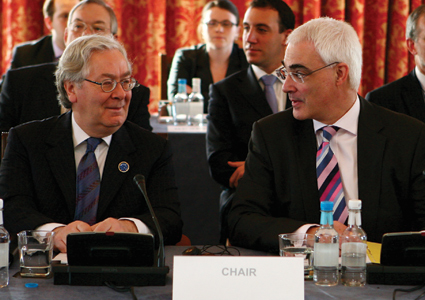
 Not too keen: Alistair Darling (right) was suspicious of Mervyn King (Gareth Fuller/PA)
Banks have debts to two kinds of people: their depositors and the rest. As bank deposits can be converted into cash at 100 pence to the pound, they can be used to make payments and are money. America's Great Depression in the early 1930s showed that widespread bank failures and a sharp fall in the quantity of money cause macroeconomic disaster. Modern liberal democracies therefore coddle the depositors with an assortment of structures and regulations to ensure that — come hell or high water — deposits are indeed always repaid at 100 pence to the pound.
What about "the rest"? They are a far more motley crew than depositors. They include both bondholders and equity shareholders. Since banking involves lending money and charging interest, they are readily caricatured as the spivs and slickers of contemporary capitalism. As the ongoing Great Financial Crisis since 2007 has shown, modern liberal democracies certainly do not coddle them. Many commentators have been alarmed that losses on loans and alleged "toxic securities" might erode the asset cover for depositors. Banks have been forced by governments and regulators to raise immense quantities of capital — by issuing more equity capital and bonds — to protect depositors. The spivs and slickers have had to cough up, and they don't like it.
In late 2008 the crisis was at its most intense. That October British officialdom pressed the clearing banks into the largest recapitalisation exercise of all time and decided to inject government money if the private sector was reluctant to participate. With the bewildered shareholders of RBS and HBOS unable to put the money together, a large chunk of the British banking system fell into public hands.
Alistair Darling's memoir Back from the Brink (Atlantic, £19.99) is another addition to the growing kiss-and-tell literature on the period. Readable and sometimes quite funny, it throws fresh light on the shambles of so-called "government" in the Gordon Brown premiership. On page 89 "the chaotic atmosphere in No 10 worsened"; on page 96 "Mervyn was seething and told me in no uncertain terms that he blamed No 10"; on page 103 the "operation in No 10" was its "usual" chaos; on page 106 "Gordon's attack dogs" unleashed "the forces of hell"; on page 231 "forty-eight hours before its presentation, we had no Budget". And so on.


Post your comment
- We Need Churchill's Vison of Liberty More Than Ever
- The Play's The Thing, So Leave The Words Alone
- An Aesthetic and Moral Disaster
- How we Syrians destroyed our home — with your help
- Euphoric Labour won’t win power led by a pied piper
- Don’t be ‘difficult’ — try ‘formidable’, Mrs May
- Enough is enough of terror — but also of our self-doubt
- Iraq’s Christians pray for help that never comes
- The Atlantic alliance may be broken beyond repair
- Catholic tastes: both English and European
- Brexit as myth: Exodus, Reckoning, or Sacrifice?
- A Decent Woman Betrayed By Her Gruesome Twosome
- Can Macron Save France — Or Is He Its Undertaker?
- Europe's Revival Is At Hand, Thanks To Brexit
- Is This The Most Important British General Election Since 1979?
- The New Europe Must Be About More Than Money
- Our Best Brexit Policy Is All-Out Free Trade
- The Bursting Of Our 'Kabubble' Fantasies
- Gambling On A Greater More Gracious Britain
- Xi Versus Trump: The Emperor And The Tycoon

- Opposites meet in the land of Scrugletopia
- The Battle Against The Philistines Never Ceases
- Home from home for the Bolshevik elite
- Can Macron Save France — Or Is He Its Undertaker?
- Why France Is Revolting Against The Ancien Regime
- How The EU Elite Paved The Way For Populism
- A Decent Woman Betrayed By Her Gruesome Twosome
- Last Of The Great Elitists