


Another edifice of Britain's decaying social structure crumbled when the anti-capitalist Occupy Wall Street movement crossed the Atlantic in October. But, proving once again that the English do farce rather better than revolutions, it was the Church of England, not the fat cats of the City, which has been seriously damaged.
The favela of tents and banners proclaiming "capitalism in crisis" outside St Paul's Cathedral provoked a crisis which came from within — and the reason is that at some point the creed of equality, that 21st-century pastiche of socialism, replaced Anglicanism as England's national religion, and the Church of England became the First Church of Christ, Marxist.
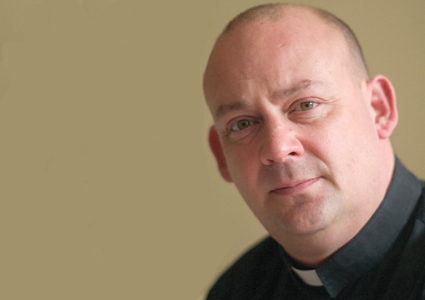
No one better exemplifies that evolution than the Rev Dr Giles Fraser, former Canon Chancellor of St Paul's, who in the first days of the occupation appeared on television news telling police to back away, and then resigned when the City of London Corporation began a legal bid to evict the protesters. Echoing the half-educated sociology graduates outside whose banners asked, "What would Jesus do?" (he'd probably sell that iPhone in your pocket and give the proceeds to the poor), Dr Fraser proclaimed: "I could imagine Jesus being born in the camp."
The canon's resignation was followed by those of the Dean, Graeme Knowles, and a part-time chaplain, while the clerk of the works is now off with stress. The Church has been left a laughing stock, but Dr Fraser is the new poster boy for the protests.
The Guardian devoted an editorial in praise of his holy endorsement of the Occupy London Stock Exchange movement, describing him as a "fiercely bright, progressive and genial man" who prefers jeans and a T-shirt to a dog-collar, and enjoys curry, football, smoking and the odd glass of wine.
Fraser has just written an introduction to a Church-sponsored report on finance and ethics, published by the St Paul's Institute, a think-tank which he heads. He is in huge demand for speaking engagements, and continues to be heard on BBC Radio — indeed, he was back on Thought for the Day the week after his resignation.
Listeners to the Today programme's reliably infuriating religion slot will recognise the former canon's thoughtful and articulate estuary English. Like most of the new establishment, however, Fraser emerged from the old one.
The son of an RAF officer (he himself considered becoming an army chaplain), he was educated at Uppingham and became a lecturer in philosophy at Wadham College, Oxford, specialising in Friedrich Nietzsche. (What Nietzsche would have thought of the Occupy rabble we can only imagine.) He has compiled an anthology on Jesus with the Marxist professor Terry Eagleton, in which Christ is presented "as a figure akin to revolutionaries like Robespierre, Marx and Che Guevara".
Fraser is also founder of the pro-gay Inclusive Church, for like many in the new Church, he wants Christians to moralise about the boardroom, but not the bedroom.
Unlike his opponents, Fraser has the sounding board of Broadcasting House. In recent months he has spoken on Thought for the Day about the execution of Troy Davis in the US state of Georgia and on the summer riots, which he could see from his "haas". He had nothing to say about the greed that drove the looting, nor the fatherlessness or welfare dependency that lie at its root.
Although TFTD devoted three slots to condemning the killing of Osama bin Laden, neither Fraser nor any other contributor has yet had much to say about Youcef Nadarkhani, the pastor sentenced to death in Iran for apostasy, or other persecuted Christians and Jews.
But Dr Fraser's media career cannot be attributed solely to the political preferences of the BBC. Journalists like him because he is genial and professional, often makes highly original points, and has an ability to translate complex theological arguments into accessible language.
He is recognisably part of the English radical tradition of plain-speaking preachers. Alas, unlike in the days of John Wesley, today's radical churchmen ally themselves with a liberal Left that is almost entirely anti-theist, and actively wants to remove this irrational creed from public life.
Fraser once wrote in Socialist Worker: "Christianity is...the religion of turning the other cheek, communal meals and blessed are the poor. In contrast, Christendom is what Christianity became when it got mixed up with the Roman Empire."
There is, of course, some truth in this, but when Fraser argues that "what secularisation specifically attacks is state religion, the religion of Christendom" and that "post-Christendom provides an opportunity for a very different Christian voice to emerge", he is deeply misguided. For secularism today instead leads the state itself to take on the role of Church, to become the arbiter of morality, the vehicle for social change, and even the font of happiness and hope. No wonder that intolerant statists are so keen to remove the influence of the rival, older faith.
Jesus said: "Love your enemies"; he didn't say actively help them destroy you. But that, unfortunately, is what the Church of England seems intent on doing.


1:02 PM
4:12 PM
5:11 PM