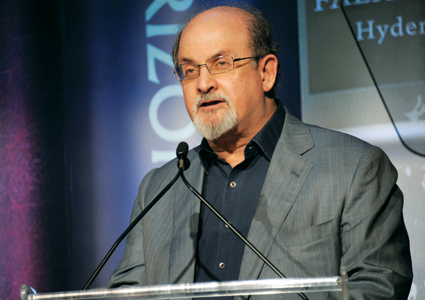
Not-so-brave new world: After Rushdie's fatwa, fear of violent reaction silenced liberal critics of Islam (Clint Spaulding/AP/Press Association Images)
Why write a defence of freedom of speech? The postmodern Left regards the idea as pernicious and contemptible. Few go as far as the American literary theorist Stanley Fish, author of There's No Such Thing as Free Speech: And It's a Good Thing, Too, who announced, "The only way to fight hate speech or racist speech is to recognise it as the speech of your enemy. What you do in response to the speech of your enemy is not prescribe a medication for it but attempt to stamp it out." But the professor is hardly the only "liberal" to believe that the state has the right to suppress offensive speech as if it were crushing an insurrection.
Laws and taboos against upsetting the tender-minded are everywhere. Polite society, by which I mean not only successive governments, but the wider bureaucracy and mainstream opinion, holds that it is wrong to cause offence, even to those whose views are offensive; wicked to be disrespectful even of those who are not worthy of respect. You can see today's censorious tendency at work in the explosions of fury on the internet and in the mainstream media modern Britons enjoy when they seek distraction from the economic crisis. The complainants do not merely wish to deliver well-deserved condemnations of Jeremy Clarkson, Jonathan Ross and other celebrity oafs. They want them punished or fired, or in the case of the Twitter users who posted a homophobic columnist's home address online, they appear to want them dead as well.
The classical liberal John Stuart Mill believed that the law could only punish the direct incitement to a crime. In his example, when agitators claimed that corn dealers starved the poor, the state had no right to silence them. Only if the agitators said the same to an angry mob gathered outside a corn dealer's home could the police move in. Mill does not say that the law should punish the incitement of hatred against corn dealers. Even if their critics made their neighbours despise them as rapacious capitalists, even if the criticism was unfair and caused them financial harm, corn dealers could not go to court.
How many liberals believe in Mill's liberalism today? Most reject his tolerant injunctions because they want to defend the social revolution of the late 20th century. They are opposed to racism, homophobia and misogyny for good reason, and know that the struggles against them extend human freedom. Whereas Mill would only allow the police to arrest a demagogue causing direct harm by whipping up a mob outside a mosque or a gay bar, they want to regulate writing and speech which does not directly cause crime in the name of a greater good. To use the phrase of the philosopher Joel Feinberg, they have replaced Mill's "harm principle" with an "offence principle", which holds that societies are allowed to punish speech that people find exceptionally offensive.
Leave aside if you can the sensible objection that the offence principle justifies the censoring of political debates — for do not many politically committed people find the views of their opponents "exceptionally offensive"? — and instead look at the boomerang that has whirled back through the air to smack the children of the 1960s in the face. They knew that racists, homophobes and misogynists were bad people with terrible ideas, and too few worried about the ground they were conceding when they accepted excessive restrictions on free speech. They ought to know better now.
Because they decided that they must do more than fight bad ideas with better ideas, and allowed "offence" to a supposedly marginalised faith or racial group, rather than actual harm, to be grounds for censorship, they could not defend liberal principles against faith groups that were racist, homophobic and misogynist.
Meanwhile on the libertarian Right, utopians think that writing a book about freedom of speech is not so much pernicious as pointless. Why bother when new technology has moved us into a new world, the liberalism of which would make Mill blink with astonishment? Debates about blasphemy, privacy, hate-speech, libel and official and corporate secrecy are leftovers from the analogue age. The wonder of the web has dispatched the concerns of the past to the dustbin of history. Now we can write what we want and no one can stop us.
Censors can try, of course. But when they do, they will find that they cannot contain the web. Look at the Arab revolutions where it allowed the rebels to break the dictatorships' information monopolies. Or look at WikiLeaks, the journalistic phenomenon of the age. It dumped masses of confidential information on to the internet about the American war in Afghanistan and the American war in Iraq and the American prison at Guantánamo Bay and the American State Department. America, the most powerful country in the world, could not stop it. WikiLeaks was based in Sweden, beyond America's control, although everyone in America with access to the internet could read what it published.
If Stanley Fish is an extreme representative of authoritarian liberalism, the American futurologist Clay Shirky represents extreme techno-utopianism. The internet, he cried, was delivering freedoms that men and women once needed liberal constitutions and democratic governments to guarantee. "To speak online is to publish, and to publish online is to connect with others. With the arrival of globally accessible publishing, freedom of speech is now the freedom of the press and freedom of the press is freedom of assembly. Naturally the changes occasioned by new sources of freedom are most significant in a less free environment."
We all feel that way sometimes. When we hear that a Premier League footballer has secured a superinjunction to stop details of his energetic adulteries appearing, we look to the web to supply us with the details. When we want to check a fact or research a problem, we believe in Google's illusion of omniscience and click on its home page.
I do not underestimate the advances in knowledge. Like all previous revolutions in communications technology, the web will change the world. But, like all previous revolutions in communications technology, it will give advantages to those who already enjoy power and wealth. As well as empowering the citizens of democracies and dissidents in dictatorships, it empowers elected governments, dictatorial regimes, police forces, spies, employers, blackmailers, frauds, fanatics and terrorists. The new technologies are Janus-faced. The future may be one of greater information-sharing and informed collective action as people exploit new resources or, as is the case in China, Belarus and Iran, one of suspicion as citizens understand the growing likelihood of computer-enabled surveillance. What happens will depend on where you live, what rights you have, and how persistently you and your fellow citizens engage in political struggles to defend or expand those rights. It will depend most of all on what arguments we have.
So despite the objections, I have published You Can't Read This Book: Censorship in an Age of Freedom (Fourth Estate, £12.99). It is easy enough to explain why. No one can write well unless they believe in a book's importance. A sincere conviction in the necessity of telling your story offers no guarantee of quality-many terrible books have a horribly misguided sincerity behind them-but without it, the task is hopeless. This rule applies as much to novels that the high-minded dismiss as trash as literary fiction. The first person an author has to sell a book to is himself or herself, and if he or she can't believe in it, no one else will. In my case, I've been a journalist for 30 years and debates about what I can or cannot write have been a part of my life. It seemed a natural subject.
How one writes about such a broad topic is a harder question to answer. Conservatives said I should condemn political correctness. As I do not want to go back to a country where jokes about the niggers, the Pakis, the yids and the micks were all over the television, I haven't, but instead looked at the failure of frightened liberals in the West to back censored liberal writers from the poor world. Ayatollah Khomeini's death threat against Salman Rushdie still casts its shadow, and I argue that fear of a violent reaction has created a culture of pretence in the Western democracies. The grand pose of intellectuals and artists is that they are the moral equivalents of the victims of repressive regimes. Loud-mouthed newspaper columnists strike heroic postures and claim to be dissenting voices bravely "speaking truth to power". Their editors never have to worry that "power" will respond by raiding their offices and throwing them in prison.
Publicly-funded comedians and state-subsidised playwrights claim to be the edgy breakers of taboos as they denounce wars and government collusion with corporations. They never fear that government will respond by cutting their grants. Few admit that what makes liberal democracies liberal is that "power" will not throw you in prison, whether you speak the truth to it or not, and that taboos have been broken for so long that the most "edgy" thing an artist can do is to uphold them. If the transgressive came clean, they would accept that they lampoon the bigotry of Christianity and the wickedness of Western governments because they know that Christians are not so bigoted and Western leaders are not so wicked that they would retaliate by trying to kill them, while the Islamists on whose behalf they self-censor just might. Their fear means that they cannot support liberal Muslims and ex-Muslims in Egypt or Iran — or, to come closer to home, Bethnal Green and Bow. From Rushdie onwards we have seen the spectacle of liberal Westerners condemning or ignoring dissident Muslim and ex-Muslim artists when their (and our) theocratic enemies seek to silence them.
If political correctness means an unbending support for the rights of women, gays and minorities to speak out against and ruthlessly satirise religion, then I am saying that the trouble with our culture is not that it is politically correct, but that it is nowhere near politically correct enough.
Left-wing friends told me to concentrate on attacking Fox News. I sighed and included a small section explaining why freedom of speech can be compatible with retaining controls on the accuracy and balance of television — a hard case to make now that spectrum scarcity has ended, but one I think I can still argue. Researching it did not stop me regarding the obsessions about the biases of the Murdoch empire on one side and the biases of liberal broadcasters on the other as silly distractions. If the prejudices of media corporations ever did sway voters — and there is little evidence that they did — that power has gone. The web has shattered the business models and fragmented the audiences of the old press barons, and we will not see their kind again.
Instead of obsessing about them, Left and Right should worry that neither the old nor new media warned about the financial crisis that has engulfed our world. The reason for the monumental failure of journalism and democratic oversight is simple. Every time you go to work you leave a democracy and enter a dictatorship. Nowhere is the citizens' right to speak out so constrained. If you confront the hierarchy, you will be fired and in all likelihood never work in your field again because no other manager will want a "troublemaker" on his "team".
In the Royal Bank of Scotland, many knew that their CEO was leading them to disaster. None went to the press or the authorities. At HBOS, one risk manager did his job by warning that the bank was taking extraordinary risks. His boss fired him. I should not have to remind you that the taxpayer has had to bail out both banks. In America it was the same story. Staff at AIG, which insured worthless subprime derivatives, lived in terror of contradicting their CEO. The only one who did was fired too, and the American taxpayer had to come to the rescue shortly afterwards.
We are living through the collapse of old orthodoxies and the bankrupting of old hierarchies. It will pass, as all crises pass, but a better future will come only when we accept that people have a right — indeed a duty — to speak out against all the collectivist blocs of faith, ethnic identity, corporate hierarchy and state that have betrayed us so thoroughly.



3:07 PM
2:04 PM
3:02 PM
9:01 PM
10:01 AM
6:01 PM
4:01 PM
12:12 PM
6:12 PM
10:12 AM