



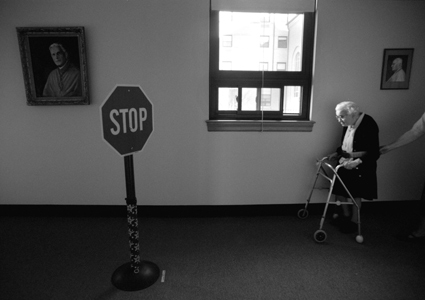
 Ageing with grace: Participants in David Snowdon's long-term study of nuns, exploring the relationship between personality and dementia
When I started training in psychiatry in the late 1980s my plan was to specialise in child and adolescent disorders. Instead, I was drawn into a research project examining mental illness in older people living at home. That in turn drew me into a peculiarly British speciality, the psychiatry of old age. (As far as I am aware, only the British Isles, Australia, New Zealand and the Netherlands have developed this as a separate discipline within psychiatry.)
In the 1980s our textbooks still referred to senile and pre-senile dementia as though some conceptually important difference existed between dementia occurring before and after 65. In the intervening two decades the public relations machine which supports medicine, pharmaceutical research and voluntary organisations (like the Alzheimer's Society) has helped to relaunch and publicise a newly-packaged bundle of concepts. Rebranding senile dementia as something largely equivalent to Alzheimer's disease was one of the most important of these. Calling it a disease tapped into our fascination with all things medical and raised the public discussion to a new level of sophistication.
The successful relaunch of dementia as Alzheimer's disease was based on several simplifications. One was the "war" declared by the pharmaceutical industry (and related researchers) on Alzheimer's disease which focused on eliminating the plaques and tangles which accumulate in the brains of those people who eventually suffer the clinical entity known as Alzheimer's.
This generation of medicines is in a trial phase and none is even close to reaching the market. Some have been ineffective, some produced unacceptable side effects and some were quite simply disastrous. A vaccine which recruited the body's own immune system to attack and eliminate amyloid plaques was trialled about ten years ago; it caused death and disability in a number of trial participants, mostly in France, where some powerful families had used their influence to get their relatives into the trial. This particular line of research has more or less dried up.


Post your comment
- Mr Cameron, Show The Country That You Care
- Campaign Diary
- Defying Duopoly: The Rise Of The Insurgents
- Don't Rig The System In Favour Of Coalitions
- Warring Gangsters Who Run The Country
- Political Correctness Is Devouring Itself
- An Archival Treasure Trove—And All Online
- Do we value freedom of speech in Britain?
- Can Europe's Jews Feel Safe Alongside Muslims?
- We Cannot Avoid The Battle Over Blasphemy
- Inside The World Of 'Non-Violent' Islamism
- We Can Fix The Economy But Not Human Nature
- The Keynesian Versus The Monetarist: A Lost Decade
- The Keynesian Versus The Monetarist: Time To Re-Read Keynes
- The New Language Of Political Narcissism
- Two Words You Won't Hear This Election: Foreign Policy
- The Many Faces Of Holocaust Denial
- Why Is 'Fifty Shades of Grey' the New Normal?
- Obama scuttles. America retreats. Things fall apart
- Putin and the Art of Political Fantasy

- The Loss Of Faith Made Music Mute
- The Great Betrayal: How Liberals Appease Islam
- Political Correctness Is Devouring Itself
- The New Language Of Political Narcissism
- Why The World Still Loves Shakespeare
- Don’t Listen to Britain’s Designer Demagogues
- Who's in Charge of BBC News?
- An English parliament: the only way to save the UK
- The Loss Of Faith Made Music Mute
- The Great Betrayal: How Liberals Appease Islam
- Political Correctness Is Devouring Itself
- The New Language Of Political Narcissism
- Why The World Still Loves Shakespeare
- Don’t Listen to Britain’s Designer Demagogues
- Who's in Charge of BBC News?
- An English parliament: the only way to save the UK
- The Loss Of Faith Made Music Mute
- The Great Betrayal: How Liberals Appease Islam
- Why The World Still Loves Shakespeare
- Who Will Lead The Berlin Band?
- Putin and the Art of Political Fantasy
- Political Correctness Is Devouring Itself
- The New Language Of Political Narcissism
- Inside The World Of 'Non-Violent' Islamism