



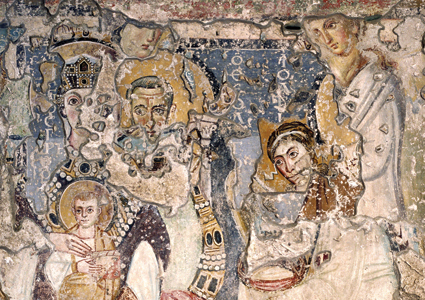
 A reflection of the eternal world: The Virgin at Santa Maria Antiqua
Giorgio Vasari, the 16th-century painter and writer whose views on art have done so much to shape our own, dismissed Byzantine painting as a mere prelude to the development of the art of the Renaissance. Vasari derisively described the Italian predecessors of Giotto as exponents of the maniera Greca, the Greek style of painting that he regarded as simply incompetent: the figures were flat, and looked as if they were on standing on their tiptoes, because the artists didn't understand perspective, and hadn't worked out how to create the illusion of a three-dimensional object on a flat surface.
Byzantine painting has never quite shaken off Vasari's stigma, even though there have been some heroic attempts to show that its artists shouldn't be condemned for not having discovered perspective. They did not aim at accurate representation of people or things: theirs was an art that tried to reflect the eternal world of the spirit, a realm not governed by the rules that restrict the solid objects of this world. Greek painters, certainly from the sixth to the ninth centuries, saw their art as a means by which the viewer could be encouraged to contemplate heaven and its inhabitants. It was not aiming at an accurate depiction of the natural world, but at an evocation of the celestial one.
Still, even for those who recognise and respect its aims, it is very hard to appreciate Byzantine painting dating from the early middle ages, principally because there is so little of it left: most of it was destroyed by the iconoclasts. The iconoclasts took the idea that art should not involve the accurate representation of people in the physical world to its logical conclusion: they abolished any representation of people at all. Taking their cue from the Second Commandment that prohibits "graven images", the iconoclasts' first major outburst of "image smashing" was between 737 and 787. You can destroy a great deal of art if you and an army of followers are devoted to getting rid of every religious image that can be found. That's what the zealots of the Byzantine empire did. Even after that rage of anti-image fever had passed, there were still enough images left to provoke another explosion of iconoclasm, between 814 and 842. By the time the second phase was over, Byzantine painting had, at least as it existed in the lands controlled by the emperor of Byzantium, been almost completely destroyed.
Greek painters had, however, also worked in Italy for the Catholic Church. Almost all of their work has been destroyed as well, not by iconoclasm, a movement that never took hold in Italy, but by later artists. When Vasari wrote The Lives of the Artists in the mid-16th century, almost every patron shared his view that Byzantine painting was irredeemably backward. Far from encouraging contemplation of the next world, most churchmen felt that its technical shortcomings-the stiff, weightless figures floating in mid-air and their cartoon-like poses-prevented it from performing any serious religious function. They had no compunction about tearing down walls, indeed whole churches, containing Byzantine frescos. When Rome was rebuilt over the three centuries from 1400 to 1700, practically all Greek painting in the eternal city perished; no one thought any of it was worth preserving. The same process happened all over Italy, with the result that there is none left. There are some spectacular Byzantine mosaics-which are harder to destroy than frescos-but with the exception of small icons painted on wood, Byzantine paintings from the first 500 years of the Byzantine empire have all but disappeared.


- The Loss Of Faith Made Music Mute
- The Great Betrayal: How Liberals Appease Islam
- Political Correctness Is Devouring Itself
- The New Language Of Political Narcissism
- Why The World Still Loves Shakespeare
- Don’t Listen to Britain’s Designer Demagogues
- Who's in Charge of BBC News?
- An English parliament: the only way to save the UK
- The Loss Of Faith Made Music Mute
- The Great Betrayal: How Liberals Appease Islam
- Political Correctness Is Devouring Itself
- The New Language Of Political Narcissism
- Why The World Still Loves Shakespeare
- Don’t Listen to Britain’s Designer Demagogues
- Who's in Charge of BBC News?
- An English parliament: the only way to save the UK
- The Loss Of Faith Made Music Mute
- The Great Betrayal: How Liberals Appease Islam
- Why The World Still Loves Shakespeare
- Who Will Lead The Berlin Band?
- Putin and the Art of Political Fantasy
- Political Correctness Is Devouring Itself
- The New Language Of Political Narcissism
- Inside The World Of 'Non-Violent' Islamism
8:10 PM