


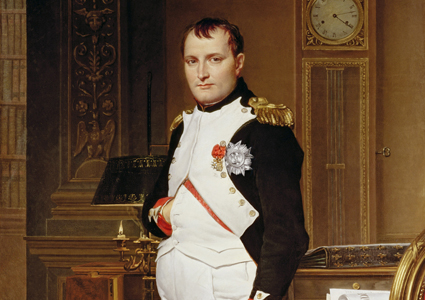
 Object of mockery: Jacques-Louis David’s portrait of Napoleon
When Winston Churchill appointed R.A. Butler as the president of the Board of Education in 1941, he advised him: "I should not object if you could introduce a note of patriotism in our schools. Tell the children that Wolfe won Quebec." Butler believed it would be too autocratic to dictate to schools what lessons they should teach, and it was not until 1988 that Kenneth Baker imposed a national curriculum on Britain's state schools.
Since the arrival of the national curriculum, public debate on school history has focused almost exclusively on what topics should be taught, namely whether the emphasis should be on British or world history. This debate has been fuelled by a steady stream of surveys revealing the ignorance of today's school-leavers. One commissioned last summer by Lord Ashcroft found that while 92 per cent of 11- to 18-year-olds could identify the animated dog from the car insurance advertisements as Churchill, only 62 per cent could identify a photograph of Britain's wartime prime minister. Fewer than half knew that the Battle of Britain took place in the sky.
However, having become a history teacher at a state secondary school two years ago, I have realised that such debates miss the real problem. I was surprised to learn that since its inception the national curriculum has stipulated a sensible split of British and world history: every pupil between the ages of 11 and 14 is expected to study a chronological sweep of British history from 1066 to the present day. To understand the degradation of history teaching, one has to focus not on what history is taught, but how it is taught.
I was inspired to become a teacher by a desire to emulate two history teachers I was fortunate enough to have at school. They loved history, liked children, and had a gift for communication. But once I embarked on my teacher training, everything I was told about good practice opposed such a vision. Apparently, such teaching is old-fashioned. I was quickly accused of having a tendency towards "didacticism", a cardinal sin in today's state sector.
This was my first introduction to the progressive ideas of child-centred education. It is hard to overestimate the extent to which such ideas now dominate in our state schools. An organisation established at Leeds University in 1972 called the Schools History Project (SHP) has done untold damage to the teaching of history. The SHP was formed with the belief that history should be used to transmit "attitudes and abilities rather than the memorisation of facts". Classrooms should "create an active learning situation for the pupil, rather than those which cast the teacher in the role of transmitter of information". This conception of the subject was dubbed "New History"—an oxymoronic moniker apparently lost on the SHP. Since its formation, the SHP's philosophy has influenced everything from the national curriculum to teacher training, textbooks and GCSE examinations.
The main tenet of a child-centred view of history teaching is the idea that pupils should not be "passive" recipients of a teacher's knowledge, but "active" individuals empowered to find things out for themselves. As a result, "chalk and talk" teaching from the front is heavily discouraged. After a senior member of staff observed one of my lessons, I was told that my role was to be the "guide on the side" rather than the "sage on the stage".
Instead of learning through listening to teachers or reading books, pupils are expected to do so through projects. It did not take me long to work out why pupils are so ignorant of British history, despite spending over a year studying it (as laid down by the national curriculum). To study the Norman Conquest, pupils would re-enact the Battle of Hastings in the playground, conduct a classroom survey to create their own Domesday Book, and make motte-and-bailey castles out of cereal boxes. Medieval England would be studied through acting out the death of Thomas Becket, and creating a boardgame to cover life as a medieval peasant. For the Industrial Revolution, pupils pitched inventions to Dragons' Den and lessons on the British Empire culminated in the design of a commemorative plate showing whether it was or was not a "force for good".
Such tasks allow pupils to learn about history in an enjoyable and engaging way—or so the theory goes. In reality, all content and understanding of the past is sucked out, and the classroom begins to resemble the playground. An unfortunate side-effect is that pupils are frequently confused by the inevitable anachronisms involved in making history "relevant". "Sir, how many Victorians would have had a TV?" I was asked. Imaginative tasks and projects can be excellent supplements to a history lesson, but when they become the mainstay of classroom activity, the consequences are disastrous.
Proponents of child-centred education are impervious to such criticism because progressive teachers have long denied the importance of knowledge in the first place. Instead, skills are seen as paramount. When I first visited my current school, the assistant head asked me how I intended to prepare for my new career. I responded that I was going to spend a few weeks boning up on my general historical knowledge. "I wouldn't worry about that," she said. "History is a skills-based curriculum. You should really be able to teach it without knowing anything at all."
In the case of history, the main skill we teach is "source analysis". In line with the SHP's recasting of history during the 1970s, pupils are now taught to become junior historians, building their own knowledge of the past through the first-hand study of historical evidence. According to the soon-to-be-revised national curriculum, history should teach "key processes" such as the ability to "identify, select and use a range of historical sources" or "evaluate the sources used in order to reach reasoned conclusions". Bemused parents have frequently asked me why their child is being taught to be a historian instead of being taught history. This is why.
Progressive educators tend to cast skills and knowledge as a dichotomy, when in reality they are a sequence, and knowledge must come first. Trying to exercise historical skills such as source analysis or understanding causation without a solid grounding in a historical topic is impossible. It is like trying to run before you can walk. Pupils find the whole process frustrating and confusing.
This became clear to me when I taught a class of 13-year-olds about Napoleon. Still under the baleful influence of my training, I started the lesson by showing them a source-Jacques-Louis David's famous painting Napoleon in his Study. I then asked them to infer from this source what sort of man Napoleon was. The class fell about laughing at his effete stance and tight trousers, and repeatedly inferred that he must be gay. I angrily explained that he enjoyed a particularly passionate marriage to a lady called Josephine, and asked them to infer something else. There was a pause. "You must admit, he does look pretty camp," came the next response.
My pupils could not take an interest in Napoleon because they did not know his story. With minimal context offered, one of the greatest figures of modern European history appeared to them as remote and risible. I decided that for the next lesson I would photocopy "The Last Conqueror", a chapter on Napoleon in Ernst Gombrich's A Little History of the World. We read it as a class, and they were fascinated: "How could so many French soldiers die retreating from Russia? . . . How was Napoleon allowed to give his brothers whole countries to rule? . . . Why were the English allied with the Germans at Waterloo?" Facts are easily derided, but facts are what make history come alive. Only when pupils become interested in them will the skills begin to emerge.
Sadly, most of the skills that are taught today are entirely bogus anyway. As Robert Tombs , professor of history at St John's College, Cambridge, wrote in a recent report for the think-tank Politeia, "The ‘skills' required are often hollow and mean little to those forced to acquire or indeed teach them." Worst of all, the GCSE examination questions designed to test these meaningless skills lead to the worst kind of teaching to the test. Generations of 16-year-olds are being taught that the most important thing to know about history is how to parrot the phrase, "this source is biased because . . . "
There is another more ideological justification for history as "source analysis". Our history classrooms are hobbled by a radical relativism which states that no one historical account should be given predominance over another. Instead of narrative textbooks, most school history books are now made up of bitty excerpts from primary sources-a photograph here, a heavily-doctored diary entry there. It is claimed that through investigating this primary evidence for themselves, pupils are empowered to construct their own version of the past.
Of course, the very process of selecting the evidence automatically renders it subjective. The GCSE syllabus I teach (designed by the SHP) is a perfect example of this: our 2,000-year study of Medicine Through Time is a teleological narrative of the triumph of science over religion, culminating with the crowning glory of the NHS; our in-depth study of the American West is a story of European racial genocide against the peace-loving Native Americans; and for our study of the Troubles in Northern Ireland, the textbook ignores the IRA's mainland bombing campaign. The result is doubly duplicitous. Pupils are told they are constructing their own historical narratives, while simultaneously being fed the soft-left worldview of the educators who put together the textbooks.
Today, traditional history lessons are invariably seen as boring, but nothing could be farther from the truth. Have you ever heard someone reminisce about an inspiring history teacher who was a "guide on the side"? Great history teachers draw upon a passion for and knowledge of the subject to tell stories, explain ideas and bring the past alive. They do not have to rely on nonsense "learning activities" to make the subject engaging, for discussing the story of humankind is interesting in its own right. In short, they teach from the front.
A pupil from a 1950s grammar school interviewed for David Cannadine's recent book The Right Kind of History sums up what this kind of teacher can achieve. "We sat in rows, facing the teacher . . . kept quiet, listened, asked questions. We had textbooks and homework and, I think, weekly informal tests." Today, such a teacher would be derided, but the pupil remembers this teacher as "fantastic". She "had a good degree and loved her subject [and] made lessons fun and interesting". Chalk-and-talk teaching does not make history boring. It is the anti-teaching, anti-narrative and anti-knowledge dogmas within state education that make history boring. Less than a third of today's schoolchildren (the beneficiaries of New History) choose to study the subject for GCSE. This is fewer than those who chose to study the considerably more challenging history O-level or CSE exams 30 years ago.
Most members of the public are unaware of how debased the teaching of history has become. For this reason, the significance of Michael Gove's reforms is frequently misunderstood, and they are repeatedly parodied as rote learning the kings and queens of England. Gove is an intelligent man and he should be given more credit than this. He is the first Secretary of State for Education to have really taken on the insidious ideologies that distort modern classroom practice. But how can he overcome them?
Draft programmes for the new national curriculum for history expected early this year will lay out in detail which historical topics pupils should study when, but this is not the answer. Quite apart from academies and free schools (now the majority in secondary education) being exempt from the national curriculum, the choice of topics has never been the fundamental problem. While I believe that a chronological study of British history, followed by forays into global history, is the best model, I am happy to accept that studying history from a global perspective can provide a first-class secondary education. Whether or not all pupils learn that Wolfe won Quebec will always be a political issue and is perhaps not for the government to dictate. The replacement of the history GCSE, due in 2015, is a more promising development. A knowledge-driven exam should give teachers a significant nudge to change their ways. However, what needs to change above all else is the received wisdom on what makes a good history teacher. A whole generation of child-centred teachers will have to be retrained or retire before this can happen. Only then will we stand a chance of producing school-leavers who can identify Winston Churchill—or even General James Wolfe.


- Admit It, Mr Kerry: You Blundered
- Bismarck Versus Blair — A Foreign Policy Crossroads
- Arab Spring, Islamist Summer — What Next?
- The Diplomat the Whole World Ignores
- The Blob Has Run Schools For Decades. Not Any More
- Would You Intervene — Or Pass On The Other Side?
- He Died That Others Might Live In Peace
- The Hero's Journey is Hollywood's McMyth
- Online Only: Countering the Counter-Jihadists
- Online Only: The Price Paid for Criticising Islam
- 'Please Sir, I Just Want to Learn More'
- Why Students Should Be Glad To Pay Tuition Fees
- A 'Liberal Racist'? Me? I Felt Like a Heretic
- Demolish the Relics of Yesterday's Future
- Was Britain Right To Go To War In 1914?
- German Victorians Who Helped Transform Britain
- The Alternative History of an Undivided India
- Online Only: Heirs to the Left
- ONLINE ONLY: The Hayward Gallery's Fashionable Primitives
- ONLINE ONLY: A Spiritual Corner of Southwark

- The Zombie Argument that Refuses to Die
- Online Only: The Price Paid for Criticising Islam
- Overrated: Dan Brown
- Is the Brain the Key to Understanding Religion?
- Overrated: George Monbiot
- Time to Wise Up to the Muslim Brotherhood
- 'Please Sir, I Just Want to Learn More'
- The Alternative History of an Undivided India
- The Zombie Argument that Refuses to Die
- Online Only: The Price Paid for Criticising Islam
- Overrated: Dan Brown
- Is the Brain the Key to Understanding Religion?
- Overrated: George Monbiot
- Time to Wise Up to the Muslim Brotherhood
- 'Please Sir, I Just Want to Learn More'
- The Alternative History of an Undivided India
- Decline and Fall of the History Men
- Uncritical Theorists Who Misread the Nazis
- The Zombie Argument that Refuses to Die
- The Banality of Hannah Arendt
- From Kitsch to Cool: Picasso and Modern Art
- Is the Brain the Key to Understanding Religion?
- Time to Wise Up to the Muslim Brotherhood
- Midfield Virtuoso Finds His Perfect Pitch
12:01 PM
12:01 PM
10:01 AM
8:01 AM
11:01 AM
10:12 PM
10:12 PM
2:12 PM
2:12 PM
2:12 AM