



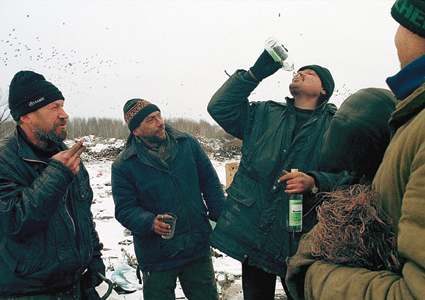
 Drinking themselves to death: Russia's alcoholism is a long-term consequence of collectivisation, the Gulag and the KGB
Driving through Russia is like travelling through a country with plague. Only hours from Moscow, in the ancient heartland, the peasant villages are dying — scattered, decaying, wooden shacks well sunk into the earth. Only a handful of moonshine drinkers and decrepit pensioners are still there. Their fields are fallow, the countryside flat and monotonous, a world of jagged forests pierced by abandoned churches. These are filled with trash, they smell of urine and their alcoves are littered with hypodermic needles.
The Russian countryside is still, almost lifeless. The only sound comes from the birds. Occasionally, by the roadside, old women stand waving mushrooms and berries at passing cars. There is no other way to make money. Bruised men, shaking after days on the bottle, stumble through the exhausted hamlets. Sometimes they shout incomprehensibly. This deep Russia is redolent of Europe after the Black Death, a place where alcoholics try and force you to drink white spirit with them, where grandmothers, all cataracts and threadbare clothes, grab you to lament that it was not like this "before".
The Last Man In Russia is a journey into a dying empire, which has lost five million people since 1991. This is an atmospheric and moving book. It makes painfully clear that in a country that hates to talk about the Gulag and has almost forgotten the terrors of collectivisation, this rural wasteland, some of the richest farmland on earth, is still the wreckage of Stalinism.
Oliver Bullough writes beautifully. He has the eye of a photographer to bring the obscure details of Russian life to the page, conjuring up what it is really like to be there; but also the ambition of a historian to explain how Russian demography turned so apocalyptic.


- Cultural Climate Change
- Opposites meet in the land of Scrugletopia
- The Battle Against The Philistines Never Ceases
- Home from home for the Bolshevik elite
- Can Macron Save France — Or Is He Its Undertaker?
- How The EU Elite Paved The Way For Populism
- Why France Is Revolting Against The Ancien Regime
- A Decent Woman Betrayed By Her Gruesome Twosome
1:03 PM
1:03 PM