


Among my earliest memories is Bernard Hailstone's oil portrait of my father, Louis Heren, in jungle-green army uniform, black beret and captain's pips, with a fiercely watchful expression. It hung on the walls of our many homes as we moved around the world with him, a foreign correspondent of The Times. Under the portrait hung the samurai sword my father acquired from the Japanese officer who had tried to behead him on the road to Mandalay in March 1945, around the time the portrait was painted. Although many combatants had their portraits painted in the Second World War, this picture must be most unusual in having been made in the field. This is how it came about.
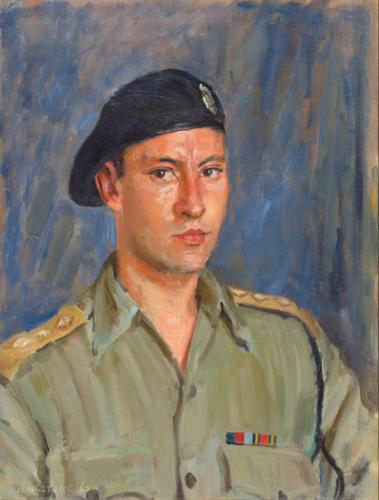 Captain Louis Heren, 7th Light Cavalry, Indian Army, by Bernard Hailstone, Burma, 1945
In early 1945, the British 14th Army under Lieut-General Wavell was advancing rapidly in Burma, and beginning the annihilation-not too strong a word-of their Japanese enemy. The advance was so swift, and the terrain so difficult, that the fighting troops were being resupplied by air. One day it fell to my father to take a detachment of lorries from 7th Light Cavalry, where he was a half-squadron commander, to collect supplies at an airstrip hacked from the jungle. It was a scene of enormous activity, DC-3s landing and taking off, vehicles from dozens of units loading food, ammunition and fuel. Amid the bustle, my father noticed a bearded Englishman in what he described as a "Savile Row jungle uniform", sitting disconsolately on incongruous leather baggage. He was Bernard Hailstone, official war artist, and he was waiting for someone from corps headquarters to collect him.
After the last Dakota had taken off, and the ground parties had mostly left, my father returned to Hailstone, and invited him to stay with 7th Light Cavalry until they could pass him on to a higher formation. Hailstone remained with the regiment a few days, and the two men became friends, conversation lubricated by gin and whisky from the Army & Navy Stores in Calcutta which had been among the newly-arrived cargo.
My father was an East Ender, Hailstone had served as an auxiliary fireman during the worst of the London Blitz in 1940/41, and they shared maverick traits. My father described himself as "officer and temporary gentleman", while Bernard, leftish and pacifistic in his views, was not entirely at ease painting senior officers of South East Asia Command; earlier in the war his subjects had been merchant seamen, firemen, bargees and shipping.


- Legacy of a Sir-Realist
- The Art Of Euphemism
- The Floor Is Theirs
- Osbert Lancaster
- Museo Dell'Opera Del Duomo, Florence
- Nordic Violet
- Berlin Metropolis: 1918-1933
- Giambattista Bodoni
- Beauty Of The Beast
- Granby Four Streets
- Ben Uri At 100
- Godfrey MacDomnic
- Ushaw College
- Peter Schmersal
- Mark Boxer
- Carol Robertson
- Drawing Board: Sarah Butterfield
- Drawing Board: Egon Schiele
- Drawing Board: New York Mid-Century
- The Schorr Collection

4:05 PM
3:02 PM