


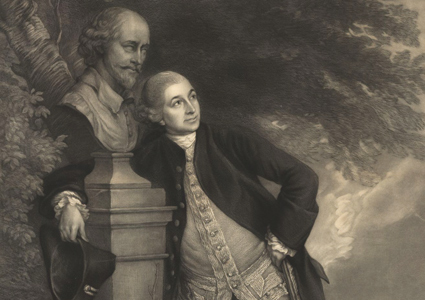
 David Garrick posing with a bust of Shakespeare: He tamed the panto beast
Two wise and shrewd observations inform the text of this engrossing book. "Theatres don't run themselves," writes Mr Whelan, "they are complex and demanding organisations that require the complete attention of whoever is in charge." And again: "Nothing stimulates the desire to see a show like the thought that you might not be able to get in."
They are both as true today as they were when Drury Lane marked the edge of London, beyond which were only fields. So this book chronicles the divergent characters and talents of the long line of managers at the Theatre Royal since Thomas Killigrew was given permission by his friend Charles II to run a theatre company in 1660, and how they progressively sought to ensure that the public would compete in the scramble to get tickets. As this building has the longest continuous use for theatrical production of any in the world, Whelan's cast-list is formidable, and he controls them with a kind of affectionate dedication. Despite its name, by the way, the theatre has never had an entrance on Drury Lane.
It is, quite properly, a chronological rather than thematic account, beginning with the scatterbrained pandemonium of the Restoration era, when spectators turned up whenever they felt like it, and left in similarly wilful fashion, so that the performance was constantly interrupted; when there was so much noise and chatter emanating from the audience that the actors could scarcely be heard; when people would wander onto the stage and behind it without hindrance, or throw fruit at it to register their opinion; when they ate and drank during, not after the show. It all sounds like boisterous fun, but I rather think our more restrained modern manners offer the performers a better chance to escape home without a headache.
Some of the managers, too, were pretty unpleasant, especially Christopher Rich, who was so mean he avoided paying the actors if he could get away with it, and my own favourite monster, the renowned 19th-century actor/manager Macready. Granted, he had a proper respect for Shakespeare (most of whose lines had been habitually rewritten to make them more "theatrical"), and for authenticity of costume and design, but his much-lauded insistence upon proper rehearsal times was his way of making sure everybody on stage sounded exactly like him. And he was irascible and vengeful to a degree bordering on the pathological. He almost ruined his rival (and better actor) Samuel Phelps by assigning him only small parts.


- The Zombie Argument that Refuses to Die
- Online Only: The Price Paid for Criticising Islam
- Overrated: Dan Brown
- Overrated: George Monbiot
- Is the Brain the Key to Understanding Religion?
- Time to Wise Up to the Muslim Brotherhood
- The Laughter of the Privileged Left
- The Alternative History of an Undivided India
- The Zombie Argument that Refuses to Die
- Online Only: The Price Paid for Criticising Islam
- Overrated: Dan Brown
- Overrated: George Monbiot
- Is the Brain the Key to Understanding Religion?
- Time to Wise Up to the Muslim Brotherhood
- The Laughter of the Privileged Left
- The Alternative History of an Undivided India
- Decline and Fall of the History Men
- Uncritical Theorists Who Misread the Nazis
- The Zombie Argument that Refuses to Die
- The Banality of Hannah Arendt
- From Kitsch to Cool: Picasso and Modern Art
- Is the Brain the Key to Understanding Religion?
- Time to Wise Up to the Muslim Brotherhood
- Midfield Virtuoso Finds His Perfect Pitch
11:06 AM