



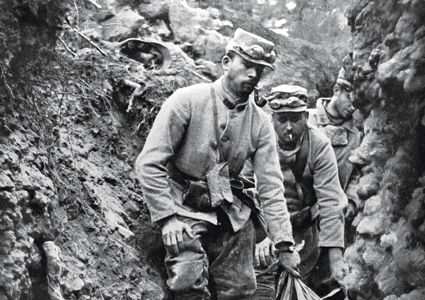
 Wounded French soldiers during the Battle of Argonne, 1918: Trench warfare was costly in lives but not always disproportionately so (credit: UIGVIA, getty images)
The History Wars are upon us. The 100th anniversary of the outbreak of the First World War is less than a year away, but conflict over how to commemorate it is already heating up. In July, Richard J. Evans, Regius Professor of History at Cambridge, made his view robustly clear in the Guardian ("Myth-Busting", July 13, 2013). Brushing aside the likes of Hew Strachan, Gary Sheffield and Max Hastings, he wrote that "the men who enlisted in 1914 may have thought they were fighting for civilisation, a better world, a war to end all wars, a war to defend freedom: they were wrong". Unable to let pass the chance to caricature his conservative opponents and to savour the easy pleasure of watching strawmen scatter before the withering breath of his indignation, Evans accuses those who would celebrate 1918 as a British military triumph of "narrow, tub-thumping jingoism" and asks, "Do we want a narrow, partisan, isolationist national identity where . . . other countries are regarded as inferior, and triumphalist myths are drummed into our children?"
Well, presumably not. I doubt even Evans's bête noire, Michael Gove, would be so unsubtle as to nod his head to that. But celebration is possible without tub-thumping, and triumphalism needn't spoil the sober recognition of triumph. It is possible to honour the military success of our national forebears in defeating an unjust invader without deeming ourselves universally superior. It is possible to judge one nation state's aggressive action morally wrong and another's defensive reaction morally right, while recognising that the victim bears some responsibility for the sins of the aggressor. It is possible to judge that it was right to fight back, and still to acknowledge the tragedy of it all.
But how do we judge? During its 1,500-year history, the "just war" tradition — originally fostered by Christian theologians, but now enshrined in international law and adopted by moral philosophers — has developed two sets of criteria, one regarding the justice of going to war in the first place (ius ad bellum) and the other regarding justice in the course of fighting (ius in bello). The six criteria of ius ad bellum are: just cause, legitimate authority, right intention, last resort, proportionality, and prospect of success. Those of ius in bello are proportionality and discrimination. In the case of Britain's belligerency in 1914-18, criticism has focused on three criteria: just cause, right intention and proportionality (both ad bellum and in bello).
Since the late 1920s it has been fashionable to attribute the outbreak of the war not to the morally accountable decisions of individuals or governments, but to the effects of impersonal systems or forces. Thus in 1928 Sidney B. Fay wrote that "the War was caused by the system of international anarchy involved in alliances, armaments and secret diplomacy" and that "all the powers were more or less responsible". This is the morally indiscriminate view taken by Evans, who invokes Christopher Clark's "magnificent" and indicatively titled 2012 book, The Sleepwalkers. Other contemporary historians, however, are more inclined both to credit human agency and to apportion moral responsibility. Thus, Hew Strachan on 1914: "What remains striking about those hot July weeks is the role, not of collective forces nor of long-range factors, but of the individual." Thus too, David Stevenson: "The European peace might have been a house of cards, but someone still had to topple it. It used to be argued that 1914 was a classic instance of a war begun through accident and error: that no statesmen wanted it but all were overborne by events. This view is now untenable."
So who caused it and why? A dominant, if not universal, view has now settled around a modified version of Fritz Fischer's 1960s interpretation. (Evans confidently denies this; Clark, undercutting him, admits it.) The Fischer thesis, according to Stevenson, is that "it is ultimately in Berlin that we must seek the keys to the destruction of peace . . . Germany willed a local war between Austria-Hungary and Serbia, deliberately risked a continental war against France and Russia, and finally actually started one." Whereas "all the European powers contributed to the growth of tension in the pre-1914 decade...the fundamental contention of the Versailles ‘war-guilt' article was justified..." While it is untrue that Kaiser Wilhelm II and his chancellor, Theobold von Bethmann-Hollweg, were intent upon a continental war in July 1914, they were nevertheless prepared to risk it in giving Germany's full support to Austro-Hungary's invasion of Serbia, with a view to isolating Russia diplomatically. Britain, France and Russia had all made it quite clear that a local Balkan war would escalate into a major continental conflict; but it was only after hostilities against Serbia had begun that Bethmann-Hollweg, finally persuaded that Russia would not stay out, sought to prevent escalation by restraining Austro-Hungary.


- May's blunders that led to Brexit chaos
- How not to deal with home-grown enemies
- Chronicle of a political disaster long foretold
- The cruel fleecing of our sheep farmers
- Amritsar: Beginning of the end of Empire
- Why good books could not deter bad leaders
- The dangers of dog in the manger democracy
- When the call of the wild can go too far
- Odds against life after the final whistle
- A beginner’s manual to grievance gibberish
- Cull the thinkers whose ideas have tanked
- Holier than thou: the hypocrisy of the zealot
- The way forward for Europe’s great outsider
- The woke gent’s guide to blurred lines
- The tricky business of gender identity
- “You’re really a man, aren’t you?”
- The ticking timebomb of internet porn
- A distinctive melody in the melodrama of our time
- A mysterious alchemy
- Corbyn's road map to a communist Britain

- The inevitability of Fortress Europe
- The way forward for Europe’s great outsider
- The devout sceptic: hope for those of little faith
- Corbyn waves the flag of anti-Semitism
- In Corbyn’s mind, there is no place for the Jews
- Women storm the podium
- Is the mental illness epidemic just a myth?
- Corbyn's road map to a communist Britain
8:02 AM
9:01 PM
6:09 PM
8:08 AM