



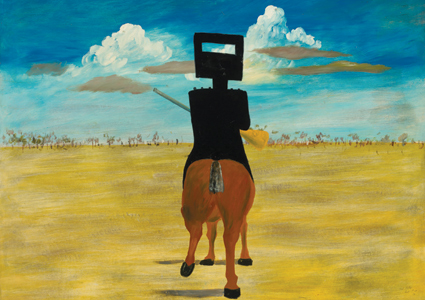
 The Antipodean Don Quixote: "Ned Kelly" (1946) by Sidney Nolan
Like a student on a gap year, the Royal Academy is currently struck with wanderlust. Having tried Mexico with its taster summer show of that country's 20th-century painting and photography, it has now crossed the Pacific to Australia for its big autumn exhibition. It is an adventurous decision: for most people, Australia's artists can be counted not on one hand but on one finger — Sidney Nolan. Indeed, in Britain, Australia's most famous art critic, the late Robert Hughes, is probably better known than any of its artists.
The point of the exhibition, with more than 200 works, is to provide an overview of two centuries of paintings that have been little seen or appreciated outside Australia itself. The last two significant surveys here were held in the Tate and Whitechapel galleries in the early 1960s. While Aboriginal art, with its "dreaming" and "creation" themes, has had its moment in the sun as an artistic-anthropological hybrid, the tradition that stemmed from the first settlers has not had the same exposure.
This tradition, with its roots in 19th-century European painting, is based on the land. Kenneth Clark wrote: "In Australian landscape painting, as in all great landscape painting, the scenery is not painted for its own sake, but as the background of a legend and a reflection of human values." The legend and values are Australia's foundation myths — the blood and soil ocker mentality that grew from the hardscrabble life and the morally dubious origins of the first settlers. And like the Hudson River School in another young country, America, there is in Australian art a continuous sense of surprise and pride at the vastness of nature.
Initially Australian artists transposed the European traditions of the picturesque and sublime. Eugene von Guérard, for example, trained as a painter in his native Austria but came to Australia in the 1852 goldrush. When that endeavour failed he turned instead to painting the big vistas of his new homeland's mountains and valleys. His indebtedness to the likes of Poussin and Salvator Rosa, though, remains clear. John Glover was another. Born in Leicestershire in 1767, he was a successful landscapist and frequent exhibitor at the RA before he moved to Van Diemen's Land in 1831 where he painted pictures of the large estate he named Patterdale (after his Ullswater farm) that washed their Italianate composition in bright Australian light.
By the late 19th century, however, a more authentic Australian style had begun to emerge. "Australian Impressionists" such as Tom Roberts and Charles Conder did exactly what their Parisian counterparts were doing 10,000 miles away: they caught the trains that had begun to pierce the outback and painted en plein air. But the skies they depicted were bigger, the light harsher and the landscape less verdant than the valley of the Seine. Others, such as Arthur Streeton, painted the very stuff of the young Australia — smoke rising from a minehead, a dried river creek, a settler's hut with a lone tree in an empty landscape.
It was a theme adapted by Sidney Nolan and Arthur Boyd in the 1950s and 1960s. Boyd brought a biblical aspect to the landscape, turning Australia into a sometime Eden but also a place for expulsions and dreams. Nolan is best known for his faux-naif Ned Kelly series in which, in comic book style, he shows the outlaw's rise and fall — his Kelly is an Antipodean Don Quixote with his tin-hatted head resembling a television screen with eyes. This, the quintessential Australian folk tale, was, said Nolan, a narrative "arising out of the bush and ending in the bush" and he was driven to paint it from "a wish to hear more of the stories that take place in the landscape".
This exhibition is full of unfamiliar works that tell the stories that take place in landscapes. Those landscapes include empty spaces as well as the urban, farms as well as beaches, and each story is a chapter in the narrative of Australia itself.
A less epic tale was told by George Grosz. His paintings and watercolours of interwar Germany are usually described as satirical but that is too mild a word for pictures that are filled with anger, disgust and, it has to be said, a palpable sense of his fascination with the tawdry scene too. His bitter vision of Weimar Germany is pervasive — a world of wounded soldiers, raddled prostitutes and porcine businessmen locked in a dance of excess.
A Communist and anti-authoritarian, Grosz wanted his art to be unequivocal: "I reject the ‘depth' that people demand nowadays, into which you can never descend without a diving bell crammed with cabbalistic bullshit and intellectual metaphysics." It is this lack of regard for niceties that gives his work some of its impact.
The Richard Nagy gallery on Bond Street, which specialises in German art, is staging George Grosz's Berlin, the first major exhibition of his work here for nearly 20 years. This is a major undertaking for a private gallery and Nagy has gathered some 50 pictures from both private and public collections. Among the array of bourgeois grotesques is a recently uncovered watercolour version of Grosz's statement oil painting, Deutschland, Ein Wintermärchen ("Germany, A Winter's Tale"), 1918, which disappeared in the early 1930s. (See p. 51.)
It was not the only one of his works to suffer this fate. Grosz's career as a provocateur started at school when he was expelled for striking a teacher and he remained foolhardy. In 1921 he was charged with defaming the German army and he ran into trouble twice more before leaving for America in the early Thirties. Numbers of his pictures were destroyed under the Third Reich. As this show demonstrates, however, what was "degenerate" was not Grosz's art but the world it portrayed.


9:09 PM