



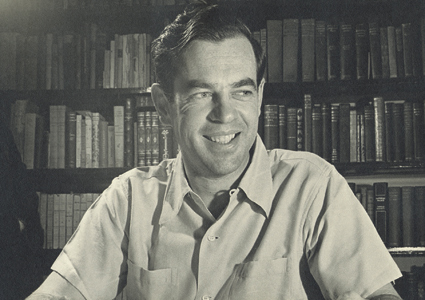
 Modern-day myth maker: Joseph Campbell's influence on Hollywood screenwriters has resulted in some of the highest-grossing movies in history, including "Star Wars". "The Lion King", and "Titanic"
Poor old Casaubon in Middlemarch. There he sits among his tremendous tomes, failing to finish his Key to All Mythologies while ignoring his incandescent bride Dorothea. "What a fool!" we think; a noble one, perhaps, but unquestionably a fool. Yet his plodding, labyrinthine, hopeless quest has been shared by two centuries of anthropologists, psychologists, linguists, poets and eccentrics who have devoted their lives to finding that elusive secret of humanity. Such figures include Sir James Frazer, Madame Blavatsky, Spengler, Freud, Jung, Mikhail Bakhtin, Vladimir Propp, Robert Graves, Aldous Huxley, Claude Lévi-Strauss and Bruno Bettelheim. One of the most influential is Joseph Campbell (1904-87), an American scholar whose central work The Hero With A Thousand Faces, published in 1949, has had an incalculable impact on the Western world through its adoption by Hollywood and the mass entertainment industry.
Campbell's legacy is an unholy knot I can only partially unravel. He inspired movie masterpieces, as well as disastrous flops. He made an important plea for cross-cultural tolerance, yet was paralysed in the face of evil. To understand his story is to understand something of our own ideals and our own contradictions.
A lecturer in comparative mythology and religion at the private liberal arts college Sarah Lawrence in New York state, Campbell took Jung's theory of universal archetypes to its logical conclusion: not only were characters such as the Wise Old Man in every myth, but every myth told the same story with different names. The Hero With A Thousand Faces covers the Epic of Gilgamesh, Native American spirituality, Graeco-Roman potshards, flying Bodhisattvas, the Young Corn God from Honduras and the "great pantomime of the sacred moon-king", to name just a few. (Little Miss Muffet is, however, bewilderingly snubbed.) Fragments of each myth are cross-cut with dreams from modern psychoanalytical sessions and introduced by gnomic chapter headings: "Mother Universe", "Matrix of Destiny", "Womb of Redemption". While intriguing, the book is perhaps more a triumph of editing than insight. Campbell's case is not helped by a foggy prose style that drains the gods of any wit, vitality, fire or sex. Take this sentence: "Makroprosopos is the Uncreated Uncreating and Mikroprosopos the Uncreated Creating: respectively, the silence and the syllable AUM, the unmanifest and the presence immanent in the cosmogonic round."
The Hero With A Thousand Faces dwelt in benign obscurity until it was discovered in the 1970s by a young film-maker struggling to write a sci-fi film in the style of Flash Gordon and Buck Rogers. Cobbling together a budget from a dubious 20th Century Fox and assembling an eager American cast, the director ended up in the deserts of Tunisia, together with a legendary British thespian rolling his eyes and predicting doom. The result? Star Wars.
Thanks to George Lucas, the Hero's Journey had arrived in Hollywood. But it really came into its own via a seven-page memo pounded out in 1985 by Christopher Vogler, a Disney story analyst who, in search of the golden fleece in Beverly Hills, pushed "A Practical Guide to The Hero with a Thousand Faces" into the hands of friends, colleagues and Disney executives. Soon, in his own words, "executives at other studios were giving the pamphlet to writers, directors, and producers as guides to universal, commercial story patterns". Furthermore, in 1988, Campbell became a celebrity through the PBS interview show The Power of Myth. Homely, avuncular, gentlemanly and enthusiastic, he was every inch the octogenarian professor you wished you'd had at university. "Follow your bliss!" he intoned to millions of Americans who kept the book version on the New York Times bestseller list for a year. So when Disney was looking for a formula to turn its embryonic plot for an Africa-set cartoon into a fully grown phenomenon, it didn't have to look too far: Vogler was called in as the witch-doctor and The Lion King was born.
Vogler went on to pen The Writer's Journey: Mythic Structure for Writers, which is now the bible in many creative writing courses. This is Campbell for Dummies. Vogler cuts out the pantomime and gets down to business. To the budding J.K. Rowling, sitting in the Platonic café, trying against the odds to pull incoherent ideas for a story into a bestselling narrative, it seems like a great boon. Introduce the hero here. Introduce a crisis there. Now the Shape-Shifter comes crashing through the window. Shazam! Since Star Wars, films like The Matrix, Fight Club and Titanic have all made use of the theory, as well as clunkers like Ishtar and Howard the Duck. Now every summer the Hero's Journey returns to our screens in a procession of explosion-filled, charmless event movies like Man of Steel.


- In Corbyn’s mind, there is no place for the Jews
- The last Republican in the age of Trump
- A martial nation needs Churchill to inspire us
- Death of a bookman: the rise and fall of a publisher
- The inevitability of Fortress Europe
- Why the World Cup is a game of tribes
- Why Israel needs its new nation-state law
- The devout sceptic: hope for those of little faith
- Will Trump's foreign policy revolution fail?
- After Draghi departs, eurozone deluge looms
- The poor need the rich to always be with us
- Is the mental illness epidemic just a myth?
- No need to sell your oil shares just yet
- Can Macron wear the General's uniform?
- Trump prefers energy dominance to Paris
- A spectre haunting Europe: Karl Marx
- The battle for British Muslims' integration
- Did Winnie's crimes open Nelson's eyes?
- Belated revenge of the 1968 generation
- Jean-Paul Sartre: the supernova of the far Left

- Cyril Ramaphosa's poisoned chalice
- Is South Africa about to fall apart?
- The inevitability of Fortress Europe
- In Corbyn’s mind, there is no place for the Jews
- Presidents for life Putin and Xi menace the West
- How Monet created motion pictures
- Is the mental illness epidemic just a myth?
- The battle for British Muslims' integration
1:07 PM