



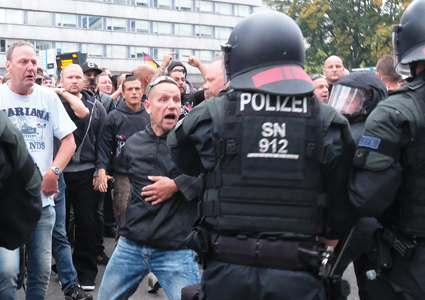
Far-Right protesters face riot police in Chemnitz the day after a man was stabbed to death in an incident with a Syrian and an Iraqi (©SEBASTIAN WILLNOW/AFP/Getty Images)
Recently, I sat in my hotel a few steps away from the Gedächtniskirche — West Berlin’s iconic “church of remembrance,” left in ruin at the end of World War II to remind Germans of the horror of their aggression — preparing for a meeting with Reiner Haseloff, minister president of the east German state of Saxony-Anhalt. The 64-year-old Haseloff is a member of Angela Merkel’s Christian Democratic Union (CDU). Like the Chancellor, Haseloff grew up on the country’s communist side, in the so-called German Democratic Republic. He, too, was trained as a scientist. Merkel holds a PhD in quantum chemistry; Haseloff’s doctorate is in physics.
I wanted to speak with Haseloff about the growing tensions between East and West Germans, three decades after the fall of the Berlin Wall; about the country’s shifting political landscape, about social cohesion and security, and Germany’s migration policies, the last being a subject where Haseloff and Merkel part ways. Haseloff has distanced himself from the Chancellor’s liberal migration policy; in 2015, Germany permitted some one million refugees from mostly Muslim majority countries to enter the country.
At the last minute my meeting with Haseloff was cancelled. The minister president was on his way to Köthen where a fight at a playground between two young Afghan men and a 22-year-old German man resulted in the German suffering a fatal heart attack. In Köthen, the mood was tense. Two weeks earlier, on August 26, violent protests had erupted in the east German city of Chemnitz where a 35-year-old German man was stabbed to death at a festival celebrating the city’s founding. A 22-year-old Iraqi and a 23-year-old Syrian were arrested for murder. If that were not enough, the same Sunday afternoon of the death in Köthen, September 9, a killing occurred in Neukölln, a Berlin neighbourhood where Turks and hipsters rub shoulder. In this case, a 36-year-old Lebanese-born man was shot to death, with five men fleeing the scene by car. Authorities suspect a clan dispute. Police estimate that 20 large families of foreign extraction in Berlin are involved in drug running, prostitution, and other organised crime. After Neukölln, Chemnitz, and Köthen a senior Berlin official said to me, with resignation, “People will have to accept some of this violence as the new normal.”
That’s a lot to swallow. And Germany’s confused public discussion about migrants, refugees and the rising Right makes none of this palatable, or easier to manage.
Start with Chemnitz. I’ve come here, my second visit in six months, to try to sort some of this out in my own mind. I started with the details of September’s disturbances. Chemnitz is an industrial town in the state of Saxony — to the south-east of Haseloff’s Saxony-Anhalt — which was called Karl-Marx-Stadt in communist times. Chemnitz and region are known for left-wing politics. The precursor to Germany’s Social Democratic Party was founded in nearby Leipzig in the 19th century; Chemnitz’s mayor today is an SPD politician, Barbara Ludwig. Today, though, Chemnitz has become reviled for its neo-Nazi scene, its reputation being further damaged by allegations that the population is swinging hard to the Right. This is in part due to the city’s recent social unrest.
Recently, I sat in my hotel a few steps away from the Gedächtniskirche — West Berlin’s iconic “church of remembrance,” left in ruin at the end of World War II to remind Germans of the horror of their aggression — preparing for a meeting with Reiner Haseloff, minister president of the east German state of Saxony-Anhalt. The 64-year-old Haseloff is a member of Angela Merkel’s Christian Democratic Union (CDU). Like the Chancellor, Haseloff grew up on the country’s communist side, in the so-called German Democratic Republic. He, too, was trained as a scientist. Merkel holds a PhD in quantum chemistry; Haseloff’s doctorate is in physics.
I wanted to speak with Haseloff about the growing tensions between East and West Germans, three decades after the fall of the Berlin Wall; about the country’s shifting political landscape, about social cohesion and security, and Germany’s migration policies, the last being a subject where Haseloff and Merkel part ways. Haseloff has distanced himself from the Chancellor’s liberal migration policy; in 2015, Germany permitted some one million refugees from mostly Muslim majority countries to enter the country.
At the last minute my meeting with Haseloff was cancelled. The minister president was on his way to Köthen where a fight at a playground between two young Afghan men and a 22-year-old German man resulted in the German suffering a fatal heart attack. In Köthen, the mood was tense. Two weeks earlier, on August 26, violent protests had erupted in the east German city of Chemnitz where a 35-year-old German man was stabbed to death at a festival celebrating the city’s founding. A 22-year-old Iraqi and a 23-year-old Syrian were arrested for murder. If that were not enough, the same Sunday afternoon of the death in Köthen, September 9, a killing occurred in Neukölln, a Berlin neighbourhood where Turks and hipsters rub shoulder. In this case, a 36-year-old Lebanese-born man was shot to death, with five men fleeing the scene by car. Authorities suspect a clan dispute. Police estimate that 20 large families of foreign extraction in Berlin are involved in drug running, prostitution, and other organised crime. After Neukölln, Chemnitz, and Köthen a senior Berlin official said to me, with resignation, “People will have to accept some of this violence as the new normal.”
That’s a lot to swallow. And Germany’s confused public discussion about migrants, refugees and the rising Right makes none of this palatable, or easier to manage.
Start with Chemnitz. I’ve come here, my second visit in six months, to try to sort some of this out in my own mind. I started with the details of September’s disturbances. Chemnitz is an industrial town in the state of Saxony — to the south-east of Haseloff’s Saxony-Anhalt — which was called Karl-Marx-Stadt in communist times. Chemnitz and region are known for left-wing politics. The precursor to Germany’s Social Democratic Party was founded in nearby Leipzig in the 19th century; Chemnitz’s mayor today is an SPD politician, Barbara Ludwig. Today, though, Chemnitz has become reviled for its neo-Nazi scene, its reputation being further damaged by allegations that the population is swinging hard to the Right. This is in part due to the city’s recent social unrest.
Like this article? Share, save or print using the icons below:


Post your comment
More Dispatches
- Beirut: Hariri — An Assassination Too Far
- New York: A ‘Post-racial’ American vs an Old Coot
- Pristina: Kosovo's Liberal Islam
- Oslo: Courage and Cowardice in Scandinavia
- ONLINE ONLY: Washington, D.C.: It's Not Rocket Science!
- La Hague: Recycling the French Model
- Jerusalem: No Via Media for Anglicans
- ONLINE ONLY: Beirut: Blood Holiday
- Rome: Arrivederci Roma
- Darfur: Panic at the Palace
- ONLINE ONLY: Letter from Bamian
- Caucasus: Diary, August-September, 2008
- ONLINE ONLY: South-East Asia: The Demons of Ignorance
- New York: Diary
- Ypres: Never Say Never Again
- New York: A Cousin in the White House
- Caracas: Chávez's Secret Fan Club
- Prague: Diary
- Park City, Utah: Movie that Pulls Aside the Veil
- Beirut: Blood on the Streets
- India: Tariq Ali's Plan for Pakistan
- Berlin and Cologne: A Tale of Two German Cities
- Mumbai: On the 'Slumdog' Trail
- Budapest: Screwed Left, Right and Centre
- Paris: Mayhem in the Marais
- Stanford, CA: Intellectual Life Under Obama
- Colombia: A Nation Reborn
- Paris: Prisoner of the Barbarians
- United States: The Path to Rome via San Francisco
- ONLINE ONLY: Black Russian
- South Africa: The ANC'S Health Lesson for Obama
- Lisieux, France: Relics of Thérèse
- Germany: Heidegger - Being, Time and Place
- Moscow: Putin's Empire Strikes Out
- Connecticut: My Battle Against Google
- Montana: Home From Home on the Range
- Siberia: In Search of the Gulag
- Rio's Heart of Darkness
- Mogadishu: Armageddon on Steroids
- Havana: The Castros Will Not Be Absolved
- Kaliningrad: Russia's Outpost in Europe's Heart
- Bishkek: Bloodsoaked Revolution
- Bishkek: Downfall of a Dictator
- Oslo: Signing OFF on Human Rights
- Bajaur: A Talk with the Taliban
- Bahrain: Women Drivers Welcome Here
- Tajikistan: In Search of the Yeti
- ONLINE Only: Ankara's Proxy
- Johannesburg: Hard Pressed
- Istanbul: Press Freedom Alla Turca
- Xinjiang: Taming China's Wild West
- The Lesson of Oz
- The Surge is Working — So Far
- A Tale of Love, Bulls and Goats
- Old-order Collapse
- Egypt's New Dawn Chorus
- From Carthage to Kasserine
- After Gaddafi: A New Libya Emerges
- To the Polo Saddle Born
- The Settlements: Life Between the Lines
- Exposed: Carnita's Cover Story
- "At last, I feel proud to be Libyan"
- Books Do Furnish a Little Freedom
- Fat Chance for Christie—This Time
- Easy Lies the Head that Wears the Crown
- Putin's Chinese Whispers
- Cain Isn't Able and Newt Defies Gravity
- The Ten Years' War against the Taliban
- We The People Say: Get Out of The Way
- Wanted: A New Ronald Reagan
- Time to Crunch the Numbers
- Who's Really Supreme?
- From Art as Life to Blood and Soil
- Talking Tactics
- The Wagner Family Soap Opera Rolls On
- Winning the Veepstakes
- Romney Takes a Risk with Ryan
- Window Brothels Get the Red Light
- Can Romney Spring an October surprise?
- Canada's Crusader for Conservatism
- No-Go Areas on the Campaign Trail
- Republicans Must Avoid Civil War
- Norway's Problem with Anti-Semitism
- Turks, Arabs and Jews: The Middle East in Crisis
- Nations United in Hypocrisy
- Siberia: Shamans, Spies and the Secret Police
- Barracked by Obama's Oratory
- Women Come Last in Syrian Refugee Camps
- The Dawn of Obamageddon
- Americans Know Her True Worth. Do We?
- Hapless Hollande’s French Farce Flops
- Save the NYPD So It Can Save the City
- Obama's Secrets Start Unravelling
- Syria Isn't Bosnia: Don't Arm the Rebels
- Who Can Stop Hilary in 2016?
- Teaching China's Anglophiles
- On Pilgrimage with the Hasids
- From Eastern Europe to the East End
- True Grits
- The Rise and Rise of Marine Le Pen
- Cold Comfort On Global Warming
- Hunting the Lynx with the Old Believers
- High-tech Israelis Aim For The Moon
- The Russians Are Coming
- The Turbulent Minister is Right
- Bad Times for Good Samaritans
- This Expat Paradise is a Woman’s Nightmare
- Two Generations Lost to Communism
- Strangers in their own Holy Land
- The Isles are Full of Big Noises
- The Kurds: Israel's not so Improbable Allies
- Islam and Innocence: Canada’s Predicament
- The Fifth Republic’s Darkest Days?
- Let's Make Putin's London Cronies Sweat
- The Global Politics Of Netanyahu's Victory
- A Grim Prospect For South Africa's Jews
- No End In Sight To The Exodus From Libya
- Undeterred, Erdogan Usurps Ataturk's Legacy
- Gaza Withdrawal Symptoms
- Red Flags Flying Over Parliament Square
- Mutinous Talk In The Highlands
- Our Principles Are All We Have
- Why The Swedes Have Had Enough
- Canada's First Nations Come Last
- Islam and the French Republic
- Unconventional Convention
- The Dying Days Of Zuma's South Africa
- Capitalist rebirth of Hoxha's hellhole
- Cyril Ramaphosa's poisoned chalice
- Trump's big gamble on North Korea
- Catalan myths must now confront reality
- Is South Africa about to fall apart?
- Refugees are big business for the UN
- Saving Europeans isn't the Italians' job
- Enter the Professor, Putin's Balkan stooge
- The Merkel era ends in angst and anger
- Midterm madness — or Trump's last stand?
- City where history is still being made
- I'm Not Antisemitic, But...
- The ELM, Dispatches and Awlaki
- A Larger Than Life Predator
Popular Standpoint topics

- Is South Africa about to fall apart?
- The inevitability of Fortress Europe
- The devout sceptic: hope for those of little faith
- Corbyn waves the flag of anti-Semitism
- In Corbyn’s mind, there is no place for the Jews
- Is the mental illness epidemic just a myth?
- Viennese rooms with a point of view
- How Monet created motion pictures
- England will sink giggling into the sea
- Corbyn's road map to a communist Britain
- Jolly Bad Taste vs. feeble Good Taste
- Vienna's empty streets
- After more than ten years, founder of Standpoint magazine Daniel Johnson stands down as Editor
- Defeat, deal, or no deal?
- The Troubles cast a shadow over Brexit
- Europe's destiny