


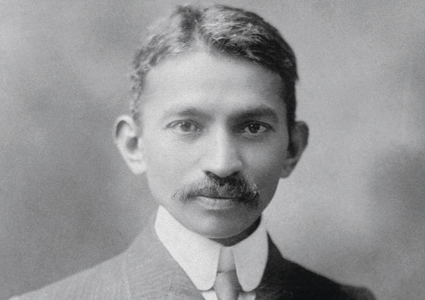
 Before the loincloth: Gandhi in 1909
Did you know that the Mahatma who led India to independence in a loincloth used to dress elegantly in a top-hat and tailcoat as a young trainee barrister in London, but wore no underwear to save money on laundry? That's the sort of unexpected detail you can expect to find in Ramachandra Guha's exhaustive, 688-page chronicle of the first half of Gandhi's life.
Of all the world's leaders and thinkers, Gandhi has probably attracted the largest volume of biographical writing. It all began in the 1950s with the monumental eight-volume official biography by Tendulkar, followed by the brilliant and very concise Life of Gandhi by the American academic Louis Fischer, who had the advantage of interviewing him in his lifetime.
Many others have trodden the path since then, drawing on the huge corpus of Gandhi's own memoirs, letters, articles and speeches, which fill 98 volumes of published Collected Works. The key enigma which both attracts and defies his biographers is how a Christ-like ascetic, so obsessed with the rejection of all that is worldly and material, could so successfully capture and wield enormous political power over a subcontinent as diverse as India.
Past biographies have ranged from reverential eulogies to the iconoclasm of a new generation of Western historians, who have tried to demystify the Mahatma, revealing him as a wily and manipulative politician with a penchant for dubious sexual experimentation with young virgins. Ram Guha enters this biographical minefield with the avowed aim of presenting a more holistic portrait than his predecessors, relying less on Gandhi's own autobiographical writings and more on previously neglected press records and the narratives of people around him.


- The Loss Of Faith Made Music Mute
- The Great Betrayal: How Liberals Appease Islam
- Political Correctness Is Devouring Itself
- The New Language Of Political Narcissism
- Why The World Still Loves Shakespeare
- Don’t Listen to Britain’s Designer Demagogues
- Who's in Charge of BBC News?
- An English parliament: the only way to save the UK
- The Loss Of Faith Made Music Mute
- The Great Betrayal: How Liberals Appease Islam
- Political Correctness Is Devouring Itself
- The New Language Of Political Narcissism
- Why The World Still Loves Shakespeare
- Don’t Listen to Britain’s Designer Demagogues
- Who's in Charge of BBC News?
- An English parliament: the only way to save the UK
- The Loss Of Faith Made Music Mute
- The Great Betrayal: How Liberals Appease Islam
- Why The World Still Loves Shakespeare
- Who Will Lead The Berlin Band?
- Putin and the Art of Political Fantasy
- Political Correctness Is Devouring Itself
- The New Language Of Political Narcissism
- Inside The World Of 'Non-Violent' Islamism
1:10 PM
12:10 AM