


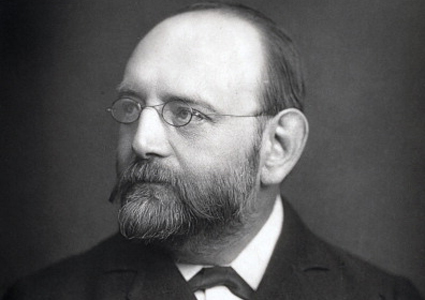
Joseph Barnby: He and other 19th-century academic composers were safe within a cloistered world (credit: Popperfoto/Getty Images)
The position of the "classical" composer in the UK university is an interesting one, and it gets more interesting the longer the view we take — for this is a landscape in which very little has remained constant. In the 19th century the academic composer was a practitioner — a practical musician of the highest skill, in charge of organ and choir — but his teaching was surely rooted in a backward-looking curriculum that prized neo-baroque technique, and his (it was always "his") own music was similarly conservative: for great men like Sir Joseph Barnby (Eton College) and Sir John Stainer (Oxford) there was no clear imperative to be an inventor within current trends, a searcher after progressive goals and brave new worlds; these composers were safe within a cloistered musical world that remained heavily indebted to Mendelssohn and Gounod. Today's composers know a different academe; if not explicitly suspicious of art, the system grows ever more addicted to what it takes to be "objective" indications, outside the music, to justify our existence.
Following the rise of modern musicology, the composer has certainly acquired a more progressive role, as erstwhile functions passed to other hands. Recent Oxbridge figures like Alexander Goehr and Robert Sherlaw Johnson, while also imparting historical tuition on Debussy and Schoenberg, have been figurehead "modern" composers whose professional profile on the scene made them important role models for composers among the students. What was not in doubt was that their "academic output" was embodied in their musical works (though of course they might also separately write criticism or musicology). Nothing troubled the idea that while academics in UK universities wrote books, composers composed — nothing, at least, until the advent, in the mid-1980s, of the research assessment culture, a watershed that now feels very much like a communal loss of innocence, if in some ways a necessary one. The spotlight which, from that point, has shone upon all academic output as the measure of "value for money" from universities, now casts a permanent beam, of increasing intensity, whose heat has for some time begun to have a distorting effect upon the role of the composer.
For the first decade or so of such assessments of academic output it was accepted that composition was, in a nostalgic phrase, "research-equivalent"; composers submitted their works, thence to be peer-assessed. However, the last decade has seen the tidal creep of a new imperative, that new music should be accompanied by the expression of tangible research aims as to its development. When the assessment of art gets entangled in claims about intent and process we enter a hall of mirrors, a distortion of the core issue: lasting artistic value. The judgment of music as a work of art cannot be reliably conducted by prioritising innovation or discovery, for art is not science.
I can best outline this rising tide from personal experience. In the last decade, as a composer in university, I have secured three research awards enabling sabbatical absence to produce three large-scale works (the last premiered in February 2013). Through this process I've become increasingly aware of an agenda that I had not conceptualised in terms before 2002, a research priority which, by my third award in 2010, served as justification for the whole process.
During the first of these applications I was relaxed about this new way of looking at artistic endeavours, but for the second, having thought I had again highlighted what was the research activity within my project, I was asked to resubmit the application, with enhanced explanation, before it went ahead. I was thus forced to scrutinise what I shall term the "research agenda" in turn, just as it was now scrutinising my efforts. This was in my interests, since no composer who does not understand this environment has a hope of support within it; many applications from reputable and serious composers in UK academe have fallen by the way-side because their proponents did not think in research terms but compositional ones, merely applying to "write an orchestral piece" and assuming that the interest on the part of a leading ensemble in performing it was itself recommendation enough. It no longer is, if once it was.
Like this article? Share, save or print using the icons below:


