


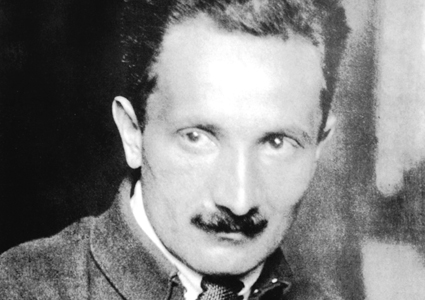
The history man: Disillusioned with Nazi education policy, Heidegger worked out his own project for German renewal (credit: Getty)
Martin Heidegger's Black Notebooks — the intellectual scrapbook the philosopher began keeping during the Nazi years — are, on any showing, a major publication, and will be indispensable not just for understanding Heidegger, but also for any account of the intellectual landscape during the early Nazi years. Ultimately, the notebooks show that we have to rethink both of the standard theories: either that Heidegger's Nazism was continuous with his philosophy and therefore somehow disqualifies him from serious philosophical consideration, or that it was an aberration unconnected with his philosophy and can therefore be ignored by intellectuals. The Notebooks make clear that his National Socialism was very much of a piece with his philosophy — but also that it was all but alien to the militaristic blood-and-soil socialism that later became identical with the term Nazism.
The recent publication comprises three volumes of notebooks: a 600-page volume spanning the years 1931-38, a 450-page volume from 1938-39, and a further 300-page volume written in 1939-41. The part of most immediate interest, from which we had expected the most controversial material, is the first, which covers the years of Heidegger's direct involvement with the party. This turns out to be an honest journal — overweening, earnest, comic, even strangely touching — of the failure of the philosopher's university rectorship at Freiburg and its aftermath, with meaty new information about his vision for philosophy, the university and Germany.
We already knew that Heidegger's institutional involvement with the Nazi party — in particular, his agreement to become rector of Freiburg University in 1933 — was motivated less by political enthusiasm than by a long-held ambition for university reform. The inadequacy of modern universities (which, Heidegger complained, were becoming mere polytechnics), and the squeezing of philosophy departments by efficiency reviews on the one hand and church control on the other, had worried him since the beginning of his university career. At the time of Heidegger's rectorship, the Nazi party had not yet developed a unified education policy, and it is clear from his inaugural address and the letters surrounding his acceptance of the post that Heidegger was hoping to seize the moment to put into action the intellectual renewal he had been writing and lecturing about for a decade. That he was soon disillusioned becomes clear both in a series of disappointed letters to friends (complaining that a very differently-minded candidate had been appointed minister of education and that he, Heidegger, had not been invited to any education policy meetings at the higher level), and in his premature resignation from the rectorship in early 1934. Heidegger never dabbled in party business again.
Martin Heidegger's Black Notebooks — the intellectual scrapbook the philosopher began keeping during the Nazi years — are, on any showing, a major publication, and will be indispensable not just for understanding Heidegger, but also for any account of the intellectual landscape during the early Nazi years. Ultimately, the notebooks show that we have to rethink both of the standard theories: either that Heidegger's Nazism was continuous with his philosophy and therefore somehow disqualifies him from serious philosophical consideration, or that it was an aberration unconnected with his philosophy and can therefore be ignored by intellectuals. The Notebooks make clear that his National Socialism was very much of a piece with his philosophy — but also that it was all but alien to the militaristic blood-and-soil socialism that later became identical with the term Nazism.
The recent publication comprises three volumes of notebooks: a 600-page volume spanning the years 1931-38, a 450-page volume from 1938-39, and a further 300-page volume written in 1939-41. The part of most immediate interest, from which we had expected the most controversial material, is the first, which covers the years of Heidegger's direct involvement with the party. This turns out to be an honest journal — overweening, earnest, comic, even strangely touching — of the failure of the philosopher's university rectorship at Freiburg and its aftermath, with meaty new information about his vision for philosophy, the university and Germany.
We already knew that Heidegger's institutional involvement with the Nazi party — in particular, his agreement to become rector of Freiburg University in 1933 — was motivated less by political enthusiasm than by a long-held ambition for university reform. The inadequacy of modern universities (which, Heidegger complained, were becoming mere polytechnics), and the squeezing of philosophy departments by efficiency reviews on the one hand and church control on the other, had worried him since the beginning of his university career. At the time of Heidegger's rectorship, the Nazi party had not yet developed a unified education policy, and it is clear from his inaugural address and the letters surrounding his acceptance of the post that Heidegger was hoping to seize the moment to put into action the intellectual renewal he had been writing and lecturing about for a decade. That he was soon disillusioned becomes clear both in a series of disappointed letters to friends (complaining that a very differently-minded candidate had been appointed minister of education and that he, Heidegger, had not been invited to any education policy meetings at the higher level), and in his premature resignation from the rectorship in early 1934. Heidegger never dabbled in party business again.
Like this article? Share, save or print using the icons below:


More Features
- How Jeremy Corbyn's Coup Hijacked Labour
- Corbyn's Signpost Back To The Ghetto
- Unionists, Don't Despair: Scotland Is Not Lost — Yet
- Britain's Apologists For Child Abuse
- Lift The Fee Cap And Set Universities Free
- The Story Behind One Dead Man's Penny
- Hitler's 'Ecological Panic' Didn't Cause The Holocaust
- Meet The Montalvos: The First Global Family
- Mr Gove, Here Is Our Statute of Liberty
- A British Bill Of Rights
- Something For Nothing Just Won't Do Any More
- Ditch Ed Miliband's Crazy Energy Legacy
- The English Public School: An Apologia
- An Open Letter To Nicky Morgan
- Escape The Heat: Head To London's Crow's Nests
- Collusion Cut Both Ways In The Troubles
- Decline Of The East? The Chinese Say No
- Conservative, Moi? Jamais De La Vie!
- How To Rescue Iraq From Obama's Folly
- Europe Must Never Again Betray Its Jews
Popular Standpoint topics

2:12 PM
2:09 PM