


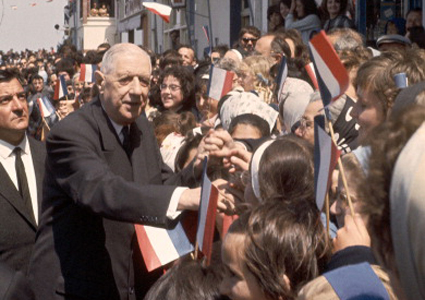
Charles de Gaulle: He envisioned a European Union in which national parliaments remained in ultimate control (credit: Dominique Beretty/Gamma-Rapho/Getty Images)
What kind of Europe do the British people want to have as their neighbour? And what kind of Europe would their Prime Minister, David Cameron, favour if the Conservatives were to win the next general election?
In widely-quoted remarks at the European Union summit on May 27, Cameron called Brussels "too big, too bossy, too interfering". He put forward a principle: that the EU should work on the basis of "nation states wherever possible, Europe only where necessary". But the new Cameron principle is not his first or most serious challenge to the EU's ambitions for greater integration. In his January 2013 Bloomberg speech, in which he promised a 2017 in/out referendum on EU membership, he repudiated the phrase "ever closer union" from the 1957 Treaty of Rome. Perhaps even more fundamentally, he did not slap down his newly-appointed Foreign Secretary, Philip Hammond, when Hammond said on July 20 that he would want the UK to quit the EU if renegotiation left the status quo little changed.
The direction of travel is clear. Nevertheless, the discussion of EU issues in the Conservative Party remains strangely spasmodic and incoherent. A tighter focus might come from recalling two alternative views on European unification in the French debate of the 1950s and 1960s, one held by Jean Monnet and the other by the Gaullists. The Conservatives, and particularly Cameron himself, must decide which of the two they want.
To the architects of the European Economic Community (which became the EU in the 1993 Maastricht Treaty), the notion of "ever closer union" defined the EEC/EU. In the closing phase of the Second World War, Jean Monnet pronounced that, "The countries of Europe are too small to guarantee their peoples the necessary prosperity and social development. The European states must constitute themselves into a federation." To such men as Monnet, Robert Schuman and Paul-Henri Spaak, sometimes revered as among the "founding fathers" of the EU, nations that participated in the European project had made an irrevocable commitment: they would deepen and broaden their togetherness until they became one nation, a fully-fledged United States of Europe.
In a United States of Europe extensive powers (to be precise, the "competences" mentioned in EU treaties) would be transferred to federal institutions and assumed by a supra-national bureaucracy in the shape of the European Commission. This bureaucracy would ultimately have more real power than national parliaments and governments, and national sovereignty would be pooled and so diluted that it would no longer be meaningful. In the so-called "Monnet method" of European integration, the bureaucrats would expand their role by subterfuge. The integration of one sector of the European economy would "spill over" into others, and economic integration would then "spill over" into political integration, and Europe would be one. Democratically-elected politicians might hardly notice what was going on.
Like this article? Share, save or print using the icons below:


Post your comment
More Features
- We Need Churchill's Vison of Liberty More Than Ever
- The Play's The Thing, So Leave The Words Alone
- An Aesthetic and Moral Disaster
- How we Syrians destroyed our home — with your help
- Euphoric Labour won’t win power led by a pied piper
- Don’t be ‘difficult’ — try ‘formidable’, Mrs May
- Enough is enough of terror — but also of our self-doubt
- Iraq’s Christians pray for help that never comes
- The Atlantic alliance may be broken beyond repair
- Catholic tastes: both English and European
- Brexit as myth: Exodus, Reckoning, or Sacrifice?
- A Decent Woman Betrayed By Her Gruesome Twosome
- Can Macron Save France — Or Is He Its Undertaker?
- Europe's Revival Is At Hand, Thanks To Brexit
- Is This The Most Important British General Election Since 1979?
- The New Europe Must Be About More Than Money
- Our Best Brexit Policy Is All-Out Free Trade
- The Bursting Of Our 'Kabubble' Fantasies
- Gambling On A Greater More Gracious Britain
- Xi Versus Trump: The Emperor And The Tycoon
Popular Standpoint topics

- Opposites meet in the land of Scrugletopia
- The Battle Against The Philistines Never Ceases
- Home from home for the Bolshevik elite
- Can Macron Save France — Or Is He Its Undertaker?
- Why France Is Revolting Against The Ancien Regime
- How The EU Elite Paved The Way For Populism
- A Decent Woman Betrayed By Her Gruesome Twosome
- Last Of The Great Elitists