


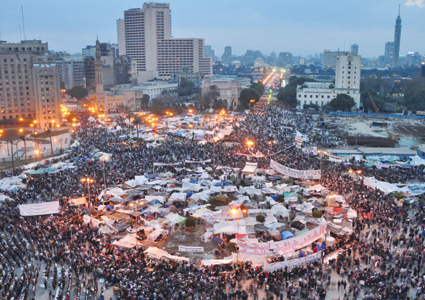
Tahrir Square, Cairo, in 2011: Protestors organised and documented the revolution using Twitter, Facebook and YouTube (credit: Jonathan Rashad)
"We have just seen the civilised world gathered as one family around a common sick bed, hope and fear alternately fluctuating in unison the world over as hopeful or alarming bulletins passed with electric pulsations over the continents and under the seas."
"Just as in a theatre you speak directly face to face with five or six hundred persons."
"All the corners of the earth are joined, kindled, fused."
These are three reflections on the invention of the telegraph in the early 1880s — but they have an uncanny resonance today in discussion of social media. We praise social media for fuelling revolutions and spreading democracy. We blame them for hosting child pornography and allowing terrorists to communicate and recruit. We say they have created new jobs and destroyed old ones. We depict either an Orwellian dystopia or a utopian global village where we are all friendly neighbours. The early media theorist Marshall McLuhan, who coined terms like "the global village" and "the medium is the message" in the 1960s, is back in vogue. But the arguments for and against social media are not black and white; rather, they are of Rubik's Cube complexity.
Over the last decade waves of civil protest have taken place around the world, both organised and reported through social media. The Arab Spring targeted totalitarian regimes in the region; the Spanish "Los Indignados" and the Occupy movement emerged after the financial crisis demanding social change. Social media were hailed as a powerful weapon, a weapon that did not involve arms.
But as those movements failed to effect the reforms they wanted, confidence in the power of social media has waned. However, they have helped to bring around some change. They give visibility and a limited degree of protection to political dissidents, like the Russian journalist Oleg Kashin, who documents political protests, or the Chinese dissident artist Ai Weiwei, who used Twitter to record the names of children who died under badly constructed school buildings in the 2008 Sichuan earthquake.
Because of the rise of smartphones and tablets more pictures were taken in the last three years than in all of previous history. Photographs taken on the phones of spectators during the Boston Marathon helped investigators identify the suspects who planted two bombs, killing three people and injuring 264. The Guardian's investigation into the death of Ian Tomlinson, a passing newspaper vendor, during a demonstration against the G20 meeting in London in 2009 was helped when an American witness provided a video of the incident taken on a phone.
But social media can also spread pictures that lie. In the aftermath of Hurricane Sandy in 2012, an image of the Statue of Liberty surrounded by a spectacular swirl of clouds was widely shared on Twitter — only to be disclosed as a fake. More recently, the BBC revealed how many pictures of destruction and devastation circulated in relation to Israel's Protective Edge operation in Gaza are actually from the Syrian conflict — nothing to do with Israel. Social media have created new ways of seeing but have also obscured the truth.
Like this article? Share, save or print using the icons below:


Post your comment
More Features
- How Jeremy Corbyn's Coup Hijacked Labour
- Corbyn's Signpost Back To The Ghetto
- Unionists, Don't Despair: Scotland Is Not Lost — Yet
- Britain's Apologists For Child Abuse
- Lift The Fee Cap And Set Universities Free
- The Story Behind One Dead Man's Penny
- Hitler's 'Ecological Panic' Didn't Cause The Holocaust
- Meet The Montalvos: The First Global Family
- Mr Gove, Here Is Our Statute of Liberty
- A British Bill Of Rights
- Something For Nothing Just Won't Do Any More
- Ditch Ed Miliband's Crazy Energy Legacy
- The English Public School: An Apologia
- An Open Letter To Nicky Morgan
- Escape The Heat: Head To London's Crow's Nests
- Collusion Cut Both Ways In The Troubles
- Decline Of The East? The Chinese Say No
- Conservative, Moi? Jamais De La Vie!
- How To Rescue Iraq From Obama's Folly
- Europe Must Never Again Betray Its Jews
Popular Standpoint topics
