



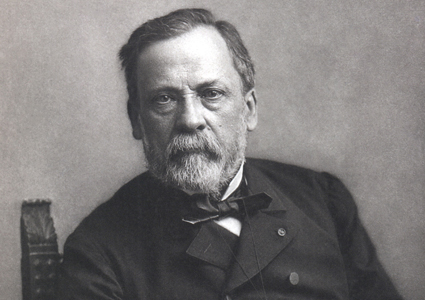
Louis Pasteur (1822-1895), photographed by Felix Nadar
In the midst of the seemingly relentless medical assault on the consumption of wine, the authoritative figure of Louis Pasteur offers wine drinkers some muchneeded support. It was, after all, this giant of 19th-century science who pronounced wine to be "the most healthful and most hygienic of beverages", and who also believed that "a bottle of wine contains more philosophy than all the books in the world". And Pasteur's own most extensive study of wine, the Études sur le vin of 1866, is much more than merely a scientific treatise or a record of experiments.
The extraordinary expansion of the French economy under Louis-Napoléon in the mid-19th century had exposed underlying problems in French viticulture which had been disguised while France's economy was more agricultural than industrial, and while most French wine was drunk — and was made to be drunk — very young and in the locality where it was grown. But the commercial treaties which had opened up vast and tempting markets for French wine had also exposed those wines to the rigours of transportation and to extreme variations of climate. The result had been an unacceptable degree of spoilage. As an English wine merchant had written to Pasteur in October 1863: "The French are astonished that the trade in French wine has not expanded since the treaty of commerce. The reason for this is simple enough. To begin with we were eager to trade in these wines, but it wasn't long before we learned to our cost that to do so led to great losses and infinite embarrassment because of the maladies to which they are subject."
The scale of the problem was immense. In mid-19th century France two million hectares were given over to the cultivation of the vine. This produced 50 million hectolitres of wine, with an annual total value of 500 million francs. But if the problems associated with the transportation of French wine could be overcome and a global market for this luxury product be secured, that value would increase dramatically. The stakes were high.
The problem was severe enough — and the potential rewards great enough — for the Emperor himself to take an interest. In July 1863 he had commanded Pasteur to investigate the problem of wine spoilage and to propose remedies. A little over two years later, in December 1865, Pasteur presented the fruits of his research to the Emperor at the palace of Compiègne. It is not an exaggeration to say that our empirical understanding of the chemistry of wine and wine-making begins at the moment Pasteur bowed before Louis-Napoléon. Pasteur paid generous tribute to his predecessors in the study of wine and fermentation — men such as Chantal, Lavoisier, and Fabroni. Nevertheless, his own contribution was transformative.


