



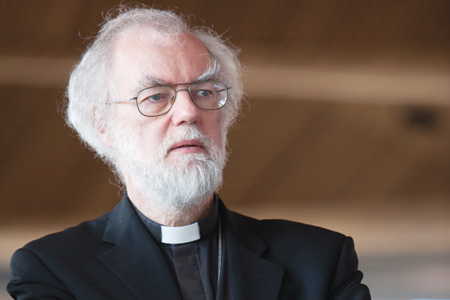
Rowan Williams: Theologian, linguist, poet and former Primate (photo: National Assembly for Wales)
Rowan Williams opens the introduction to his new book by asking, "Does the way we talk as human beings tell us anything about God?", adding immediately, "This may sound a slightly odd question." The answer that his book would seem to suggest might be better understood as directed to the question of what our way of talking may tell us about what it is to be a human being and just why that way (or ways) may lead us to go on to talk about God, a God or even Gods. But, if I have understood that answer aright, my use of the word "just" in the preceding sentence may itself be taken to be a fair exemplification of a typically misleading linguistic habit, with its suggestion of an answer claiming to be more exact than, according to its own underlying argument, it could possibly be. It is remarkably hard to pin down in any very exact terms "just" what this centrally underlying argument amounts to. But that, paradoxically (or perhaps not so paradoxically) enough, would seem to be one of its own main points.
A significant part of this main point lies, then, in its insistence both on how our use of the meaningful symbols through which we are enabled to make thinkable the world which we inhabit, demands always to be understood in terms of our having to carry on from what has gone before linguistically, and as being always susceptible to moving, or being moved, off in different and hitherto unsuspected directions. In this Rowan Williams's sense of the irreducible indeterminacy of language, including its inherent lack of any determinate beginning, is strikingly reminiscent of that expressed by Jacques Derrida who, as just one among a remarkably wide range of thinkers and experts of all kinds with whom, as the blurb puts it, "Williams enters into dialogue," does indeed make a fleeting appearance on page 152 of the main text, but not, curiously enough and as do most at least of the others, in the index. A bibliography would have been helpful — but its lack must be accounted a relatively minor complaint in the context of a notably stimulating and remarkably wide-ranging discussion.
Rowan Williams's main contention, as I understand it, is that the practice of our engagements in language, and in our conceptualised and conceptualising interchange with the world in which we find ourselves, cannot in principle be understood and explained in terms of the causal structures of our existence alone; and this, he argues, carries with it the irresistible implication that the universe which we inhabit and about which we are able to think and to communicate our thoughts with each other has somehow to be understood as the manifestation or "representation" of an underlying and all-pervasive intelligence. Moreover — and this is a further and crucially important part of his argument — we cannot seriously suppose that the only way in which to record the true nature of this universe must be through the cumulative stating of facts about it or through hopefully accurate descriptions of its various aspects and workings. For one thing, the universe does not impose on us any one "true" way of formulating or expressing those facts; different "natural" — as indeed different "artificial" — languages carve them up and re-present them sometimes very differently.
Like this article? Share, save or print using the icons below:


- The Loss Of Faith Made Music Mute
- The Great Betrayal: How Liberals Appease Islam
- Political Correctness Is Devouring Itself
- The New Language Of Political Narcissism
- Why The World Still Loves Shakespeare
- Don’t Listen to Britain’s Designer Demagogues
- Who's in Charge of BBC News?
- An English parliament: the only way to save the UK
- The Loss Of Faith Made Music Mute
- The Great Betrayal: How Liberals Appease Islam
- Political Correctness Is Devouring Itself
- The New Language Of Political Narcissism
- Why The World Still Loves Shakespeare
- Don’t Listen to Britain’s Designer Demagogues
- Who's in Charge of BBC News?
- An English parliament: the only way to save the UK
- The Loss Of Faith Made Music Mute
- The Great Betrayal: How Liberals Appease Islam
- Why The World Still Loves Shakespeare
- Who Will Lead The Berlin Band?
- Putin and the Art of Political Fantasy
- Political Correctness Is Devouring Itself
- The New Language Of Political Narcissism
- Inside The World Of 'Non-Violent' Islamism
6:12 PM
6:12 AM
12:12 AM