


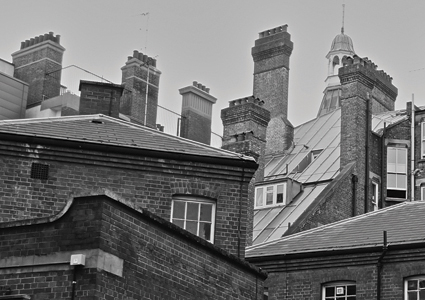
 "Not so bad, I suppose, for an old old love: this just pottering along" (photo: Nick Peligno, via Flickr)
I kept seeing him. When I popped out to get milk and a paper he was leaving the posh greengrocer’s with whatever he’d bought in a black backpack. No plastic bag with a garish logo for him. But then a writer should be a person of taste, in touch with a better world.
Late afternoons he’d seem to be coming home from work, with everyone else, but what made him different in his search for a better world was he wore a suit. Although the style was casual, and the dark material faded, it made him look more thoughtfully dressed than most. “Smart casual”, the people who copy him call it now. With the suit he wore a grey shirt open at the neck, and carried a briefcase.
One day he and I caught the same bus.
I got to calling him my 21st-century intellectual. He was tall and limber, striding down the long hill at twice the speed I could manage, as I was coming home. I never minded when we overlapped. He had what people call a leonine head, with a sweep of thick grey wavy hair that never moved in the wind. His facial features were all perfectly proportioned.
I wondered where he lived.
I went out and bought his latest book. But before I began I wanted to see into his eyes.
I noticed it that first day when he was coming out of the luxury greengrocers and I was buying my pint of milk. There was something about his eyes which made me feel I couldn’t actually see them; that they were somehow growing ever paler and vanishing into his head.
By plotting the course of his two routes home, the route on foot and the route by bus, and the location of the shops, and seeing where the lines converged, I could work out more or less where he lived, although I was too respectful to go there and knock on the door.
I turned instead to his book, which I opened with the feeling it had been written just for me.
He been brought up and educated in a still Christian country, that I knew, and I wondered whether he believed in God (my own atheism notwithstanding). Had he willingly joined the millions who’d deserted the church, in our lifetime, or had it all remained vague? Today, asked a fashionably phrased question about faith, I suspected he would tell the newspapers he didn’t mind one way or another.
His latest stories were frankly rather boring, so I wondered about the characters he created. They were all men. They interacted with women, but mostly they were men alone, alone again perhaps, mostly getting the blame, taking the rap, and retreating into themselves. Their remaining energy they used to cast a cool, critical gaze on life around. Husbands and partners phoning home from the supermarket to check the shopping list. Teenage girls endlessly taking photographs of each other, preparing for a phantom career in the media. Mothers phoning over the heads of their under-stimulated children. Conversation at an end. People converse electronically now. The keystroke and the click are how modern man makes his marks.
Like this article? Share, save or print using the icons below:


Post your comment
More Text
- Liberty And Sovereignty
- Art And Public Culture In The 1830s And Today
- The Casanova Of LaSalle Street
- New Poetry
- Cartagena Poems
- A British Subject
- Travels with Betjeman
- Kizerman and Feigenbaum
- Communism’s Comeback?
- Irving Kristol on Jews and Judaism
- The State of Charity
- Teeth
- La Buena Muerte
- Judaeophobia
- Cool It
- Rachmones
- From 'Russia'
- 'Going Out' and Five Other Poems
- The Final Edition
- 'The Ship of Endurance' And Three More New Poems
Popular Standpoint topics
