


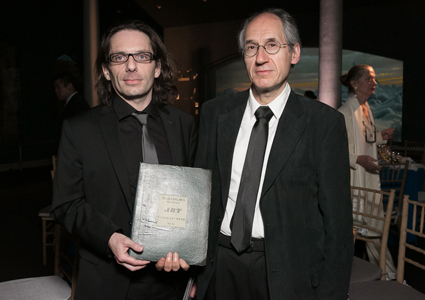
Gerard Biard and Jean-Baptiste Thoret, editors of "Charlie Hebdo", after being awarded a "Freedom Of Expression" prize by PEN (photo: PEN American Centre)
The rich are cruel, F. Scott Fitzgerald wrote; the liberty of wealth makes them careless. Nearly a century after Gatsby, Americans remain richer and freer than the rest of the world. They remain careless, too. The First Amendment guarantees freedom of conscience, expression, and assembly; the Second Amendment, the right to bear arms. Two events in May showed how Islamist violence, actual or anticipated, is redefining the practice of free speech in America.
On May 2 in the Dallas suburb of Garland, two Islamists attempted to critique Pamela Geller’s “Muhammad Art Exhibit and Contest” with assault rifles. A massacre was averted only because a guard suspended the attackers’ freedom of assembly with a Glock pistol. Two days later in New York, there was extra security at PEN’s annual black-tie dinner. When PEN’s board had conferred its annual Freedom of Expression Courage Award on Charlie Hebdo, six of the dinner’s table hosts had resigned. Two of the six, Peter Carey and Michael Ondaatje, are global figures; two, Rachel Kushner and Francine Prose, are names in America; and two, Teju Cole and Taiye Selasi, need all the publicity they can get. “6 pussies,” Salman Rushdie tweeted, before remembering that he is a man of letters. “Six Authors in Search of a bit of Character.”
Politics, J.K. Galbraith claimed, means choosing between “the disastrous and the unpalatable”. Geller is unpalatable; the PEN refusés are disastrous. Geller does not discriminate between Muslims and Islamists. She has praised the thugs of the English Defence League; the guest speaker at Garland was Geert Wilders. She demonises her critics; she called the Daily Mail part of the “enemedia” for blacking out images of the Garland cartoons. When her organisation, the American Freedom Defense Initiative, campaigned against the “9/11 Mosque”, it attacked the First Amendment rights of American Muslims. Geller is a bigot, deliberately testing the margins of tolerance and legality. She is, then, exactly the kind of person that the First Amendment exists to protect.
The First Amendment does not protect “fighting words”: speech, acts, or images that are likely to provoke a punch. But do the Islamists have the right to be throwing punches? In 1977, the Supreme Court ruled that the American National Socialist Party could march through Skokie, Illinois, swastikas and all. Public funds supported the exhibition of Andres Serrano’s Piss Christ in 1987, and Chris Ofili’s The Holy Virgin Mary in 1996, which rendered Jesus’s mother in pornographic cut-outs and elephant dung. The Garland cartoons are aesthetically worthless, but Americans have the right to draw and display them: there are no laws against poor taste, or even insult. Geller is frequently wrong and hateful, but she is brave and right to warn that Islamists wish to intimidate Americans into restricting their First Amendment rights. This is how America rolls, at least in the red states.
While Geller guards free speech’s wild frontier, over in the blue states the PEN writers surrender disputed territory without a fight. All of them called the Charlie Hebdo massacre, in Peter Carey’s words, a “hideous crime”. None of them mentioned the associated murders of Jews at the Hyper Cacher supermarket. Rachel Kushner accused Charlie Hebdo of “cultural intolerance” and promoting “a kind of forced secular view’, which is kind of hypocritical of her. Carey denounced PEN for ignoring “the cultural arrogance of the French nation, which does not recognise its moral obligation to a large and disempowered segment of their population”. Teju Cole called himself a “free-speech fundamentalist”, but wanted to fill PEN’s “headspace” with “more progressive” causes, like Edward Snowden, Chelsea Manning, and “the awful effects of government spying in the US”.
Fitzgerald’s Nick Carraway would call the PEN Six “a rotten crowd”. Issuing a trigger warning about an organisation that protects their freedom of expression, and publicises the persecution of less fortunate writers abroad, they bit the hand that feeds, and shot themselves in the foot. They seem not to understand that France’s constitutional laïcité is the European sibling of America’s constitutional neutrality. Unfamiliarity breeds contempt, and provinciality.
“If PEN as a free speech organisation cannot defend and celebrate people who have been murdered for drawing pictures,” Salmon Rushdie said, “then frankly the organisation is not worth the name. What I would say to Peter, Michael, and the others is, I hope nobody ever comes after them.” Yet Rushdie did not comment on Garland, where people were nearly “murdered for drawing pictures”. Nor did PEN’s president, Andrew Solomon, extend to Geller his defence of Charlie Hebdo: “There is courage in refusing the very idea of forbidden statements.”
Emerson called politics “a government of bullies, tempered by editors”, but the editors led the bullying of Geller. An unsigned editorial in the New York Times attacked Geller’s “provocative” behavior. The Harvard law professor Noah Feldman suggested that Geller had “deliberately” provoked the assault; if so, she was “morally culpable” for her attackers’ deaths.
“The test of a first-rate intelligence,” Fitzgerald wrote in The Crack-Up, “is the ability to hold two opposing ideas in mind at the same time and still retain the ability to function.” The depiction of Muhammad, and the application of standard critical methods to the history of Islam, have become test cases for the practice of Western freedoms, and the capacity of states to protect their citizens. It is possible to assert the right of speech without falling into Geller’s strategy of contempt or the PEN writers’ trahison des clercs. When editors vacillated over reprinting Charlie Hebdo cartoons, Timothy Garton Ash made a first-rate suggestion: to create an independent website, on which all media could publish the cartoons simultaneously. Without such a mechanism, terrorists will define the bounds of free speech.
Fitzgerald’s Nick Carraway would call the PEN Six “a rotten crowd”. Issuing a trigger warning about an organisation that protects their freedom of expression, and publicises the persecution of less fortunate writers abroad, they bit the hand that feeds, and shot themselves in the foot. They seem not to understand that France’s constitutional laïcité is the European sibling of America’s constitutional neutrality. Unfamiliarity breeds contempt, and provinciality.
“If PEN as a free speech organisation cannot defend and celebrate people who have been murdered for drawing pictures,” Salmon Rushdie said, “then frankly the organisation is not worth the name. What I would say to Peter, Michael, and the others is, I hope nobody ever comes after them.” Yet Rushdie did not comment on Garland, where people were nearly “murdered for drawing pictures”. Nor did PEN’s president, Andrew Solomon, extend to Geller his defence of Charlie Hebdo: “There is courage in refusing the very idea of forbidden statements.”
Emerson called politics “a government of bullies, tempered by editors”, but the editors led the bullying of Geller. An unsigned editorial in the New York Times attacked Geller’s “provocative” behavior. The Harvard law professor Noah Feldman suggested that Geller had “deliberately” provoked the assault; if so, she was “morally culpable” for her attackers’ deaths.
“The test of a first-rate intelligence,” Fitzgerald wrote in The Crack-Up, “is the ability to hold two opposing ideas in mind at the same time and still retain the ability to function.” The depiction of Muhammad, and the application of standard critical methods to the history of Islam, have become test cases for the practice of Western freedoms, and the capacity of states to protect their citizens. It is possible to assert the right of speech without falling into Geller’s strategy of contempt or the PEN writers’ trahison des clercs. When editors vacillated over reprinting Charlie Hebdo cartoons, Timothy Garton Ash made a first-rate suggestion: to create an independent website, on which all media could publish the cartoons simultaneously. Without such a mechanism, terrorists will define the bounds of free speech.
Like this article? Share, save or print using the icons below:


11:06 AM