


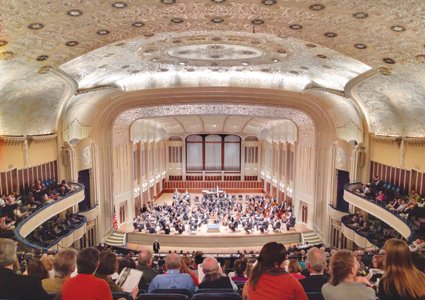
 Art Deco plus acoustics: Severance Hall, home of the Cleveland Orchestra (photo: James G. Milles via Flickr)
America got its first orchestra in 1842 and waited almost 40 years for another. The New York Philharmonic, a players’ cooperative, struggled to cope with capitalism in the raw and a flood of unchecked immigration. It did not begin to thrive until Andrew Carnegie opened his glittering hall.
America’s fourth-largest city was next, in 1880. The St Louis Symphony, rolling in Mississippi river profits, really got things going. It was swiftly followed by the Boston Symphony (1881), Detroit (1887), Chicago (1891), Cincinnati (1895) and Philadelphia (1900) — by which time St Louis, preparing to host the Olympic Games, had proved that an orchestra was a prime emblem of civic prosperity, ambition and civilisation. Soon, every town wanted one.
By the middle of the 20th century, the US accounted for half the world’s symphony orchestras, decked out in more flavours than Heinz (who paid for Pittsburgh’s). There was shameless razzmatazz from “the fabulous Philadelphians”, surgical precision at George Szell’s Cleveland Orchestra, modern music commissioned by Boston and Louisville, rampant charisma from Bernstein’s New York and naked power from Solti’s Chicago. On tour, American orchestras took Europe by storm.
But by the end of the century the boom went bust. The subscription audience greyed and died; the next generation found other distractions. America’s growing minorities resented European culture and shunned the concert hall. Programming got safe and stale, managers were stubbornly white, and musicians, fearful of a shrinking future, demanded greater security. In 2000, the Chicago Symphony broke the bank with a $100,000 starting wage for new players, fresh out of college. The writing could be read on my wall (though hardly at all in US media).
The crash of 2008 drove several orchestras out of business and prompted others to resort to the raw capitalist remedy of locking out musicians without wages or health insurance until they accepted lower compensation. In the worst collision, the Minnesota Orchestra starved its musicians for 16 months until local worthies and a loyal conductor, Osmo Vänskä, forced a board retreat and the sacrifice of a meek English president, Michael Henson (the meeker the manager the more presidential his title).
So when the League of American Orchestras (LAO) went into its annual convention in Cleveland this spring it was in subdued and introspective mood, concerned not to rock a listing boat, exercising a flummery of euphemisms by which every problem is a challenge, every steep decline a temporary setback.
As a guest speaker, I was struck by the forced smiles of wilful denial — and even more struck by the absence of musicians. Not one conductor, not one principal player, was invited (or agreed) to address the heads of their industry. Like Britain in the 1970s American orchestras exist in a collective mindset of them and us. The realism that I offered was respectfully received and politely declined.
At night, I attended the Cleveland Orchestra, an irrational extravagance. Cleveland, a rustbelt town deserted by one-fifth of its population in the past decade, sinking below 400,000, has no right to own an orchestra of world quality and renown — or so the industry wisdom goes. After 2008, insiders foretold its demise. Since then, the orchestra has gone from strength to strength, with winter residencies in Miami and summers at Europe’s elite festivals. Abroad, Cleveland has outshone every other US orchestra, bar perhaps the LA Phil.
How it has survived is by bucking the trend. In 2002 Cleveland took on a 40-year-old music director when other orchestras wouldn’t look at a conductor under 60. Franz Welser-Möst, with rocky London beginnings behind him, set about building symbiosis. He recently renewed his contract until 2022 and I have never seen this sensitive, fine-tuned musician happier anywhere on earth (last summer he quit overnight as music director of the Vienna Opera).
The secret, Franz believes, is pride. Musicians in the Cleveland Orchestra can be seen on stage a full hour before the concert begins, rehearsing tricky passages, showing the audience how much they care. The woodwind and brass principals are swagger players, big personalities. You would not want to catch a scolding from the concertmaster: William Preucil looks as if he runs a double marathon before breakfast yet his solos are sweet as day-old kittens. Like many top soloists, he studied with Joseph Gingold, a former Cleveland concertmaster. Tradition here runs as deep as in Vienna.
Where last year’s LAO convention in Seattle was entertained by a sexist rapper, Cleveland played three programmes without a trace of frivolity: a semi-staging of Richard Strauss’s rarely-seen opera Daphne, a pairing of Beethoven’s Pastoral and Strauss’s Domestic symphonies, and a Messiaen-Dvořák triple bill. In the pianissimo before the Pastoral finale, the strings played at a mere hint of a whisper, daringly confident of the audience’s motionless, coughless attention.
The hall helps: Severance Hall, built in 1931, has not just the finest acoustic in America but the most gorgeous art deco ambience, no cent spared of an iron-ore mogul’s generosity. Pride glows from every gold-leaf wall. The orchestra plays the hall like an extra instrument.
Rather than grooming social leaders for big donations, Cleveland asks them to meet young professionals who join its under-40s circle. You want to get ahead in Cleveland? Go to a concert. The orchestra has reinvented itself as a high-achieving social network. Its president, Gary Hanson, who retires this summer, has highlighted several routes out of the LAO gloom.
A 50-minute flight away, I tested by way of comparison the vaunted Chicago Symphony — with $32 million after two recent donations — in its updated hall. The music director, Riccardo Muti, was away and the orchestra did not look much at his stand-in, the Seattle conductor Ludovic Morlot. Several of the principals had taken the night off.
A new violin concerto by the British composer Anna Clyne was given a desultory premiere (soloist: Jennifer Koh); Beethoven’s Eroica never rose above the routine. Player pride — the way Cleveland principals seem to own the music — was sporadic and the refurbished hall gave a dulled response to the night’s best efforts. Chicago — population 2.7 million — shows just how brilliant Cleveland has been in rethinking the future of the orchestra.
The secret, Franz believes, is pride. Musicians in the Cleveland Orchestra can be seen on stage a full hour before the concert begins, rehearsing tricky passages, showing the audience how much they care. The woodwind and brass principals are swagger players, big personalities. You would not want to catch a scolding from the concertmaster: William Preucil looks as if he runs a double marathon before breakfast yet his solos are sweet as day-old kittens. Like many top soloists, he studied with Joseph Gingold, a former Cleveland concertmaster. Tradition here runs as deep as in Vienna.
Where last year’s LAO convention in Seattle was entertained by a sexist rapper, Cleveland played three programmes without a trace of frivolity: a semi-staging of Richard Strauss’s rarely-seen opera Daphne, a pairing of Beethoven’s Pastoral and Strauss’s Domestic symphonies, and a Messiaen-Dvořák triple bill. In the pianissimo before the Pastoral finale, the strings played at a mere hint of a whisper, daringly confident of the audience’s motionless, coughless attention.
The hall helps: Severance Hall, built in 1931, has not just the finest acoustic in America but the most gorgeous art deco ambience, no cent spared of an iron-ore mogul’s generosity. Pride glows from every gold-leaf wall. The orchestra plays the hall like an extra instrument.
Rather than grooming social leaders for big donations, Cleveland asks them to meet young professionals who join its under-40s circle. You want to get ahead in Cleveland? Go to a concert. The orchestra has reinvented itself as a high-achieving social network. Its president, Gary Hanson, who retires this summer, has highlighted several routes out of the LAO gloom.
A 50-minute flight away, I tested by way of comparison the vaunted Chicago Symphony — with $32 million after two recent donations — in its updated hall. The music director, Riccardo Muti, was away and the orchestra did not look much at his stand-in, the Seattle conductor Ludovic Morlot. Several of the principals had taken the night off.
A new violin concerto by the British composer Anna Clyne was given a desultory premiere (soloist: Jennifer Koh); Beethoven’s Eroica never rose above the routine. Player pride — the way Cleveland principals seem to own the music — was sporadic and the refurbished hall gave a dulled response to the night’s best efforts. Chicago — population 2.7 million — shows just how brilliant Cleveland has been in rethinking the future of the orchestra.
Like this article? Share, save or print using the icons below:


8:06 PM
7:06 PM
5:06 PM
2:06 PM
11:06 AM
2:06 AM