



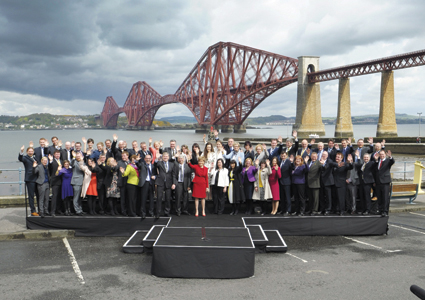
 Triumphalist: Nicola Sturgeon and the 56 new SNP MPs pose near the Forth Bridge. Some English people would like to cut them adrift (photo: Andy Buchanan/AFP/Getty Images)
Exasperation is understandable. In the run-up to the referendum on Scottish independence last September, the holes in the “Yes” campaign’s platform were made embarrassingly plain; but the nationalists suffered no embarrassment. Since then one hole has grown even larger; yet the Scottish National Party’s star continues to rise.
During the referendum debate about the crucial issue of the currency, Alex Salmond shamelessly plucked the heartstrings of nationalist sentiment by defiantly asserting what no one actually denied — the right of the Scottish people to exercise their sovereign will in choosing to keep the pound. What he artfully passed over was the equal but awkward truth that the Scots’ sovereign will had neither the right nor the power to dictate how the rest of the United Kingdom would respond. Salmond argued that it would be in everyone’s interests to enter into a formal currency union. True or not, such a proposal attracted two problems. One was that it would inevitably involve Scotland agreeing to compromise its independence by suffering constraints on its tax and spending policies. The other was that the leaders of the UK’s main political parties, backed up by the Canadian Governor of the Bank of England, had all said that it would not be in the rest of the UK’s interests to enter into a formal currency union with an independent Scotland, and that they wouldn’t agree to it.
Without a formal currency union, the Bank of England would set interest rates to suit the rest of the UK’s economy, not Scotland’s. Sooner or later the situation would arise where Scotland needed higher rates, say, to calm a property boom, but the rest of the UK needed lower rates, say, to stimulate a sluggish economy. In that case, the Bank of England would not act in the Scots interests but in everyone else’s. This is exactly what happened in the Republic of Ireland in the run-up to the financial crisis of 2007. The value of property there was rocketing unsustainably because the European Central Bank, with its eye fixed mainly on Germany, kept interest rates low at 2 per cent. The result: the Irish property bubble burst, with values tumbling by up to 50 per cent.
As long as it remains part of the UK, Scotland has a seat at the table of the Bank of England’s deliberations, in which its needs will continue to figure. But were it to leave, it wouldn’t. Thus an independent Scotland could keep the pound unilaterally, but only at the price of losing all control over its own interest rates. Hence the incoherence at the heart of the “Yes” campaign’s position: that its kind of independence would actually amount to less economic self-determination.
Like this article? Share, save or print using the icons below:


More Features
- Our EU Deal Gives Us The Best Of Both Worlds
- Brexit Would Save Us And Set Europe An Example
- Are Both Sides Playing By The Referendum Rules?
- Should We Stay Or Should We Go?
- Ignore Project Fear: Brexit Won't Ruin Us
- Uncontrolled Immigration Means Finis Britanniae
- The Next US President Must Carry A Big Stick
- Can Clinton Or Trump Crack The US Tax Code?
- How to Survive the Fourth Industrial Revolution
- The Spectre Of Mayor Khan's Islamist London
- Students Are Leading The Free Speech Fightback
- Fortress Europe Faces An African Migrant Tsunami
- Trump May Be Bad, But What Comes Next Will Be Worse
- Myth Of Stressed-Out Soldiers On The Street
- The Russian Love Affair With Palmyra Resumes
- How Russia Is Ruled By The Putin Doctrine
- The Doors Of Holocaust Memory Are Closing
- Rediscovering The Point Of Language
- The Novelist For Whom Small Was Beautiful
- A Recipe For Disaster
Popular Standpoint topics

10:08 AM
4:08 PM