


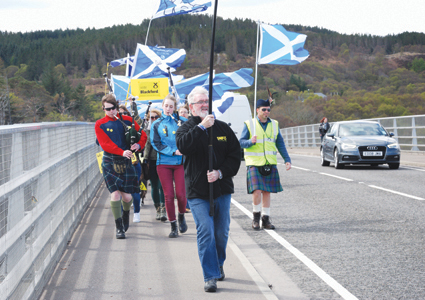
The true believers: SNP supporters march on the Isle of Skye (Martainn Macdomnhnaill CC BY-NC 2.0)
The decline of formal religion has done nothing to weaken the religious impulse. At its best, it allows Europe to welcome refugees. At its worst, it fosters a sectarianism that damns rational argument as the blasphemies of scheming heretics.
Public service broadcasters ought to study the large and often impressive academic literature on how sects manipulate and control believers. For they are under attack from three of the most potent and most cultish forces in British society: Scottish nationalism, Euroscepticism and the far-Left — or as we must now call it, Her Majesty’s Opposition.
The political faithful dream of a glorious future: a Scotland free of English tutelage, an England free of the domination of Brussels, a Britain free of greed and poverty. Like the great religious dreams of the past, these causes take over lives. But all present formidable difficulties. In political as in religious cults, believers must be insulated against doubts. The most effective method is to blacken the outside world, and make alternative sources of information appear like the Devil’s seductions that tempt the godly into darkness. As Professors Dennis Tourish and Tim Wohlforth put it in their study of political sectarianism: “There is only one truth — that espoused by the cult. Competing explanations are not merely inaccurate but degenerate”.
The initiated can never see sceptics as just foolish or misguided, let alone as reasonable people asking legitimate questions. To maintain the unity of the faithful they must be damned as malicious. The outside world is no longer a place where sensible people test their theories. It is a contaminated space, a land full of traps, set by enemies, who mean you only harm. Paranoia and hypersensitivity follow. You can see them everywhere.
Broadcasters are the natural targets. The public gets its news overwhelmingly from television and radio (which is why complaints about the power of the press are so anachronistic). They respect them because what they hear is true overall. I can say this with some assurance because the sheer tedium of following the impartiality rules drove me out of television. When you make a television documentary, you must check every fact, as you always should. But then every criticism must be put to the target of your scorn. Their answers, however evasive or dishonest, must then be broadcast. The results of this exhausting process are often bland, but I will say this for it: the documentaries are trustworthy.
Panorama made one on Jeremy Corbyn. It did not have the space to cover his endorsement of Putin’s imperial ambitions. Nor, like the rest of the mainstream media, did it emphasise the hypocrisy of a modern Left that says it believes in justice for minorities and women, then allies with the misogynists, homophobes and racists of radical Islam. Nevertheless, within his limited remit, Panorama’s John Ware asked hard questions. What did Corbyn’s supporters expect it to do when their man wants to be prime minister? They expected adulation, was the short answer. And when they did not get it, they bombarded BBC with complaints. The programme was an “establishment smear”, and a “hatchet job”. They were inside the cocoon of their cult and anything that disturbed their tranquillity had to be the result of a conspiracy of reactionary forces determined to protect the hated status quo.
Like this article? Share, save or print using the icons below:


- Cultural Climate Change
- The American mind continues to close
- Opposites meet in the land of Scrugletopia
- The West must restore a sense of the sacred
- Sweet singing in the choir
- Home from home for the Bolshevik elite
- A portrait of the artists as a pair of young wastrels
- The new Leviathan: Trump and the nation state
8:08 PM
5:09 PM
10:09 PM
9:09 AM
9:09 AM
1:09 AM
10:09 PM
5:09 PM
4:09 PM