



What is now being called Europe’s “migrant crisis” is far more than that. It is in fact a crisis of European thought and of political leadership. At the heart of this crisis are the irreconcilable feelings of the European publics, the problems of a European political class trying to found policies based on those contradictions and a continent-wide unwillingness to think this crisis through beyond short-term emotionalism to any of its logical endpoints.
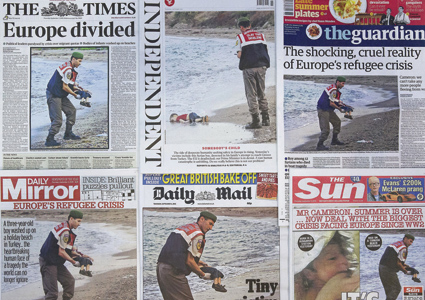 The turning point of the migrant crisis? Front-page coverage of the tragedy of Aylan Kurdi, a Syrian toddler washed up on the Turkish coast (Justin Tallis/AFP/Getty Images)
The first of those problems — the contradictions of the public — has been most evident in recent weeks. In late August, in the eastern German town of Heidenau, there were protests outside a refugee centre and an arson attack on a facility to be used by migrants. The German Chancellor, Angela Merkel, announced that Germany would accept around 800,000 refugees (about 1 per cent of the current German population) this year. When she subsequently appeared in Heidenau, Merkel was roundly booed and heckled by the crowds. This was, understandably, not the image that many other Germans wished to give to the world. Only days later, as refugees flowed across the borders of Germany, there were almost euphoric scenes as people lined the way, clapping, doling out toys and in some places throwing what appeared to be a carnival for their new arrivals. Yet these two groups of people are not wholly separate entities but rather represent a confusion which goes through the heart of many Europeans.
Because of course when we in Europe see people fleeing across borders we think of those who fled from country to country as refugees from Nazi Germany and scoured the globe for anyone to take them in. Our immediate instinct is compassion and, in some cases, guilt. Yet emotion is not enough and little enough, and while journalists compete to find the worst horror stories from those escaping from Syria few people if any are asking the questions behind the emotions.
Here are just a few of the questions we still cannot answer. Is Syria really like Nazi Germany? To date Lebanon, Turkey and Jordan — among other countries — have grudgingly taken in many refugees, but is the choice for Syria’s exiled populations really Europe or death? Even if it was, would Europe be able to take in millions of Syrian refugees? What will we do once they are here? Do we have any jobs for them or places for them to live? If they come here will they ever return to their country, once the war is over? Could “temporary asylum” even exist, given that most people will enter the welfare system and their children access schooling and other undoable provisions? In truth, these questions are the simplest of all. Because that is not the problem in full, but only a portion of it. We are failing to deal with even a portion of the problem.
Of the migrants who now form the largest inflow of migrants into Europe in recent history, only around 40 per cent are Syrians. We have lasered-in on the Syria portion of this problem. But it is only part of the problem. Most of those currently coming into Europe — as I saw on a recent trip to the Italian Mediterranean island of Lampedusa — are from elsewhere in the world, including sub-Saharan Africa and in particular Eritrea. Even if it were in Britain or Europe’s gift to bring peace to Syria, what is the plan to bring stability and prosperity to Eritrea? Has anybody, anywhere got any idea? The British Home Secretary, Theresa May, recently said that Britain and other countries must try to improve living standards in such countries to prevent people coming here. But the truth is — as many studies have shown — it is only when living standards rise (though hardly to luxurious levels) that the migration truly begins. Truly poor people do not have the money to bribe the smugglers.
The turning point of the migrant crisis? Front-page coverage of the tragedy of Aylan Kurdi, a Syrian toddler washed up on the Turkish coast (Justin Tallis/AFP/Getty Images)The first of those problems — the contradictions of the public — has been most evident in recent weeks. In late August, in the eastern German town of Heidenau, there were protests outside a refugee centre and an arson attack on a facility to be used by migrants. The German Chancellor, Angela Merkel, announced that Germany would accept around 800,000 refugees (about 1 per cent of the current German population) this year. When she subsequently appeared in Heidenau, Merkel was roundly booed and heckled by the crowds. This was, understandably, not the image that many other Germans wished to give to the world. Only days later, as refugees flowed across the borders of Germany, there were almost euphoric scenes as people lined the way, clapping, doling out toys and in some places throwing what appeared to be a carnival for their new arrivals. Yet these two groups of people are not wholly separate entities but rather represent a confusion which goes through the heart of many Europeans.
Because of course when we in Europe see people fleeing across borders we think of those who fled from country to country as refugees from Nazi Germany and scoured the globe for anyone to take them in. Our immediate instinct is compassion and, in some cases, guilt. Yet emotion is not enough and little enough, and while journalists compete to find the worst horror stories from those escaping from Syria few people if any are asking the questions behind the emotions.
Here are just a few of the questions we still cannot answer. Is Syria really like Nazi Germany? To date Lebanon, Turkey and Jordan — among other countries — have grudgingly taken in many refugees, but is the choice for Syria’s exiled populations really Europe or death? Even if it was, would Europe be able to take in millions of Syrian refugees? What will we do once they are here? Do we have any jobs for them or places for them to live? If they come here will they ever return to their country, once the war is over? Could “temporary asylum” even exist, given that most people will enter the welfare system and their children access schooling and other undoable provisions? In truth, these questions are the simplest of all. Because that is not the problem in full, but only a portion of it. We are failing to deal with even a portion of the problem.
Of the migrants who now form the largest inflow of migrants into Europe in recent history, only around 40 per cent are Syrians. We have lasered-in on the Syria portion of this problem. But it is only part of the problem. Most of those currently coming into Europe — as I saw on a recent trip to the Italian Mediterranean island of Lampedusa — are from elsewhere in the world, including sub-Saharan Africa and in particular Eritrea. Even if it were in Britain or Europe’s gift to bring peace to Syria, what is the plan to bring stability and prosperity to Eritrea? Has anybody, anywhere got any idea? The British Home Secretary, Theresa May, recently said that Britain and other countries must try to improve living standards in such countries to prevent people coming here. But the truth is — as many studies have shown — it is only when living standards rise (though hardly to luxurious levels) that the migration truly begins. Truly poor people do not have the money to bribe the smugglers.
Even here we are far beyond the current acceptable political discussion, yet barely scratching the surface of the problem. But the questions have to be asked. What system does Europe have in place to discern who is a legitimate refugee and who is an economic migrant? Is it fit for purpose? In Italy I asked every aid worker I could find if they knew of anybody being sent back home after arriving in European waters. Nobody could think of such a case. The truth is that once someone is here they stay because Europe cannot work out who is who (most people having deliberately come without papers) and even if they are clearly economic migrants they are never sent home. Europe had no workable system to do this when the movement was at a low-point. Now that it is at a historic high Europe has less than no system.
And then there is the question of the composition of the migrants. If this movement is indeed a movement of the genuinely dispossessed then why are almost all of them young men? In recent weeks the media has zoomed its cameras in on the occasional woman or child. But they are the rarities. On Lampedusa I saw only young men from sub-Saharan Africa. I saw no women. One of the first things that many of the arrivals did on getting to the island was to buy a SIM card and call home to tell their families that they had made it: families they will end up sending money to if they make any (largely in the underground economy) and whom they will often aim to bring over to join them.
And of course there is the question of integration. Does anybody, anywhere in Europe still think integration has happened to date? Almost every government, currently opening its borders to further migrants, has in fact accepted that it has not. Chancellor Merkel said as much in a speech five years ago, as David Cameron did four years ago. So why would integration happen when immigration is at the current historic highs, if it didn’t happen when immigration was at — remarkably — a comparative low? Some politicians want to blame the public for a lack of enthusiasm about importing millions more people into Europe. If they are looking for someone to blame for that attitude they could do worse than looking to the citizens of Dewsbury, Gennevilliers, Malmö and many other places in Europe anyone can name.
All of this, again, barely touches the beginning of the debate which our continent is so far away from having. But perhaps it brings me to the most crucial question of all. Assuming that the majority of the arrivals are economic migrants and that we are going to do little or nothing to prevent them coming, ought not Europeans to try to start thinking their way through the first-principles questions? Such as: “Is it the job of Europeans to give a better standard of living in our continent to anybody in the world who wants it?’
If public opinion polls are anything to go by it would seem that the publics of Europe already have an answer to a question their political representatives still dare not ask. In Hungary, Poland, Slovakia and other countries, politicians are trying to respond to public sentiment. But everywhere else the strain of sustaining the current disconnect is beginning to show. The Swedish government recently announced that it is going to take a further 80,000 refugees this year (around 1 per cent of its current population). It is a continuation of a more-than generous asylum policy which has seen Sweden boast of becoming a “humanitarian superpower”. But these things have consequences. One recent poll showed the only anti-immigration party in the country — the Sweden Democrats — for the first time leading the opinion polls. This party, often described as far-right, was until recently never polling above low single digits.
And then there is the question of the composition of the migrants. If this movement is indeed a movement of the genuinely dispossessed then why are almost all of them young men? In recent weeks the media has zoomed its cameras in on the occasional woman or child. But they are the rarities. On Lampedusa I saw only young men from sub-Saharan Africa. I saw no women. One of the first things that many of the arrivals did on getting to the island was to buy a SIM card and call home to tell their families that they had made it: families they will end up sending money to if they make any (largely in the underground economy) and whom they will often aim to bring over to join them.
And of course there is the question of integration. Does anybody, anywhere in Europe still think integration has happened to date? Almost every government, currently opening its borders to further migrants, has in fact accepted that it has not. Chancellor Merkel said as much in a speech five years ago, as David Cameron did four years ago. So why would integration happen when immigration is at the current historic highs, if it didn’t happen when immigration was at — remarkably — a comparative low? Some politicians want to blame the public for a lack of enthusiasm about importing millions more people into Europe. If they are looking for someone to blame for that attitude they could do worse than looking to the citizens of Dewsbury, Gennevilliers, Malmö and many other places in Europe anyone can name.
All of this, again, barely touches the beginning of the debate which our continent is so far away from having. But perhaps it brings me to the most crucial question of all. Assuming that the majority of the arrivals are economic migrants and that we are going to do little or nothing to prevent them coming, ought not Europeans to try to start thinking their way through the first-principles questions? Such as: “Is it the job of Europeans to give a better standard of living in our continent to anybody in the world who wants it?’
If public opinion polls are anything to go by it would seem that the publics of Europe already have an answer to a question their political representatives still dare not ask. In Hungary, Poland, Slovakia and other countries, politicians are trying to respond to public sentiment. But everywhere else the strain of sustaining the current disconnect is beginning to show. The Swedish government recently announced that it is going to take a further 80,000 refugees this year (around 1 per cent of its current population). It is a continuation of a more-than generous asylum policy which has seen Sweden boast of becoming a “humanitarian superpower”. But these things have consequences. One recent poll showed the only anti-immigration party in the country — the Sweden Democrats — for the first time leading the opinion polls. This party, often described as far-right, was until recently never polling above low single digits.
In late August the official immigration statistics for the UK were released and showed that Cameron’s 2011 boast that his government would bring net immigration into the UK down from the “hundreds of thousands” a year to the “tens of thousands” has been missed by more than ever. The figures showed that net migration into the UK had actually reached an historic peak — rising to 330,000 up to the start of this year. We know how few people welcomed this because poll after poll tells us so. One poll carried out last year found that a mere 11 per cent of the UK population want the population to increase. Another recent poll showed that just 7 per cent of the British public want more immigration to our country. Now that 13 per cent of the UK population were not born in the UK, one interesting thing this shows is that even most immigrants to Britain do not want more immigrants. In the initial part of the current crisis Cameron tried to reflect British public opinion. He stood against the demands of Merkel and the European Commission that European countries take quotas even as they conceded that the quotas were insufficient to address the problem.
But then the internal contradictions of Europe were demonstrated again by what most seem to agree was a turning-point: the photograph of a dead Syrian boy, Aylan Kurdi, washed up on the shores of Turkey. A social media campaign grew — like the “Bring back our girls” hashtag of a couple of years ago about Nigerian girls kidnapped by Boko Haram. This time the hashtag was “Refugees welcome” and celebrities, politicians and others photographed themselves with the sign and sent the photograph around on social media. Public and media opinion grew militant, simultaneously demanding slashes in net migration and vast increases in the number of refugees. The political class understandably struggled to keep pace with these contradictory demands. Soon the Hungarian government was being sat upon from above and every voice of caution seemed to be on the defensive.
To be opposed to letting in refugees was suddenly to be indifferent to the fate of dead children. Unsurprisingly the British Prime Minister buckled and agreed to start by allowing in a further 20,000 Syrian refugees. Dams broke elsewhere in Europe too, with media cameramen running alongside migrants as they poured through the fields and across the borders. Over the next 48 hours the New York Times reported a surge of migrant movement from Nigeria and elsewhere as people saw that a window of opportunity had opened for citizenship in Europe.
The Sun, meanwhile, responded to the photo of the drowned Syrian boy by drum-beating for RAF airstrikes inside Syria, and the Chancellor of the Exchequer, George Osborne, used the opportunity to lambast the Labour party for voting against intervention in Syria two years ago, describing it as “one of the worst decisions the House of Commons has ever made”. Few knee-jerks could more adequately sum up our confusion. For the 2013 Commons vote proposed a set of punitive airstrikes against the Assad regime for its use of chemical weapons in the Syrian civil war. As some of us who opposed those airstrikes said at the time, there was no strategic thinking about this, and no thinking whatsoever about what Britain would do if those strikes helped topple Assad and left Britain (which had previously had no involvement in Syria’s descent into chaos) with at least some responsibility for putting the country back together again. Those purported strikes had nothing to do with Isis, would have done nothing to stem the flow of refugees from Syria and might easily have made the refugee flow even larger.
But then the internal contradictions of Europe were demonstrated again by what most seem to agree was a turning-point: the photograph of a dead Syrian boy, Aylan Kurdi, washed up on the shores of Turkey. A social media campaign grew — like the “Bring back our girls” hashtag of a couple of years ago about Nigerian girls kidnapped by Boko Haram. This time the hashtag was “Refugees welcome” and celebrities, politicians and others photographed themselves with the sign and sent the photograph around on social media. Public and media opinion grew militant, simultaneously demanding slashes in net migration and vast increases in the number of refugees. The political class understandably struggled to keep pace with these contradictory demands. Soon the Hungarian government was being sat upon from above and every voice of caution seemed to be on the defensive.
To be opposed to letting in refugees was suddenly to be indifferent to the fate of dead children. Unsurprisingly the British Prime Minister buckled and agreed to start by allowing in a further 20,000 Syrian refugees. Dams broke elsewhere in Europe too, with media cameramen running alongside migrants as they poured through the fields and across the borders. Over the next 48 hours the New York Times reported a surge of migrant movement from Nigeria and elsewhere as people saw that a window of opportunity had opened for citizenship in Europe.
The Sun, meanwhile, responded to the photo of the drowned Syrian boy by drum-beating for RAF airstrikes inside Syria, and the Chancellor of the Exchequer, George Osborne, used the opportunity to lambast the Labour party for voting against intervention in Syria two years ago, describing it as “one of the worst decisions the House of Commons has ever made”. Few knee-jerks could more adequately sum up our confusion. For the 2013 Commons vote proposed a set of punitive airstrikes against the Assad regime for its use of chemical weapons in the Syrian civil war. As some of us who opposed those airstrikes said at the time, there was no strategic thinking about this, and no thinking whatsoever about what Britain would do if those strikes helped topple Assad and left Britain (which had previously had no involvement in Syria’s descent into chaos) with at least some responsibility for putting the country back together again. Those purported strikes had nothing to do with Isis, would have done nothing to stem the flow of refugees from Syria and might easily have made the refugee flow even larger.
Like all the other responses — public, media and political — this one was shot through with mistakes, zig-zags and incorrect assumptions. If Europe is going to find its way through the current crisis we will first have to find our way through these misperceptions. But, like peeling an onion, it is going to require care and undoubtedly cause tears.
First, we need to address the idea of our alleged “responsibility” for this crisis. Much though many British people are willing to berate the former Labour government for its 2003 intervention in Iraq, our country has notably had extremely limited military involvement in Syria. Qatar and the UAE — two countries which have set up quotas to accept precisely no Syrian refugees — certainly have done. And Iran — whose Hezbollah and other militia have been fighting for Iranian interests in Syria for at least four years now — has now even berated Europe for not doing more. In early September Iran’s President Rouhani had the gall to lecture Hungary’s ambassador to Iran over Hungary’s “shortcomings” in the refugee crisis. Saudi Arabia — which has made no Syrians into Saudi citizens — has been backing its preferred sides inside the country. It has also refused to allow the use of 100,000 air-conditioned tents used only for only five days a year by pilgrims on the Hajj. But the Saudis have offered to build 200 new mosques in Germany. Explaining the failure of Gulf countries to take in Syrian refugees, one Kuwaiti official said: “In the end it is not right for us to accept a people that are different from us. We don’t want people that suffer from internal stress and trauma in our country.”
Throughout most of human history it has been easier for people to refuse rather than accept responsibility for things that they have done. Only in the modern West have we landed in the unnatural position of finding it easier to accept responsibility for things we have not done than to profess the truth of our innocence.
But there are even worse truths underneath all this, not least the fact that even our best policies are unattainable. If this has been clear for some time, it is only making itself felt now. The problem might be summed up in the economic migrant/asylum-seeker debate. For the consensus that a lot of mainstream centre-ground politicians in Europe have come to is that the jury is out or unpersuaded by the cause of economic migrants, but that all asylum-seekers must come in. Pretending that we could invent tomorrow an instrument to perfectly differentiate between the two, even that policy is impossible. Consider one example. European law dictates that people fleeing a country because of persecution for their faith, race or sexual orientation (to give just three examples) will be given asylum if they can find their way to Europe. If the number of gay men and women in Africa and the Middle East is — as there is no reason to think it is not — around the same percentage it is in other societies, then that means just for starters that around 5 per cent of the populations of those countries should (providing they can find their way here) be given asylum in Europe. We do know that this is not possible, don’t we? But we pretend it is — pretence based on the quiet hope that they will not find their way here. But what if they do? What if all those people our policy assumed wouldn’t come here now do? The problem of not facing up to any of these failures of thought is that they stop our politicians being able to think their way through to any political leadership.
First, we need to address the idea of our alleged “responsibility” for this crisis. Much though many British people are willing to berate the former Labour government for its 2003 intervention in Iraq, our country has notably had extremely limited military involvement in Syria. Qatar and the UAE — two countries which have set up quotas to accept precisely no Syrian refugees — certainly have done. And Iran — whose Hezbollah and other militia have been fighting for Iranian interests in Syria for at least four years now — has now even berated Europe for not doing more. In early September Iran’s President Rouhani had the gall to lecture Hungary’s ambassador to Iran over Hungary’s “shortcomings” in the refugee crisis. Saudi Arabia — which has made no Syrians into Saudi citizens — has been backing its preferred sides inside the country. It has also refused to allow the use of 100,000 air-conditioned tents used only for only five days a year by pilgrims on the Hajj. But the Saudis have offered to build 200 new mosques in Germany. Explaining the failure of Gulf countries to take in Syrian refugees, one Kuwaiti official said: “In the end it is not right for us to accept a people that are different from us. We don’t want people that suffer from internal stress and trauma in our country.”
Throughout most of human history it has been easier for people to refuse rather than accept responsibility for things that they have done. Only in the modern West have we landed in the unnatural position of finding it easier to accept responsibility for things we have not done than to profess the truth of our innocence.
But there are even worse truths underneath all this, not least the fact that even our best policies are unattainable. If this has been clear for some time, it is only making itself felt now. The problem might be summed up in the economic migrant/asylum-seeker debate. For the consensus that a lot of mainstream centre-ground politicians in Europe have come to is that the jury is out or unpersuaded by the cause of economic migrants, but that all asylum-seekers must come in. Pretending that we could invent tomorrow an instrument to perfectly differentiate between the two, even that policy is impossible. Consider one example. European law dictates that people fleeing a country because of persecution for their faith, race or sexual orientation (to give just three examples) will be given asylum if they can find their way to Europe. If the number of gay men and women in Africa and the Middle East is — as there is no reason to think it is not — around the same percentage it is in other societies, then that means just for starters that around 5 per cent of the populations of those countries should (providing they can find their way here) be given asylum in Europe. We do know that this is not possible, don’t we? But we pretend it is — pretence based on the quiet hope that they will not find their way here. But what if they do? What if all those people our policy assumed wouldn’t come here now do? The problem of not facing up to any of these failures of thought is that they stop our politicians being able to think their way through to any political leadership.
One question I ask politicians whenever I get a chance is: why do they not do now the things which they will end up having to do at some point down the line? If you speak with Australian officials who dealt with a similar refugee boat-crisis in their country last decade, they will tell you that you have to keep the migrants out of your country and dissuade others from coming. The Australian example is not a perfect match with the current European one, but it is close. The Australians set up holding centres outside Australian territory, so that people could not land in the country and claim asylum once there. If European politicians were responsible they would now be doing what they will end up having to do anyway, and pay North African countries and others to have holding centres where the claims of the various migrants can at least aim to be assessed. Stop them from setting foot in Europe and you can prevent them all claiming every right which will most likely allow them to remain in Europe in perpetuity.
We must also consider what is best for the migrants in question. Even if we agree that life inside Syria is unlivable for much of the population, a sensible policy would be based on the fact — discussed by David Goodhart and Paul Collier in their recent seminal works — that it is almost always better to keep somebody in proximity to the country from which they are fleeing. If somebody is fleeing Syria it is far better that they stay in Jordan than that they are plonked down in Scandinavia. For sure there are few job prospects for such refugees in Jordan (there may be fewer still in Scandinavia) but as Collier has argued, one solution is for European countries to do more to provide employment opportunities for Syrians inside neighbouring countries rather than a continent away. It is also vital for Europeans to consider what this crisis is not. The father of the Syrian boy who drowned on the shores of Turkey had a job in Turkey, and the family had been living there for three years at the time. He now blames Canada for the death of his son because Canada did not immediately take his family in. Like many European countries, Canada (where I am sitting at the time of writing) is uncertain how much to beat itself up over this. A Holocaust survivor I sat beside at a dinner in Toronto expressed her horror at the repetition of history. But the situations are not analogous. The Syrian father’s job may not have been the best job in the world, but his family’s situation was not remotely analogous to the situation of a German Jew in the 1930s. A German Jew of that time who had managed to move to Sweden and get a job did not have transport provided to deliver him to Britain. But in the spreading-around of the German reaction to all this you can see something else working itself out. For the motivation in whole swathes of the West is a misreading of current and historical events. But this is not even the worst misunderstanding. That must be saved for the “economic” justification which has once again emerged.
It is an argument which has been heard among Germans at the train-station receptions and elsewhere. And it was expressed just last month by the EU head of the International Organisation for Migration (IOM) in the pages of the Wall Street Journal Europe. A more reckless argument is impossible to find. Eugenio Ambrosi argued that it was “troubling” that the continent was having “difficulty” accepting the unprecedented wave of migrants and claimed Europe “is experiencing the most widespread and intense anti-immigrant sentiment seen in decades”. But he went on to argue that migrants bring “new ideas and high motivation” and “pitch in and contribute to our economies and societies when given a fair chance. Sometimes they have a better work ethic than native Europeans.”
We must also consider what is best for the migrants in question. Even if we agree that life inside Syria is unlivable for much of the population, a sensible policy would be based on the fact — discussed by David Goodhart and Paul Collier in their recent seminal works — that it is almost always better to keep somebody in proximity to the country from which they are fleeing. If somebody is fleeing Syria it is far better that they stay in Jordan than that they are plonked down in Scandinavia. For sure there are few job prospects for such refugees in Jordan (there may be fewer still in Scandinavia) but as Collier has argued, one solution is for European countries to do more to provide employment opportunities for Syrians inside neighbouring countries rather than a continent away. It is also vital for Europeans to consider what this crisis is not. The father of the Syrian boy who drowned on the shores of Turkey had a job in Turkey, and the family had been living there for three years at the time. He now blames Canada for the death of his son because Canada did not immediately take his family in. Like many European countries, Canada (where I am sitting at the time of writing) is uncertain how much to beat itself up over this. A Holocaust survivor I sat beside at a dinner in Toronto expressed her horror at the repetition of history. But the situations are not analogous. The Syrian father’s job may not have been the best job in the world, but his family’s situation was not remotely analogous to the situation of a German Jew in the 1930s. A German Jew of that time who had managed to move to Sweden and get a job did not have transport provided to deliver him to Britain. But in the spreading-around of the German reaction to all this you can see something else working itself out. For the motivation in whole swathes of the West is a misreading of current and historical events. But this is not even the worst misunderstanding. That must be saved for the “economic” justification which has once again emerged.
It is an argument which has been heard among Germans at the train-station receptions and elsewhere. And it was expressed just last month by the EU head of the International Organisation for Migration (IOM) in the pages of the Wall Street Journal Europe. A more reckless argument is impossible to find. Eugenio Ambrosi argued that it was “troubling” that the continent was having “difficulty” accepting the unprecedented wave of migrants and claimed Europe “is experiencing the most widespread and intense anti-immigrant sentiment seen in decades”. But he went on to argue that migrants bring “new ideas and high motivation” and “pitch in and contribute to our economies and societies when given a fair chance. Sometimes they have a better work ethic than native Europeans.”
Here is the crux: “Europe is getting older and will soon be dealing with a serious shortage of working-age people . . . Germany alone could experience a labour shortage of up to 2.4 million workers by 2020, according to the Boston Consulting Group. Our existing social-security systems are not threatened by migration. Quite to the contrary: The contribution of migrants will ensure that the support Europeans receive now will continue into the future.”
Lest anybody missed it, this is an argument for cultural suicide, dressed-up in the language of palliative care.
Even if Europe’s demographic fall-off were as severe as Mr Ambrosi claims, who but a madman would think the answer is to import people from a wholly different culture to make up the next generation? Do Ambrosi and other free-marketeers in America and Europe really foresee no problems at all in this? Perhaps they should explain their theory to the 25-50 per cent of young people in Spain, Portugal, Italy and Greece who do not have a job. Tell them that they have just been leap-frogged by people willing to work harder for less, with the approval of American free-marketeers and assorted libertarians.
Many of us who live in Europe, love Europe as it is. We do not want our politicians, through weakness, cowardice or prevarication, to change our home into an utterly different place. Europeans may be almost endlessly compassionate but not to the point of being suicidal. The public may want many contradictory things, but they will not forgive politicians if — whether by accident or design — they change our continent completely. If they do so then many of us will regret this quietly. Others will regret this less quietly. In either case, if our politicians do not start to lead their publics through this morass then our continent’s crisis may be just beginning.
Lest anybody missed it, this is an argument for cultural suicide, dressed-up in the language of palliative care.
Even if Europe’s demographic fall-off were as severe as Mr Ambrosi claims, who but a madman would think the answer is to import people from a wholly different culture to make up the next generation? Do Ambrosi and other free-marketeers in America and Europe really foresee no problems at all in this? Perhaps they should explain their theory to the 25-50 per cent of young people in Spain, Portugal, Italy and Greece who do not have a job. Tell them that they have just been leap-frogged by people willing to work harder for less, with the approval of American free-marketeers and assorted libertarians.
Many of us who live in Europe, love Europe as it is. We do not want our politicians, through weakness, cowardice or prevarication, to change our home into an utterly different place. Europeans may be almost endlessly compassionate but not to the point of being suicidal. The public may want many contradictory things, but they will not forgive politicians if — whether by accident or design — they change our continent completely. If they do so then many of us will regret this quietly. Others will regret this less quietly. In either case, if our politicians do not start to lead their publics through this morass then our continent’s crisis may be just beginning.
Like this article? Share, save or print using the icons below:


More Features
- Can Macron wear the General's uniform?
- Trump prefers energy dominance to Paris
- A spectre haunting Europe: Karl Marx
- The battle for British Muslims' integration
- Did Winnie's crimes open Nelson's eyes?
- Belated revenge of the 1968 generation
- Jean-Paul Sartre: the supernova of the far Left
- Presidents for life Putin and Xi menace the West
- Nation states could save the Middle East
- The Trump Presidency is bigger than the man
- Great power politics means greater dangers
- The new project fear shames Whitehall
- Technology menaces childhood and culture
- The onslaught against the West's moral codes
- The Brexit cringe — Mrs T would say 'No!'
- Will the genius of the common law survive?
- Sex, politics and the new blasphemy
- Social market liberals of the world, unite!
- The West must restore a sense of the sacred
- The Arabs need us to support democracy
Popular Standpoint topics

- Cyril Ramaphosa's poisoned chalice
- The American mind continues to close
- The West must restore a sense of the sacred
- The onslaught against the West's moral codes
- Is South Africa about to fall apart?
- Technology menaces childhood and culture
- How the hate mob tried to silence me
- Will the genius of the common law survive?
1:09 AM
5:09 PM
1:09 AM
10:09 PM
1:09 AM
4:09 PM
7:09 AM
9:09 PM
8:09 PM
7:09 PM