


When, one year ago, President Emmanuel Macron designed the setting for his first official photograph he placed himself in front of a desk in the Elysée Palace on which lay a copy of the War Memoirs of Charles de Gaulle — a work which he appears to have studied with care.
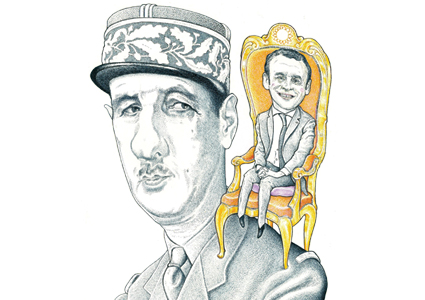 (Illustration by Michael Daley)
At first glance there could hardly be two less similar men. Macron, short, slim, regularly formed, neat good looks — something of the lithe air of a tango professor about him, with a warm smile, a willingness to please, quietly spoken, every mother’s darling. Opposite Charles de Gaulle, huge in stature, long thin legs supporting a prominent paunch, sloping shoulders and then a drôle de tête, with the massive beaky nose and the invisible chin, a cartoonist’s dream, silent, charmless, grumpy, given to terrifying fits of rage, and absolutely nobody’s cheri. And yet these two men share a number of dominating characteristics — unusually quick intelligence, disdain for most of their fellow beings, a brazen capacity to deceive both their colleagues and their opponents, and an exceedingly sharp eye for the main chance. And Macron demonstrates another common characteristic which has served him well. He is remarkably difficult to read — unpredictability is Macron’s stock in trade.
In many ways the comparison is absurd. De Gaulle’s life was lived on a heroic scale, not something Emmanuel Macron is ever likely to experience, despite his vast ambitions. It is difficult to imagine de Gaulle spending €29,000 on 35 makeup sessions for instance, and le Grand Charles would probably not have invited Annie Leibowitz into his domestic life to immortalise it in Vanity Fair. But both men’s style of government has been described as jupitérien, and like de Gaulle, Macron is multiplying the regional tours and the walkabouts. He has a hypnotic gaze and is never happier than when he is plunging into a group of voters, smiling, embracing, distributing physical contact as though he were curing the “King’s Evil” (scrofula) under the ancien regime. His election was assured by left-of-centre voters, but he has modelled his first year in power on the methods of a hero of the Right, and there are further similarities in the way in which that power was achieved.
In 1958 de Gaulle was recalled to office to rewrite France’s Constitution and replace the Fourth Republic with the Fifth. He, who had always scorned professional politicians, governed with an open contempt for the powers of the National Assembly, where he lacked an overall majority. And he twice amended the constitution (by referendum) to increase his own power at the expense of the elected deputies.
In 2017 Macron’s unforeseen election victory was won by wrong-footing the leaders of the Fifth Republic and reducing the established political parties to irrelevance. When he was elected (running against Marine Le Pen) the pundits said that he owed his victory to a rejection of the Front National, and that he would never win a majority in the National Assembly because he was not backed by his own party. In the event Macron’s REM (La République En Marche) and its centrist allies won an overall majority of 123 with the Socialists, who had been in government for 20 of the previous 36 years, managing a pathetic total of 45 out of 577 seats. The French Constitution remained unchanged, but the alternating left-right see-saw by which political power could be switched, had been dismantled, and the Republic that has emerged from Macron’s election victory bears little resemblance to its founding model.
(Illustration by Michael Daley)At first glance there could hardly be two less similar men. Macron, short, slim, regularly formed, neat good looks — something of the lithe air of a tango professor about him, with a warm smile, a willingness to please, quietly spoken, every mother’s darling. Opposite Charles de Gaulle, huge in stature, long thin legs supporting a prominent paunch, sloping shoulders and then a drôle de tête, with the massive beaky nose and the invisible chin, a cartoonist’s dream, silent, charmless, grumpy, given to terrifying fits of rage, and absolutely nobody’s cheri. And yet these two men share a number of dominating characteristics — unusually quick intelligence, disdain for most of their fellow beings, a brazen capacity to deceive both their colleagues and their opponents, and an exceedingly sharp eye for the main chance. And Macron demonstrates another common characteristic which has served him well. He is remarkably difficult to read — unpredictability is Macron’s stock in trade.
In many ways the comparison is absurd. De Gaulle’s life was lived on a heroic scale, not something Emmanuel Macron is ever likely to experience, despite his vast ambitions. It is difficult to imagine de Gaulle spending €29,000 on 35 makeup sessions for instance, and le Grand Charles would probably not have invited Annie Leibowitz into his domestic life to immortalise it in Vanity Fair. But both men’s style of government has been described as jupitérien, and like de Gaulle, Macron is multiplying the regional tours and the walkabouts. He has a hypnotic gaze and is never happier than when he is plunging into a group of voters, smiling, embracing, distributing physical contact as though he were curing the “King’s Evil” (scrofula) under the ancien regime. His election was assured by left-of-centre voters, but he has modelled his first year in power on the methods of a hero of the Right, and there are further similarities in the way in which that power was achieved.
In 1958 de Gaulle was recalled to office to rewrite France’s Constitution and replace the Fourth Republic with the Fifth. He, who had always scorned professional politicians, governed with an open contempt for the powers of the National Assembly, where he lacked an overall majority. And he twice amended the constitution (by referendum) to increase his own power at the expense of the elected deputies.
In 2017 Macron’s unforeseen election victory was won by wrong-footing the leaders of the Fifth Republic and reducing the established political parties to irrelevance. When he was elected (running against Marine Le Pen) the pundits said that he owed his victory to a rejection of the Front National, and that he would never win a majority in the National Assembly because he was not backed by his own party. In the event Macron’s REM (La République En Marche) and its centrist allies won an overall majority of 123 with the Socialists, who had been in government for 20 of the previous 36 years, managing a pathetic total of 45 out of 577 seats. The French Constitution remained unchanged, but the alternating left-right see-saw by which political power could be switched, had been dismantled, and the Republic that has emerged from Macron’s election victory bears little resemblance to its founding model.
Like this article? Share, save or print using the icons below:


More Features
- In Corbyn’s mind, there is no place for the Jews
- The last Republican in the age of Trump
- A martial nation needs Churchill to inspire us
- Death of a bookman: the rise and fall of a publisher
- The inevitability of Fortress Europe
- Why the World Cup is a game of tribes
- Why Israel needs its new nation-state law
- The devout sceptic: hope for those of little faith
- Will Trump's foreign policy revolution fail?
- After Draghi departs, eurozone deluge looms
- The poor need the rich to always be with us
- Is the mental illness epidemic just a myth?
- No need to sell your oil shares just yet
- Trump prefers energy dominance to Paris
- A spectre haunting Europe: Karl Marx
- The battle for British Muslims' integration
- Did Winnie's crimes open Nelson's eyes?
- Belated revenge of the 1968 generation
- Jean-Paul Sartre: the supernova of the far Left
- Presidents for life Putin and Xi menace the West
Popular Standpoint topics

- Cyril Ramaphosa's poisoned chalice
- Is South Africa about to fall apart?
- The inevitability of Fortress Europe
- In Corbyn’s mind, there is no place for the Jews
- Presidents for life Putin and Xi menace the West
- How Monet created motion pictures
- Is the mental illness epidemic just a myth?
- The battle for British Muslims' integration
3:06 PM