



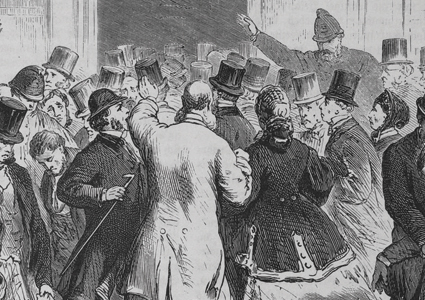
 “A catastrophe in the London gold markets. Outside the bank of Overend, Gurney & Co on May 11”, an 1866 German illustration
The starting point for any discussion of the UK banking crisis of 2007 and 2008 must be the events of May 10, 1866. The nation’s second-largest financial institution, Overend, Gurney & Co, announced that it could no longer repay creditors with cash. A few weeks later it was declared insolvent. The question for the Bank of England, the nation’s largest financial institution, was, “How should we respond?”
At that time the Bank employed no economists. It saw itself very much as a bank, if a rather special kind of bank because it was by far the dominant issuer of legal-tender notes and could freely expand these note liabilities. Strictly, it had to have enough gold to back the notes, but on a day-to-day basis it could do what it liked. That made it different from all other English banking institutions, which by law could not increase their note issues at all. It was a proto-central bank. It had this status even though at that stage the distinction between the central bank and commercial banks had not been clarified.
Since the Bank’s directors had let Overend, Gurney & Co go bust, they plainly did not see their job as being to rescue insolvent organisations. But the failure of that bank had wider ramifications, as it sparked “runs” on banks that were generally believed to be solid, well-managed and profitable. The Bank let it be known that it would lend notes freely to solvent banks. As its notes were the best-quality asset in the system, their injection into the economy restored confidence and the runs were brought to a halt.
There were two stings in the tail. The first was that, while the Bank made loans freely available, it charged heavily for them and demanded good collateral. The second was that, as Britain was on the gold standard, the Bank rate had to soar to 10 per cent to attract gold and maintain an adequate metallic cover for the Bank’s much-expanded liabilities. But life went on. According to statistics prepared more than a century later by the eminent economic historian Charles Feinstein, the UK’s gross national product fell by 1.5 per cent in money terms in 1867 and stayed down in 1868. But it moved ahead by 3.5 per cent in 1869 and surged by almost 8 per cent in 1870.
The Bank’s actions prevented the crisis at Overend, Gurney & Co from having too serious an effect on economic activity. In his celebrated 1873 book Lombard Street, Walter Bagehot, the first and most famous Editor of the Economist, said the Bank had “more or less” fulfilled its duty of making “enormous advances” in a “panic”. But he entered the caveat that it had not gone far enough.
According to Bagehot, not only should a central bank lend freely at a penalty rate against good collateral, it should also let its banking customers and the public at large know that this was its policy. By explicitly accepting a responsibility to lend in a crisis, the Bank could go a long way to ensuring that such crises did not happen at all. He warned, “Until we have on this point a clear understanding with the Bank of England, both our liability to crises and our terror at crises will always be greater than they otherwise would be.”
Like this article? Share, save or print using the icons below:


More Features
- We Need Churchill's Vison of Liberty More Than Ever
- The Play's The Thing, So Leave The Words Alone
- An Aesthetic and Moral Disaster
- How we Syrians destroyed our home — with your help
- Euphoric Labour won’t win power led by a pied piper
- Don’t be ‘difficult’ — try ‘formidable’, Mrs May
- Enough is enough of terror — but also of our self-doubt
- Iraq’s Christians pray for help that never comes
- The Atlantic alliance may be broken beyond repair
- Catholic tastes: both English and European
- Brexit as myth: Exodus, Reckoning, or Sacrifice?
- A Decent Woman Betrayed By Her Gruesome Twosome
- Can Macron Save France — Or Is He Its Undertaker?
- Europe's Revival Is At Hand, Thanks To Brexit
- Is This The Most Important British General Election Since 1979?
- The New Europe Must Be About More Than Money
- Our Best Brexit Policy Is All-Out Free Trade
- The Bursting Of Our 'Kabubble' Fantasies
- Gambling On A Greater More Gracious Britain
- Xi Versus Trump: The Emperor And The Tycoon
Popular Standpoint topics

- Opposites meet in the land of Scrugletopia
- The Battle Against The Philistines Never Ceases
- Home from home for the Bolshevik elite
- Can Macron Save France — Or Is He Its Undertaker?
- Why France Is Revolting Against The Ancien Regime
- How The EU Elite Paved The Way For Populism
- A Decent Woman Betrayed By Her Gruesome Twosome
- Last Of The Great Elitists
11:11 AM