


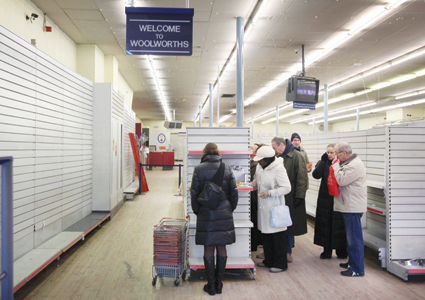
 The Great Recession strikes: Customers crowd around the last stock left in a London branch of Woolworths on the day it closed in 2009 (© Peter MacDiamid/Getty Images)
September 15, 2008 was an important date in financial history. It was then that bankers ceased to be regarded as acceptable representatives of the human race. Lehman Brothers filed for bankruptcy, with liabilities of potentially over $600 billion. Newspapers around the world said that the failure would be the largest in history, imperilling jobs, threatening small and medium-sized businesses, and risking economic collapse. According to the headlines, bankers were to blame for catastrophe.
More restrained words would have been sensible. Lehman’s losses were to total about $150 billion, equivalent to 0.2 per cent of American household net worth of $66,800 billion at the end of 2007. The losses fell in particular on Lehman’s commercial counterparties, including a list of widows and orphans with such names as Goldman Sachs, Bank of America and JP Morgan Chase. In the market turmoil and media hubbub no one noticed an obvious point: larger losses (relative to national output) had been reported by many companies and industries in America’s past, with no effect whatsoever on macroeconomic activity.
An amazing feature of modern life is that people believe what they read in newspapers. The headlines did their work. Bankers everywhere became the villains in a cops-and-robbers melodrama. The credit rating agencies, which had hardly been great heroes in the early phases of the crisis, decided to join the lynch mob. Hundreds of financial institutions in many countries received credit downgrades, undermining their ability to fund assets. One victim of this process was Bradford & Bingley, a Yorkshire-based mortgage lender with its roots in the Victorian mutual movement and self-help.
Despite having raised £400 million of new equity capital in July so that its solvency would not be in doubt, Bradford & Bingley’s downgrade meant that — like Northern Rock a year earlier — it faced a funding shortfall and might have to seek a loan from the Bank of England. UK officialdom did not want a repeat of the barrage of hostile publicity it had received in late 2007. Whereas Northern Rock’s nationalisation had taken some months and paid attention to due process, Bradford & Bingley was seized by the British state over the weekend of September 27-28. As with Northern Rock, no compensation was paid to shareholders.
Did government press officers tell the newspapers to report the story? The first paragraph of the Sunday Telegraph’s coverage read, “British taxpayers will be liable for more than £150 billion of potentially toxic mortgage debt following the nationalisation of Bradford & Bingley”; the headline was less circumspect, “Financial crisis: Bradford & Bingley nationalisation will cost taxpayers £150bn”. The Sunday Telegraph story has turned out to be drivel. According to its annual reports, Bradford & Bingley made a combined profit before tax of £2.4 billion in the period from January 2009 to March 2015. In addition, the government snaffled the company’s equity capital as it was in September 2008, which amounted to over £1 billion. Further profits will be earned on the rump of the business.
Like this article? Share, save or print using the icons below:


More Features
- We Need Churchill's Vison of Liberty More Than Ever
- The Play's The Thing, So Leave The Words Alone
- An Aesthetic and Moral Disaster
- How we Syrians destroyed our home — with your help
- Euphoric Labour won’t win power led by a pied piper
- Don’t be ‘difficult’ — try ‘formidable’, Mrs May
- Enough is enough of terror — but also of our self-doubt
- Iraq’s Christians pray for help that never comes
- The Atlantic alliance may be broken beyond repair
- Catholic tastes: both English and European
- Brexit as myth: Exodus, Reckoning, or Sacrifice?
- A Decent Woman Betrayed By Her Gruesome Twosome
- Can Macron Save France — Or Is He Its Undertaker?
- Europe's Revival Is At Hand, Thanks To Brexit
- Is This The Most Important British General Election Since 1979?
- The New Europe Must Be About More Than Money
- Our Best Brexit Policy Is All-Out Free Trade
- The Bursting Of Our 'Kabubble' Fantasies
- Gambling On A Greater More Gracious Britain
- Xi Versus Trump: The Emperor And The Tycoon
Popular Standpoint topics

- Opposites meet in the land of Scrugletopia
- The Battle Against The Philistines Never Ceases
- Home from home for the Bolshevik elite
- Can Macron Save France — Or Is He Its Undertaker?
- Why France Is Revolting Against The Ancien Regime
- How The EU Elite Paved The Way For Populism
- A Decent Woman Betrayed By Her Gruesome Twosome
- Last Of The Great Elitists
10:12 AM