



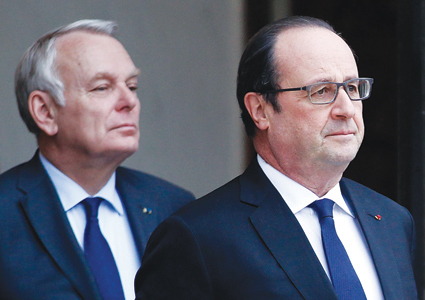
 Foreign Minister Jean-Marc Ayrault wants “more Europe” while President François Hollande warns of Brexit’s “consequences” (©Chesnot/Getty Images)
I am a Eurosceptic. I have never understood the idea of a political community without sovereignty or accountability. I have always found bizarre the idea that political representation can be independent of history, tradition and language. I have always frowned upon the prose of Jean Monnet, who condemned nation-states as essentially harmful and triggers of war. I was shocked by the aftermath of the 2005 French referendum on the European Constitution, in which a majority of people voted against it, only to be forced to accept that the same treaty under another name (the Lisbon Treaty) would be inserted into the French constitution by parliament.
The most intriguing aspect of the EU is that it has constantly denied that nations matter. It has ignored that the fact that the very strength of Europe, from the 18th century onwards, has been the prominence of its nations, their mutual influences, and their friendly competition. It has also misunderstood the real lesson of the 20th century — that nations become dreadful if they feel diminished, as Germany did after the First World War. Instead of seeing fascism as a pathology of the nation, and to treat it as a pathology, the EU has tried to erase the idea of the nation altogether. This is exactly the same thing as killing somebody in order to cure his illness. However, after 1957, the balance of power in the Common Market allowed two visions to coexist — the federalist one, supported by some Germans and French, and the nation-based one, championed by General de Gaulle. Ironically, while the British disliked de Gaulle because he refused them entry to the European Community: he could now be their hero. And if de Gaulle’s vision clashed with the UK’s, it was not on the importance of nations but on the influence of America on Europe. Seen from here, it was a good time for Europe.
From the 1980s onwards, the “Europe of nations” has lost ideological ground within EU institutions. What is particularly striking is that the EU has become a goal to be reached, and never to be lived. Instead of being a set of pragmatic agreements on a range of matters, it has become the embodiment of an ideological vision of how people should live politically. Hence the striking fact that every time the EU has reached a standstill, the answer has been either more integration or an extension of the Union’s border — that is what “ever-closer union” means. But would you treat a drug addict by prescribing him more drugs? Now the nations are rebelling — beginning with the UK. But there are still federalists who sincerely believe in the political consistency of the EU.
Interestingly, though, their case against Brexit, here and on the Continent, is mainly economic and not political — “if you leave, the economic consequences will be terrible”. Until June 23, the day of the referendum, experts and campaigners on both sides will do battle, armed with their contradictory economic data. But is that the right battle to concentrate on? While the short-term consequences of a Leave vote may be economically harmful, the long-term ones are unknown, and could go either way.
Like this article? Share, save or print using the icons below:


More Features
- Now Or Never
- Who Will Heal This Divided Country?
- What Made The West Great Is What Will Save Us
- Shock And Awe: Tales Of A Washington Insider
- We Shouldn't Let Old Men Rot Away In Jail
- Arnold Wesker’s Bid To Build A New Jerusalem
- Our EU Deal Gives Us The Best Of Both Worlds
- Brexit Would Save Us And Set Europe An Example
- Are Both Sides Playing By The Referendum Rules?
- Should We Stay Or Should We Go?
- Ignore Project Fear: Brexit Won't Ruin Us
- Uncontrolled Immigration Means Finis Britanniae
- The Next US President Must Carry A Big Stick
- Can Clinton Or Trump Crack The US Tax Code?
- How to Survive the Fourth Industrial Revolution
- The Spectre Of Mayor Khan's Islamist London
- Students Are Leading The Free Speech Fightback
- Fortress Europe Faces An African Migrant Tsunami
- Trump May Be Bad, But What Comes Next Will Be Worse
- Myth Of Stressed-Out Soldiers On The Street
Popular Standpoint topics

1:04 PM