



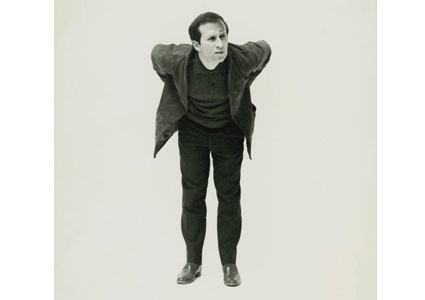
 Arnold Wesker: Was his career a story of success or failure? (©Cecil Beaton/Condé Nast via Getty Images)
Arnold Wesker’s greatest plays return again and again to one question: are they about hope or defeat and failure? “All his plays end in disappointment,” said Margaret Drabble, who first saw Roots as a student a Cambridge, but his characters “keep on trying”. At the end of Chicken Soup with Barley (1958) Ronnie Kahn turns on his mother Sarah and says, “The family you always wanted has disintegrated, and the great ideal you always cherished has exploded in front of your eyes.” However, it is Sarah who is given the last words: “Ronnie, if you don’t care you’ll die.”
At the climax of Roots (1959), Beatie Bryant’s family have been waiting for her boyfriend, the same Ronnie Kahn, to arrive. He doesn’t come and they turn on her, her head filled “wi’ high-class squit” and pretentious ideas about art and learning. “I got no roots in nothing,” she responds. “I come from a family of farm labourers yet I ent got no roots — just like town people — just a mass o’ nothin’.” But then she finds her own voice and ends, “I’m beginning, on my own two feet — I’m beginning . . .”
The third work of the Wesker trilogy, I’m Talking About Jerusalem (1960), is about the attempt by Ronnie’s sister Ada and her husband Dave to make a new life for themselves in the country. It comes to nothing. Dave reflects, “Here I’ve been, comrade citizen, presenting my offerings, and the world’s rejected them.” Already, at the very beginning of his career, Wesker was asking the question that haunted him for more than 50 years. As he presented his “offerings” had the world “rejected them”? After his death in April, what do we make of his legacy? Was his career essentially a story of success or failure?
But we shouldn’t personalise this. What is missing here are the larger cultural questions which Wesker’s career raises, questions about class, politics and Jewishness in British postwar culture that have generally gone unasked in all the tributes and obituaries. The highpoint of Wesker’s career, the five years between writing The Kitchen (1957) and the production of Chips with Everything (1962), were not just the story of one playwright finding his voice, but of a whole new generation of writers: the so-called “Angry Young Men”, on the Left, debating the issues raised in 1956 by Hungary and Suez, the collapse of faith in Soviet Communism, the end of Empire, the decline of Britain as a great power.
Like Wesker, many of these writers were from working-class backgrounds and were on the Left, emerging after almost a decade of political failure by Labour. They produced new drama, but above all new kinds of voices: working-class characters like Wesker’s kitchen workers, poor East Enders like the Kahns, agricultural labourers like the Bryants, and conscripts doing their military service. And many of these writers and characters, like Wesker, were from the Jewish East End.
Like this article? Share, save or print using the icons below:


Post your comment
More Features
- We Need Churchill's Vison of Liberty More Than Ever
- The Play's The Thing, So Leave The Words Alone
- An Aesthetic and Moral Disaster
- How we Syrians destroyed our home — with your help
- Euphoric Labour won’t win power led by a pied piper
- Don’t be ‘difficult’ — try ‘formidable’, Mrs May
- Enough is enough of terror — but also of our self-doubt
- Iraq’s Christians pray for help that never comes
- The Atlantic alliance may be broken beyond repair
- Catholic tastes: both English and European
- Brexit as myth: Exodus, Reckoning, or Sacrifice?
- A Decent Woman Betrayed By Her Gruesome Twosome
- Can Macron Save France — Or Is He Its Undertaker?
- Europe's Revival Is At Hand, Thanks To Brexit
- Is This The Most Important British General Election Since 1979?
- The New Europe Must Be About More Than Money
- Our Best Brexit Policy Is All-Out Free Trade
- The Bursting Of Our 'Kabubble' Fantasies
- Gambling On A Greater More Gracious Britain
- Xi Versus Trump: The Emperor And The Tycoon
Popular Standpoint topics

- Cultural Climate Change
- Opposites meet in the land of Scrugletopia
- The Battle Against The Philistines Never Ceases
- Can Macron Save France — Or Is He Its Undertaker?
- Home from home for the Bolshevik elite
- Why France Is Revolting Against The Ancien Regime
- How The EU Elite Paved The Way For Populism
- A Decent Woman Betrayed By Her Gruesome Twosome