


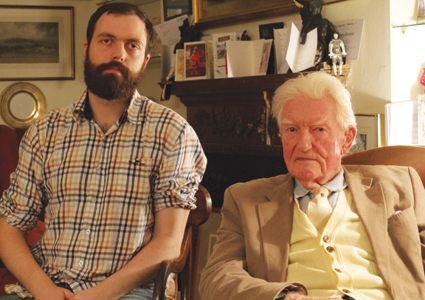
 Paul Johnson (right) and his grandson Tycho Johnson (©Marianna Nikodem)
Tycho Johnson: Let’s start by talking about Reagan. What were your first impressions when you met in 1980?
Paul Johnson: He was a very smooth operator. Everything about him was smooth. He had a soft, sympathetic voice, he loved talking, and he talked well. You could tell that he had been a professional actor. He had a lot of the graces and characteristics of one, he spoke well, spoke evenly, never at a loss for a word, and in fact gave a very good performance, you might say.
TJ: Modern Times, your history of the 20th century, profoundly influenced American conservatism, and Reagan himself is believed to have read it.
PJ: He did read it, and I remember he read a number of things of mine, and said he liked the way I wrote.
TJ: Did Modern Times have an impact on his presidency?
PJ: I think that would be going a bit too far, but I think it had some impact on him, yes, and he certainly enjoyed it.
TJ: Could you say that it provided the historical framework to give conservatism purpose at the time?
PJ: Yes. I think he liked to see things through the lenses of history. And therefore he needed a historical context in which he could place himself and his work as president of the United States. I think my writings helped him to do that, they helped him to see how his times fitted in to the general perspective of history, and how he emerged from it, and how he could possibly change things as a result of his perception of himself.
TJ: How would you describe the economic and political mood of America before Reagan?
PJ: The Cold War was coming to an end, and America had won it, but he didn’t want to proclaim this too openly, for fear the Russians would react too strongly against it.
TJ: Would you say that the feeling of the nation, before Reagan, was one of uncertainty? That they felt in a precarious situation?
PJ: Yes, they did feel that way, but Reagan was a very reassuring figure. He looked reassuring, he had a reassuring voice, reassuring things to say, and his general aura was one of calmness: “We’re doing well, and we’re going to do even better!” He was also the kind of person who got his inner strength from reassuring other people, to give them the sense that life was improving in general and he wanted people to aim higher than just “good”.
Like this article? Share, save or print using the icons below:


More Dialogue
- Why Israel's DNA Is So Revolutionary
- The Socialism of Fools
- The Anti-Elitist Elite Versus the Underclass
- Putting A Value On Human And Animal Life
- American Jews and the Defence of Western Civilisation
- Is China Really a Threat to us?
- Will Germany be a Divided Nation Again?
- Europe, America and the Coalition
- Incurable Romantics
- Staving Off Despair: On the Use and Abuse of Pessimism for Life
- Can the Atlantic Coalition Hold?
- Has Britain Found a Role Yet?
- Life, Death and the Meaning of Cancer?
- Is the Party Really Over for Labour?
- Should Baby Boomers Feel the Pinch?
- Will the Tories Give us the Schools We Deserve?
- What Would Keynes Say?
- How European are the British?
- Speaking Truth Unto the BBC
- Booking a Place in History
Popular Standpoint topics

- Cultural Climate Change
- Opposites meet in the land of Scrugletopia
- The Battle Against The Philistines Never Ceases
- Home from home for the Bolshevik elite
- Can Macron Save France — Or Is He Its Undertaker?
- How The EU Elite Paved The Way For Populism
- Why France Is Revolting Against The Ancien Regime
- A Decent Woman Betrayed By Her Gruesome Twosome
11:01 PM