


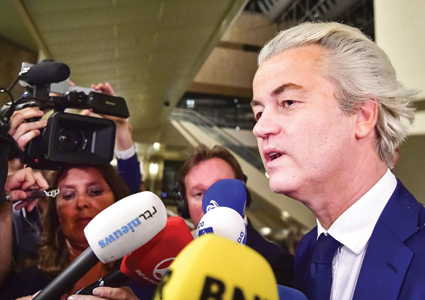
 Geert Wilders on the morning after the Dutch election last month: His populist Party for Freedom came second (©ROBIN UTRECHT/AFP/Getty Images)
In a now largely forgotten book published in 1982, Redemption by War: The Intellectuals and 1914, the American historian Roland Stromberg detailed how European intellectuals, almost to a man, welcomed the outbreak of the First World War. Things did not improve in the following decades, when scores of Europe’s thinkers fell under the spell of one extreme ideology or the other.
Is it different this time? Intellectuals across the continent seem almost unanimous in their defence of European liberalism which is threatened — as they see it — by Brexit and populism. Support for Leave in British universities ranged from the non-existent to the minuscule; and hardly a day goes by without some prominent intellectual warning of a return to the politics of the 1930s, to which the Saturday Guardian recently devoted a special supplement. Are Europe’s intellectuals on the right side of history at last?
Speaking of warnings, a small platoon of European thinkers did sound the alarm about the process of European integration in articles and books published at the turn of the century. Among them was Ernst-Wolfgang Böckenförde. Jurist, historian, and former judge on Germany’s Constitutional Court, he is little known in Britain although hopefully not for much longer now that a collection of his essays is available in English (Constitutional and Political Theory: Selected Writings, edited by Mirjam Künkler and Tine Stein, OUP, £70).
In 1997 Böckenförde argued that the path to integration chosen by the EU would delegitimise both the EU and member states. The transfer of extensive legislative and regulatory powers to the EU — he predicted — would lead to “a fragmentation of the care for the common good”. Böckenförde did not accept that the “administrative-technocratic structure” of the EU, manifesting itself “as a mere legal community” and “governance of experts”, could ever provide democratic legitimacy: its “chain of legitimation” is “too indirect . . . too abstract to create closeness”. He concluded with the sobering assessment that the “market-economic approach” — and the then impending monetary union — “will not lead to greater unity, but to greater separation”.
Böckenförde was not alone in these concerns. Sir Larry Siedentop’s Democracy in Europe (2000) warned that democratic legitimacy was at risk in Europe. The “economic model of democracy” — the idea that European democratic citizenship would be the natural outgrowth of the single market and monetary union — undermines “the classic liberal alliance of state and market” by minimising the claims of politics and maximising those of the market. “European elites,” he continued, “are in danger of creating a profound moral and institutional crisis in Europe — a crisis of democracy.” In a Europe of consumers and debased national citizenship, “the way will be open for more extreme movements of the Right and Left to seize the label ‘democratic’ and use it for their own purposes”. For Pierre Manent the separation of democracy from the nation state was the “great illusion” behind the European project, a point he made in A World Beyond Politics? A Defence of the Nation State, published in French in 2001, and in English in 2006.
Like this article? Share, save or print using the icons below:


More Features
- Will Trump's foreign policy revolution fail?
- After Draghi departs, eurozone deluge looms
- The poor need the rich to always be with us
- Is the mental illness epidemic just a myth?
- No need to sell your oil shares just yet
- Can Macron wear the General's uniform?
- Trump prefers energy dominance to Paris
- A spectre haunting Europe: Karl Marx
- The battle for British Muslims' integration
- Did Winnie's crimes open Nelson's eyes?
- Belated revenge of the 1968 generation
- Jean-Paul Sartre: the supernova of the far Left
- Presidents for life Putin and Xi menace the West
- Nation states could save the Middle East
- The Trump Presidency is bigger than the man
- Great power politics means greater dangers
- The new project fear shames Whitehall
- Technology menaces childhood and culture
- The onslaught against the West's moral codes
- The Brexit cringe — Mrs T would say 'No!'
Popular Standpoint topics

- Cyril Ramaphosa's poisoned chalice
- Is South Africa about to fall apart?
- The onslaught against the West's moral codes
- Technology menaces childhood and culture
- Will the genius of the common law survive?
- The Talmudist in the Tower
- Is the mental illness epidemic just a myth?
- Presidents for life Putin and Xi menace the West
11:04 AM
11:04 PM
8:04 AM
7:03 AM
7:03 PM