



Something catastrophic has happened to academic literary criticism in the last 30 years. Much of it has become inaccessible and riddled with jargon, reluctant to engage with large cultural and political questions. It has decisively moved away from the general reader.
George Steiner could hardly be more different. He has always been prepared to address big, often controversial questions and has unfailingly written for the general reader. He started out in the early 1950s, writing for the Economist. Later, he succeeded Edmund Wilson as the chief literary critic of the New Yorker and for many years reviewed for the Sunday Times. His best-known books were not academic monographs but were published in paperback by Penguin and Faber. He appeared regularly on television, debating Freud’s legacy with Bruno Bettelheim, the relationship between creativity and totalitarianism with Joseph Brodsky, and T.S. Eliot’s anti-Semitism with Christopher Ricks.
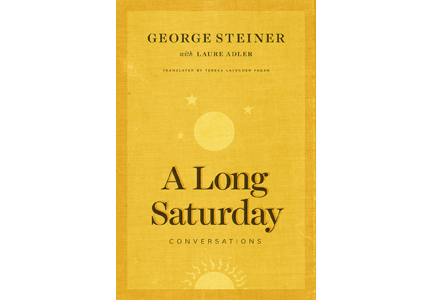
A Long Saturday is a book of conversations with the French journalist and biographer, Laure Adler, first published in France in 2014. It now appears in translation and provides an excellent introduction to Steiner’s major preoccupations over 60 years.
The interview begins with Steiner’s background. Born in Paris in 1929, he escaped with his parents to New York in 1940. He studied at Chicago and Harvard before going to Oxford and then spent most of his academic career at Churchill College, Cambridge. A number of things emerge from these early years. Steiner grew up trilingual. His Viennese parents spoke German, he was educated in French and learned English in wartime America. His parents loom large over his account of his early years. “The decisive factor in my life was my mother’s genius,” he tells Adler. But it was his father who made him watch French crowds shouting “Kill the Jews!” as they marched through Paris. It was also his father who put Proust’s A La Recherche du Temps Perdu tantalisingly out of reach so that his precocious son would want to reach for the book and begin his lifelong affair with great literature. What emerges is a childhood soaked in high culture: classical concerts, his father’s library full of great literature, learning Latin and Greek (not Hebrew, a lifelong regret), and a secular, cultured Jewishness.
The rest of the book explores Steiner’s chief preoccupations. There are chapters on Judaism, language, the Bible and literature, and the great paradox of the humanities: “Is it possible . . . that the humanities can make us inhuman? That far from making us better (to put it naively), far from sharpening our moral sensibility, they dampen it?” This leads us to a question which has been at the heart of Steiner’s writing since Language and Silence, published 50 years ago. Steiner tells Adler:
. . . the death camps, Stalin’s camps, the great massacres, didn’t come from the Gobi desert; they came from the high civilisations of Russia and Europe, from the very centre of our greatest artistic and philosophical pride; and the humanities put up no resistance.
Like this article? Share, save or print using the icons below:


- Cultural Climate Change
- Opposites meet in the land of Scrugletopia
- The Battle Against The Philistines Never Ceases
- Can Macron Save France — Or Is He Its Undertaker?
- Home from home for the Bolshevik elite
- Why France Is Revolting Against The Ancien Regime
- How The EU Elite Paved The Way For Populism
- A Decent Woman Betrayed By Her Gruesome Twosome
8:05 PM
8:05 PM
1:05 PM
8:04 AM
3:04 PM
10:04 AM
9:04 AM