



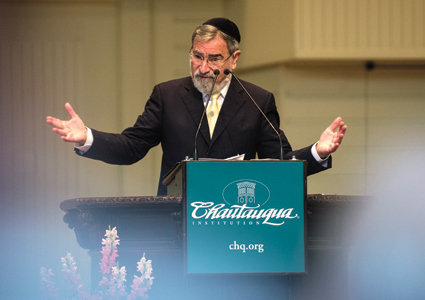
“It’s not a matter of more religion or less religion”: Rabbi Lord Sacks at the Chautauqua Institution (© Olivia Sun/The Chautauquan Daily)
There is an old Chinese curse which goes, “May you live in interesting times.” We are living in interesting times. Sometimes, I think the world has gone so crazy that the best account of it was that wonderful remark by Woody Allen: “More than any other time in history, mankind faces a crossroads. One path leads to despair and utter hopelessness, the other to total extinction. Let us pray we have the wisdom to choose correctly.” Well, that’s how it seems sometimes.
Or it seems like my favourite Jewish text of all time, which goes, “Start worrying. Details to follow.” Because the truth is we are living through one of the most profound revolutions in all of human history. It is a time of political economic and social change brought about by the internet; a revolution which is the greatest and most fateful since the invention of printing in the West in the 15th century. I sum it up in a single phrase: “Cultural climate change.” We are worrying about our physical climate change and that climate change doesn’t just make things warmer. What it does is produce more extreme weather conditions, and so it is with cultural climate change. It’s not just extreme heat, but sometimes it expresses itself in the cold and the wind and the rain. An old pattern that has governed the West for four centuries is broken. A new one has not yet emerged and it has brought great damage to that spiritual experience that is our ozone layer. The result is a revolution, which goes in many directions about the role of religion in society.
It is not so much a matter of more religion or less religion because the truth is, both are happening at once: a lot of people getting more religious, a lot of people getting less religious. The result is a series of storms in the West and even more so elsewhere, in the Middle East, Asia and Africa. I want to say why I think it has happened and what we can do about it to save the planet from cultural climate change.
So first of all, let me analyse what is happening. The simplest answer I can give is that the West had three master narratives which we have held since the 17th or 18th century. Today, they have all broken down. Those three master narratives are, first: the world is getting progressively more secular. Second: the world is getting more Westernised. Third: to survive in the contemporary world any religion has to accommodate to society. It has to go with the flow. Those three stories have held for four centuries. But today each one of them is breaking down.
Let us take them one by one. The secularisation thesis has been functioning for four centuries. It has four dimensions, one for each century. First of all came the 17th century, which saw the secularisation of knowledge. In science, there was Newton. In philosophy, there was Descartes, both of whom were not irreligious or anti-religious. They were very religious indeed, but they sought to base knowledge on non-doctrinal foundations. That’s the essence of Newtonian physics and Descartesian philosophy.
Like this article? Share, save or print using the icons below:


More Text
- Self-Deception
- New Poetry
- The Fate Of The West
- Monks, Magi and Mosques: Religion on the Silk Road
- The Rest Is Silence
- The Sacred And The Secular In Contemporary Art
- Siege
- Regulating Markets In An Economy Without Angels
- Birth Mother
- Europe and the Nation State: Thoughts on Ortega y Gasset
- Seven New Poems
- Rediscovering Our Moral Purpose
- Our Strength And Stay
- Three Poems By Heinrich Heine
- Two Poems From Spain
- Why Only Countries Willing To Take Risks Will Survive And Prosper
- From The Berlin Wall To Brexit: Why Politics Needs A Free Press
- Saying Yes To Sara
- The Viagra Triangle
- Two Languages And The Chasm Between Them
Popular Standpoint topics

- Cultural Climate Change
- Opposites meet in the land of Scrugletopia
- Home from home for the Bolshevik elite
- Can Macron Save France — Or Is He Its Undertaker?
- Sweet singing in the choir
- A portrait of the artists as a pair of young wastrels
- Last Of The Great Elitists
- A Decent Woman Betrayed By Her Gruesome Twosome
11:10 AM
5:09 AM
9:09 AM
2:09 PM
1:09 PM
4:09 AM