


I love Europe in spite of the European Union. I love Europe because, as Charles de Gaulle declared, it is a Europe of nations. I love Europe because it comprises some 50 countries, just over half of them members of the EU, each one a unique, irreplaceable microcosm of mankind. I love Europe because it abhors the uniformity of tyranny and the tyranny of uniformity. I love Europe because no region on Earth is more resistant to rule from above. I love Europe because I despise those who wish to abolish its distinctive diversity and turn it into a feeble imitation of the United States.
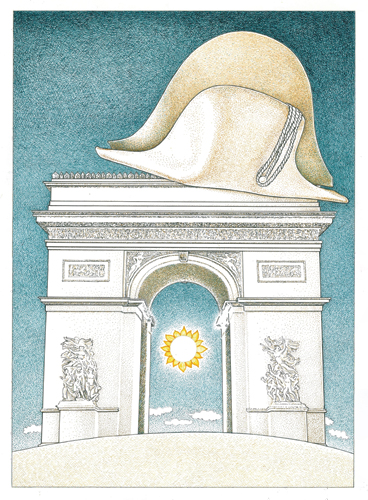
(Cover illustration by Michael Daley)
Europe’s architectural simulacrum is the Arc de Triomphe: magnificent in conception, monumental in scale — and monstrous in practice. It was built to celebrate Napoleon’s victories; it was the high point of Hitler’s triumphal tour of Paris. Our continent has witnessed the cruelest spectacles in human history, from religious persecution to world war and genocide. Now its most ambitious political organisation so far, the European Union, claims to set an example to the world, undertaking the greatest political experiment of all time by banishing not merely violence itself but the intellectual causes of violence, above all nationalism. In practice, though, these pacific claims are belied by the quasi-imperial tendency to centralisation that is in constant tension with the centrifugal forces of national, religious or cultural identity.
All these conflicting emotions swirled around last month’s centenary of Armistice Day, the end of the Great War. In London, the annual ceremony took place at the Cenotaph, with the Queen (now 92 and the only head of state to have actively participated in one of the world wars) watching from a balcony and the Prince of Wales laying a wreath on her behalf, and the German President also present — an unprecedented gesture that yet aroused no controversy. The Prime Minister of course attended too, giving her a good excuse to be the only absentee among the Allies from the commemoration in Paris.
This was a much grander affair, with 60 leaders including the presidents of Russia and the United States. It took place in the shadow of the Arc de Triomphe, surely the world’s most ostentatiously martial monument, even though the tomb of the unknown soldier lies beneath it. The highlight was neither prayers of reconciliation nor wreath-laying nor the two-minute silence, but a speech by Emmanuel Macron. It was a rare opportunity for the Président de la République quite literally to look down on the global elite, and he delivered an oration intended to remind the world that in France, at least, presidents still know the value of eloquence.
Like this article? Share, save or print using the icons below:


More Features
- The Troubles cast a shadow over Brexit
- South of the border, China holds sway
- Academic pawns in the game of Orban v. Soros
- A brief glimpse of Corbyn’s Utopia
- Memories of a long lost Jewish world
- Wholesome homes are better for all of us
- A brief light on a field of shades
- Brexit may trigger a European revolution
- Wrong turn — or an inevitable process?
- Brexit and the UK constitution
- Wanted: a post-Brexit vision of national life
- How can Theresa May survive Brexit?
- Disestablish the C of E? Ask Corbyn
- Angry anthems of a doomed war poet
- In Corbyn’s mind, there is no place for the Jews
- The last Republican in the age of Trump
- A martial nation needs Churchill to inspire us
- Death of a bookman: the rise and fall of a publisher
- The inevitability of Fortress Europe
- Why the World Cup is a game of tribes
Popular Standpoint topics

- Is South Africa about to fall apart?
- The inevitability of Fortress Europe
- The devout sceptic: hope for those of little faith
- Corbyn waves the flag of anti-Semitism
- In Corbyn’s mind, there is no place for the Jews
- Is the mental illness epidemic just a myth?
- Viennese rooms with a point of view
- How Monet created motion pictures
3:12 PM