


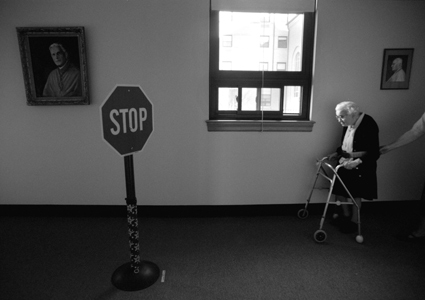
 Ageing with grace: Participants in David Snowdon's long-term study of nuns, exploring the relationship between personality and dementia
When I started training in psychiatry in the late 1980s my plan was to specialise in child and adolescent disorders. Instead, I was drawn into a research project examining mental illness in older people living at home. That in turn drew me into a peculiarly British speciality, the psychiatry of old age. (As far as I am aware, only the British Isles, Australia, New Zealand and the Netherlands have developed this as a separate discipline within psychiatry.)
In the 1980s our textbooks still referred to senile and pre-senile dementia as though some conceptually important difference existed between dementia occurring before and after 65. In the intervening two decades the public relations machine which supports medicine, pharmaceutical research and voluntary organisations (like the Alzheimer's Society) has helped to relaunch and publicise a newly-packaged bundle of concepts. Rebranding senile dementia as something largely equivalent to Alzheimer's disease was one of the most important of these. Calling it a disease tapped into our fascination with all things medical and raised the public discussion to a new level of sophistication.
The successful relaunch of dementia as Alzheimer's disease was based on several simplifications. One was the "war" declared by the pharmaceutical industry (and related researchers) on Alzheimer's disease which focused on eliminating the plaques and tangles which accumulate in the brains of those people who eventually suffer the clinical entity known as Alzheimer's.
This generation of medicines is in a trial phase and none is even close to reaching the market. Some have been ineffective, some produced unacceptable side effects and some were quite simply disastrous. A vaccine which recruited the body's own immune system to attack and eliminate amyloid plaques was trialled about ten years ago; it caused death and disability in a number of trial participants, mostly in France, where some powerful families had used their influence to get their relatives into the trial. This particular line of research has more or less dried up.


Post your comment
- Admit It, Mr Kerry: You Blundered
- Bismarck Versus Blair — A Foreign Policy Crossroads
- Arab Spring, Islamist Summer — What Next?
- The Diplomat the Whole World Ignores
- The Blob Has Run Schools For Decades. Not Any More
- Would You Intervene — Or Pass On The Other Side?
- He Died That Others Might Live In Peace
- The Hero's Journey is Hollywood's McMyth
- Online Only: Countering the Counter-Jihadists
- Online Only: The Price Paid for Criticising Islam
- 'Please Sir, I Just Want to Learn More'
- Why Students Should Be Glad To Pay Tuition Fees
- A 'Liberal Racist'? Me? I Felt Like a Heretic
- Demolish the Relics of Yesterday's Future
- Was Britain Right To Go To War In 1914?
- German Victorians Who Helped Transform Britain
- The Alternative History of an Undivided India
- Online Only: Heirs to the Left
- ONLINE ONLY: The Hayward Gallery's Fashionable Primitives
- ONLINE ONLY: A Spiritual Corner of Southwark

- The Zombie Argument that Refuses to Die
- Online Only: The Price Paid for Criticising Islam
- Overrated: Dan Brown
- Overrated: George Monbiot
- Is the Brain the Key to Understanding Religion?
- 'Please Sir, I Just Want to Learn More'
- An Assault on Free Speech at the LSE
- The Alternative History of an Undivided India
- The Zombie Argument that Refuses to Die
- Online Only: The Price Paid for Criticising Islam
- Overrated: Dan Brown
- Overrated: George Monbiot
- Is the Brain the Key to Understanding Religion?
- 'Please Sir, I Just Want to Learn More'
- An Assault on Free Speech at the LSE
- The Alternative History of an Undivided India
- Decline and Fall of the History Men
- Uncritical Theorists Who Misread the Nazis
- The Zombie Argument that Refuses to Die
- The Banality of Hannah Arendt
- From Kitsch to Cool: Picasso and Modern Art
- Is the Brain the Key to Understanding Religion?
- Time to Wise Up to the Muslim Brotherhood
- Midfield Virtuoso Finds His Perfect Pitch
- Online Only: The Price Paid for Criticising Islam
- Overrated: George Monbiot
- Letter from Ukraine: Reviving Lost Literature
- On Pilgrimage with the Hasids
- The Blob Has Run Schools For Decades. Not Any More
- Tsar Of The Holy Land
- Bismarck Versus Blair — A Foreign Policy Crossroads
- My Dieting Guide: Listen To Mother