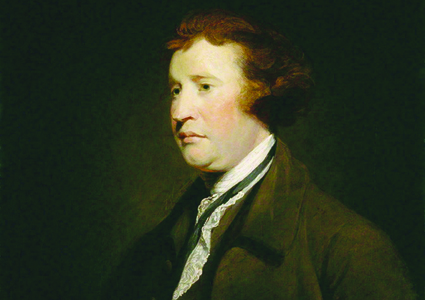
Edmund Burke: His thoughts are relevant to our present discontents
Of all the great British political thinkers, only Burke has any present currency. Hobbes and Locke both possessed arguably more penetrating minds, and Mill wrote on issues that are more germane to our current preoccupations. Yet, for all their superiority of intellectual equipment or apparent relevance, these writers are not living presences in our political culture in the way that Burke, however tenuously, still seems to be. Modern politicians still reflect on Burke, and the more literate among them (such as Jesse Norman) even still write about him. By contrast, Hobbes and Locke are firmly imprisoned in the Schools. Academics love to pore over their subtleties, so vividly practical as they were in the 17th century, so utterly estranged as they now are from any present urgency. Backroom policy aides are occasionally interested in Mill, but I have never met a practising politician who was. And fascinating political thinkers such as Harrington, Selden, Bolingbroke, Hume, Coleridge and Arnold are today all but forgotten even by academics. Why should it be that Burke alone still has the power to engage, even if only infrequently, the current political class? And what does that enduring power tell us about the nature and scope of Burke's achievement?
The probing and subtle first volume of David Bromwich's The Intellectual Life of Edmund Burke: From the Sublime and Beautiful to American Independence (a second volume will consider his writings on India and France) helps us glimpse the sources of Burke's surprising longevity. Bromwich begins by offering sharply intelligent readings of the two books Burke published in the 1750s: his disingenuous imitation of Bolingbroke in A Vindication of Natural Society, and his influential treatise on aesthetics, A Philosophical Enquiry into the Origin of Our Ideas of the Sublime and Beautiful. Bromwich then moves on to consider the more narrowly political writings generated by three convulsions of the British body politic in the late 1760s and 1770s: first, the controversy surrounding John Wilkes and the conflict between the rights of parliament and the prerogative of the Crown it set in train; second, the conflict with the American colonies and the loss of Britain's western empire; and finally the Gordon Riots of 1780 and the issues of representation and popular sovereignty which they raised.
As Bromwich points out when explaining his particular angle of approach, his focus is on Burke's ideas as they found expression in his speeches and writings. He aspires to grasp "the originality and continuities of Burke's thinking and not the rise and fall of his fortunes" (those who feel a need to plot the circumstances of Burke's day-to-day life should consult F.P. Lock's recent two-volume biography from OUP, which is unlikely soon to be surpassed on that score); and he hopes also to provide a more adequate account of "the scope and depth" of Burke's genius for those who are presently acquainted only with Reflections on the Revolution in France and a handful of speeches. However, that does not mean that Bromwich has confined himself to a seriatim parsing of what we might call the propositional content of Burke's major writings. Bromwich is also concerned to bring out how Burke's conception of his role as a public moralist shaped and conditioned his political interventions.
Bromwich twice quotes Burke's deceptively simple political creed, that "the principles of true politicks are those of morality enlarged, and I neither now do nor ever will admit of any other." This biography can be viewed as a careful unpacking of the varying implications of that stance, as Burke both adhered to it, and attained a deeper understanding of its meaning, over the course of his career in public life. Bromwich's Burke is not the evasive pragmatist who has been conscripted as the founding father of conservatism (notwithstanding his lifelong adherence to a form — sometimes it must be said a rather idiosyncratic form — of Whiggism).
As Bromwich says, "The portrait of Burke as an anti-theoretical critic of modern politics, a ‘pragmatic' adapter to local needs, has always been overdrawn. The truth is that he cherished certain abstract ideals unconditionally." Bromwich is committed, in a responsively Burkean way, both to recovering those unconditional commitments and to tracing the sometimes sinous path Burke trod in the attempt to make those commitments operative in politics.
In Burke's quest to understand ever more completely what it might mean for true politics and enlarged morality to be coordinated, language was more than just a medium. As Bromwich points out, for Burke writing and speaking were forms of action, and the consequence is that, for him, language was a means not just of presentation and persuasion, but also of political discovery: "Shakespeare can awaken new thoughts by the force and patience of words; and Burke is the writer of English prose who suggests a similar intuition and command."
A frequent emphasis in the radical ripostes published in the early 1790s to Burke's Reflections on the Revolution in France, such as those written by Mary Wollstonecraft and Tom Paine, is that Burke had no consistency as a political thinker. In the 1790s with his attacks on revolutionary France he had emerged as a defender of monarchy and the hereditary principle; but previously (as in Thoughts on the Cause of the Present Discontents) he had been acutely critical of the growing influence of the British Crown under Bute and George III. In the 1770s and 1780s Burke had been the advocate of the American colonists and had urged Britain towards policies of peace and conciliation, but in the 1790s he had become the unappeasable enemy of the French revolutionaries and the unflinching spokesman for a regicide war to be pursued à l'outrance. The passage of less than a decade had transformed (so it seemed to the radicals) the indignant champion of the Indians suffering under the despotic administration of the East India Company into an apologist for Europe's ancien régime who had nothing but indifference for the hardships imposed on the French people by an absolute monarchy.
Those were telling and effective blows then, and even now they raise stubbornly important questions for the interpretation of Burke's writings and his character as a political thinker. Bromwich's biography promises to be the fullest and most responsibly sensitive account of both Burke's consistency and his ductility that we will ever have. What he reveals is, to be sure, not immobility — Bromwich is scrupulous to underline those moments when something Burke says jars with something else he has said. So, for instance, Bromwich rightly underlines the challenge Burke's early writings on the sublime pose to what would become the cardinal premises of his later political writings:
In Burke's quest to understand ever more completely what it might mean for true politics and enlarged morality to be coordinated, language was more than just a medium. As Bromwich points out, for Burke writing and speaking were forms of action, and the consequence is that, for him, language was a means not just of presentation and persuasion, but also of political discovery: "Shakespeare can awaken new thoughts by the force and patience of words; and Burke is the writer of English prose who suggests a similar intuition and command."
A frequent emphasis in the radical ripostes published in the early 1790s to Burke's Reflections on the Revolution in France, such as those written by Mary Wollstonecraft and Tom Paine, is that Burke had no consistency as a political thinker. In the 1790s with his attacks on revolutionary France he had emerged as a defender of monarchy and the hereditary principle; but previously (as in Thoughts on the Cause of the Present Discontents) he had been acutely critical of the growing influence of the British Crown under Bute and George III. In the 1770s and 1780s Burke had been the advocate of the American colonists and had urged Britain towards policies of peace and conciliation, but in the 1790s he had become the unappeasable enemy of the French revolutionaries and the unflinching spokesman for a regicide war to be pursued à l'outrance. The passage of less than a decade had transformed (so it seemed to the radicals) the indignant champion of the Indians suffering under the despotic administration of the East India Company into an apologist for Europe's ancien régime who had nothing but indifference for the hardships imposed on the French people by an absolute monarchy.
Those were telling and effective blows then, and even now they raise stubbornly important questions for the interpretation of Burke's writings and his character as a political thinker. Bromwich's biography promises to be the fullest and most responsibly sensitive account of both Burke's consistency and his ductility that we will ever have. What he reveals is, to be sure, not immobility — Bromwich is scrupulous to underline those moments when something Burke says jars with something else he has said. So, for instance, Bromwich rightly underlines the challenge Burke's early writings on the sublime pose to what would become the cardinal premises of his later political writings:
The truth is that Burke's idea of the sublime cannot be incorporated with society in any way. Society depends on custom and habit, but a custom or habit of the sublime, if one could conceive of such a thing, would mean an end of the self or an end of society.
The way that Bromwich brings out how Burke's career as a public intellectual begins with a systematic meditation on the aesthetic category which mounts the fiercest possible challenge to the foundations of his later prescriptive politics, so reliant as they are on a positive redescription of prejudice as the habit of reasonable action, prepares us for later moments in his study, when earlier and subsequent comments are juxtaposed, and the flexibility in Burke's opinions is brought out. For instance, in 1790 Burke, replying to Richard Price's sermon "On the Love of Our Country", elaborated what would become a famous interpretation of the Glorious Revolution of 1688 as a defensive manoeuvre brilliantly calculated to disguise or camouflage the revolutionary potential in the various acts of resistance to James II which had led to his violent deposition (itself tendentiously described as an "abdication"). But in November 1771, writing in reply to William Markham, the Bishop of Chester and tutor to the Prince of Wales, and defending his conduct in public life against Markham's attacks, Burke had acknowledged that his party was one of "resistance", and had gone on to argue that the Glorious Revolution had in some way incorporated the principle of resistance as an intrinsic part of the British constitution; for 1688 "could not be supported unless some lesser modes of opposition could also be justified". There is a similar tension between Burke's well-known later scepticism about natural or inherent rights (as expressed in Reflections on the Revolution in France, where they are contrasted with specific, defined, and explicitly granted legal rights) and his description of the Rockingham Whigs in A Letter to the Sheriffs of Bristol as a party committed to "a tradition of progress in the expansion of English rights".
Often a close attention to shifting circumstances can unlock a thread of consistency stretched between apparently opposed utterances. Considering Burke's Speech on the Reform of Representation, probably delivered in 1784, Bromwich notes how its rhapsodic treatment of the British constitution —
— contrasts with the more pungent Whiggism of the Letter to the Sheriffs of Bristol, though the two texts were separated by barely five years. But in 1782 Burke had set his shoulder to a different political wheel — now he was trying to recall the exponents of moderate reform to their senses. As Bromwich says, "That makes a plausible case for his consistency."
If Burke on close and careful inspection was not all sail and no anchor, as his detractors maintained, what are the constant elements in his thought? Bromwich identifies two areas of important recurrent concern. The first is a nuanced formulation of the proper role of the people in the political life of a nation. As one might expect, it is a position tensed between two simpler, but more damaging, poles:
Often a close attention to shifting circumstances can unlock a thread of consistency stretched between apparently opposed utterances. Considering Burke's Speech on the Reform of Representation, probably delivered in 1784, Bromwich notes how its rhapsodic treatment of the British constitution —
Our Constitution is like our island, which uses and restrains its subject sea — in vain the waves roar. In that Constitution I know, and exultingly I feel, both that I am free, and that I am not free dangerously to myself or to others. I know that no power on earth, acting as I ought to do, can touch my life, my liberty, or my property. I have that inward and dignified consciousness of my own security and independence, which constitutes, and is the only thing which does constitute, the proud and comfortable sentiment of freedom in the human breast.
— contrasts with the more pungent Whiggism of the Letter to the Sheriffs of Bristol, though the two texts were separated by barely five years. But in 1782 Burke had set his shoulder to a different political wheel — now he was trying to recall the exponents of moderate reform to their senses. As Bromwich says, "That makes a plausible case for his consistency."
If Burke on close and careful inspection was not all sail and no anchor, as his detractors maintained, what are the constant elements in his thought? Bromwich identifies two areas of important recurrent concern. The first is a nuanced formulation of the proper role of the people in the political life of a nation. As one might expect, it is a position tensed between two simpler, but more damaging, poles:
The people, says Burke, should not be trusted as advisers on policy or even necessarily as true reckoners of their interests in the short run, but they are always the best judges of their own oppression — so much so that we ought to fear any power on earth that sets itself above them.
The second is Burke's undeviating commitment to justice. And it is in relation to the theme of justice that we encounter moments when Bromwich — himself a respected commentator on contemporary American politics — allows his exposition of the 18th-century British scene to resonate with our present discontents. Sometimes these connections with the present are introduced gently by way of an explanatory analogy, as in this helpful guidance about how to grasp Burke's insistence that, in politics, the means must justify themselves, and that consequently means "always alter the character of the actor":
This is clear, although implicit. Eventually, in connection with Burke's insistence that representatives are not delegates and therefore should resist mandates, Bromwich makes an explicit connection with the present:
In moments such as these Bromwich impels us to reflect on what it would mean to make Burke really active now in our political life (as opposed to being an occasionally invoked name in our political discourse).
Really to revive Burke in 21st-century British politics would demand the allocation of a much greater role for the imagination in our public affairs, and a much greater appreciation of the power of the imagination in the actors who bustle in (one hesitates to use the word "govern") those affairs. This in its turn will entail on the part of those actors a much greater understanding of the power of language, not just as persuasion, but more profoundly as a medium for the apprehending of both crises and solutions.
Finally (and lest the lash should seem to fall on only one cohort), really to revive Burke now will require also a much greater power of attentiveness in the populace — or at least that dwindling fraction of the populace for whom politics is something more than a reality television show set in the Houses of Parliament.
Thus, if you justify the torture of suspects in order to assist a war against a wicked enemy, you will find that in doing so you have incorporated torture in your idea of justice. You have come to an understanding with yourself, and the utmost savagery will be compatible with your nature thereafter. You have become one of those who can acquit themselves of any wrong by appealing to a result in a plausible future.
This is clear, although implicit. Eventually, in connection with Burke's insistence that representatives are not delegates and therefore should resist mandates, Bromwich makes an explicit connection with the present:
A representative not only has a duty to resist mandates; he must pry himself loose from intimidation by political threats, popular insurgencies, and all that two centuries later goes under the American name of lobbying.
In moments such as these Bromwich impels us to reflect on what it would mean to make Burke really active now in our political life (as opposed to being an occasionally invoked name in our political discourse).
Really to revive Burke in 21st-century British politics would demand the allocation of a much greater role for the imagination in our public affairs, and a much greater appreciation of the power of the imagination in the actors who bustle in (one hesitates to use the word "govern") those affairs. This in its turn will entail on the part of those actors a much greater understanding of the power of language, not just as persuasion, but more profoundly as a medium for the apprehending of both crises and solutions.
Finally (and lest the lash should seem to fall on only one cohort), really to revive Burke now will require also a much greater power of attentiveness in the populace — or at least that dwindling fraction of the populace for whom politics is something more than a reality television show set in the Houses of Parliament.