


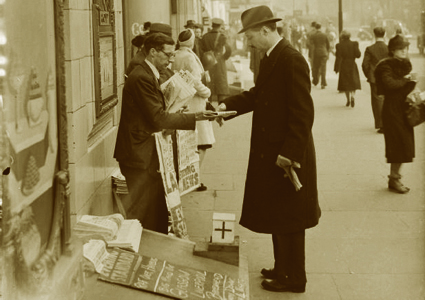
Newspaper vendor, London, 1941: Few are now prepared to pay for their news
I joined the Birmingham Post and Evening Mail group in 1984, the same year Apple advertised the launch of its first personal computer. Ridley Scott showed an athlete smashing a giant image of Big Brother to announce that new technology would break down the old barriers and set us free. I was a young curmudgeon, and sneered at the hubris of corporate advertisers selling a luxury good to hobbyists.
Like novelists, who thought they could survive merely by publishing well-regarded books, or musicians who thought they did not need to be stars, just capable players, I thought the future would be like the past. I assumed journalism would carry on as it had for 150 years: that readers would always want to fund its crafts and subcultures, and be happy to keep specialist magazines and newspapers in business forever.
I did not realise that deciding to be a journalist in the year Steve Jobs shipped out his first Mac was like deciding to be a blacksmith the year Karl Benz built his first automobile. Traditional journalism was over. It had flourished not just because readers paid for newspapers, although that helped, but because everyone from estate agents to employers had to advertise in newspapers and magazines, and everyone from house hunters to jobseekers had to buy them. Now nearly all that classified advertising has gone online to Gumtree, Craigslist and specialist sites that are free or next to free and, well, that seems to be that.
Counts of newspapers that have closed or of dailies that have become weeklies (like the Birmingham Post) are deceptive. A title may still exist. A paper may still appear on the streets. People may still want newspapers, as the vast number of hits on their websites shows, and a few are prepared to pay for news. But without the captive market of advertisers, most local newspapers cannot afford to hire the reporters you need to provide what I still think of as "proper" coverage. Today the Birmingham Post and Birmingham Mail struggle to stay in business. But in 1984 they had a near-monopoly on the city's classified advertising. Their newsroom was the size of a football pitch and held more than a hundred journalists. We reported on every serious crime, and went to every court case, and every council, water and health authority meeting. Public figures looked at us sitting in the press gallery and had to ask themselves what the public might think of their behaviour. In towns and cities across the developed world local and regional reporters, who had been trained to spot news, condense and present it, provided a lowly but essential democratic service.
Now consider this story — or absence of a story — from the Barts Health NHS Trust. It runs Europe's oldest hospital, St Bartholomew's, and one of Britain's toughest, the Royal London Hospital, in the East End. The state has mistreated both. Gordon Brown said that essential rebuilding work must be done under the terms of his disastrous private finance initiative, which tied up a significant portion of the hospital budget. The department of health made matters worse by insisting that the trust bought an expensive computer system that never worked. The waste of public money the government presided over with botched IT programmes and extortionate private contracts was a national news story. The future of the mistreated hospitals was an urgent matter of public concern.
I joined the Birmingham Post and Evening Mail group in 1984, the same year Apple advertised the launch of its first personal computer. Ridley Scott showed an athlete smashing a giant image of Big Brother to announce that new technology would break down the old barriers and set us free. I was a young curmudgeon, and sneered at the hubris of corporate advertisers selling a luxury good to hobbyists.
Like novelists, who thought they could survive merely by publishing well-regarded books, or musicians who thought they did not need to be stars, just capable players, I thought the future would be like the past. I assumed journalism would carry on as it had for 150 years: that readers would always want to fund its crafts and subcultures, and be happy to keep specialist magazines and newspapers in business forever.
I did not realise that deciding to be a journalist in the year Steve Jobs shipped out his first Mac was like deciding to be a blacksmith the year Karl Benz built his first automobile. Traditional journalism was over. It had flourished not just because readers paid for newspapers, although that helped, but because everyone from estate agents to employers had to advertise in newspapers and magazines, and everyone from house hunters to jobseekers had to buy them. Now nearly all that classified advertising has gone online to Gumtree, Craigslist and specialist sites that are free or next to free and, well, that seems to be that.
Counts of newspapers that have closed or of dailies that have become weeklies (like the Birmingham Post) are deceptive. A title may still exist. A paper may still appear on the streets. People may still want newspapers, as the vast number of hits on their websites shows, and a few are prepared to pay for news. But without the captive market of advertisers, most local newspapers cannot afford to hire the reporters you need to provide what I still think of as "proper" coverage. Today the Birmingham Post and Birmingham Mail struggle to stay in business. But in 1984 they had a near-monopoly on the city's classified advertising. Their newsroom was the size of a football pitch and held more than a hundred journalists. We reported on every serious crime, and went to every court case, and every council, water and health authority meeting. Public figures looked at us sitting in the press gallery and had to ask themselves what the public might think of their behaviour. In towns and cities across the developed world local and regional reporters, who had been trained to spot news, condense and present it, provided a lowly but essential democratic service.
Now consider this story — or absence of a story — from the Barts Health NHS Trust. It runs Europe's oldest hospital, St Bartholomew's, and one of Britain's toughest, the Royal London Hospital, in the East End. The state has mistreated both. Gordon Brown said that essential rebuilding work must be done under the terms of his disastrous private finance initiative, which tied up a significant portion of the hospital budget. The department of health made matters worse by insisting that the trust bought an expensive computer system that never worked. The waste of public money the government presided over with botched IT programmes and extortionate private contracts was a national news story. The future of the mistreated hospitals was an urgent matter of public concern.
Like this article? Share, save or print using the icons below:


- Conduct Unbecoming: The Classical Commentaries of Norman Lebrecht in Standpoint
- Propaganda Shouldn’t Pay
- The US Can Still Help Save Syria — and Iraq
- A Putrid Pact between Devils
- Strangers in their own Holy Land
- The Taboo of the Tombola
- Putin has his Useful Idiots on the Left and the Right
- Russian Resurgence has Blindsided Nato
3:06 AM
5:05 AM