


However, I am conscious that as a system of historical explanation, to say that a widespread historical phenomenon such as the institutionalisation of art was the result of the agency of a small number of highly motivated individuals will be viewed by historians as intellectually suspect. There were very obviously wider forces at play.
The first of the wider forces was parliament. It is impossible to ignore the fact that parliament, following a quite heated argument and debate, agreed to the foundation of the National Gallery. It was not just a small group of self-interested individuals who were themselves already deeply involved in the art world, such as George Beaumont and Sir Thomas Lawrence, the then President of the Royal Academy, who led the move to found a National Gallery, but the Prime Minister Lord Liverpool himself, who wrote to the Duchess of Devonshire in support and chose to have himself painted by Sir Thomas Lawrence with the original charter of foundation in his hand. The Chancellor of the Exchequer, Frederick Robinson, known as "Prosperity" Robinson, was able to give grants not only for the foundation of the National Gallery, but also towards the new building by Robert Smirke for the British Museum.
And a young backbench MP, George Agar-Ellis, later Lord Dover, combined his service in parliament with trusteeships of both the British Museum and the National Gallery, the formation of a collection of British art and the editing of Horace Walpole's letters.
In the 1830s, after the Great Reform Act, a new class of idealistic and reforming MPs entered parliament, sparking a tremendous amount of involvement in state policy towards the arts. Peel took a close personal interest in the development of a new building for the National Gallery. There was detailed discussion of its design and cost in debates in the House of Commons. In July 1835, parliament established a Select Committee "to inquire into the best means of extending a knowledge of the Arts and Principles of Design among the people (especially the Manufacturing Population) of the Country; also to enquire into the Constitution of the Royal Academy, and the effects produced by it". It asked for evidence to be heard from both Gustav Waagen, who spoke forcefully in favour of wider public access to the arts and to "the employment of artists in public buildings", and from Leo von Klenze, the court architect of Bavarian King Ludwig who designed Munich's Glyptothek and the Alte Pinakothek.
Nor did this level of parliamentary interest in arts policy diminish in the 1840s. The requirements of decorating the Houses of Parliament were what led to the establishment of the Royal Fine Arts Commission. Prince Albert brought a very Germanic view of the importance of the arts to his role as Prince Consort, collecting the works of Winterhalter and Landseer, and acting as chairman of the Royal Fine Arts Commission. Gladstone, in The State in its Relations to the Church, wrote how the state was able to offer "to its individual members those humanising influences which are derived from the contemplation of Beauty embodied in the works of the great masters of painting." There were further Select Committees to investigate the possible relocation of the National Gallery. Throughout these discussions and debates there was a keen awareness of the educational benefits of museums and galleries and the improving advantages of wider public access to great works of art, which seems to have spanned the political spectrum. In 1844, Joseph Hume, the radical parliamentarian, was able to boast:
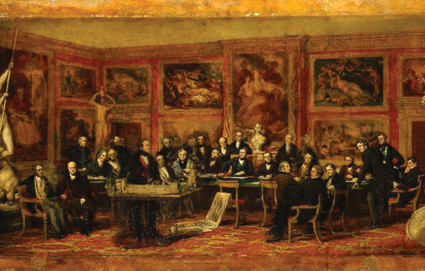
"Study for the Fine Arts Commissioners" (1846), by John Partridge


Post your comment
- Folie à Dieu
- New Poetry
- Adultery?
- Reece Mews
- Robin
- Two New Poems
- Three New Poems
- Freedoms We Risk Losing
- The Legacy of John Maynard Keynes
- Was Crucifixion a Jewish Penalty?
- Sweet Crude
- Four New Poems
- Two New Poems
- My Five Husbands
- Reasons
- Spain (With Apologies to Auden)
- A Ballad of Bo-oz and Ruth
- The True Origins of the Royal Academy
- Three New Poems By Ruth Padel
- A Sequence of Seven Poems by Blake Morrison

- The Zombie Argument that Refuses to Die
- Online Only: The Price Paid for Criticising Islam
- Overrated: Dan Brown
- Is the Brain the Key to Understanding Religion?
- Overrated: George Monbiot
- Time to Wise Up to the Muslim Brotherhood
- 'Please Sir, I Just Want to Learn More'
- The Alternative History of an Undivided India
- The Zombie Argument that Refuses to Die
- Online Only: The Price Paid for Criticising Islam
- Overrated: Dan Brown
- Is the Brain the Key to Understanding Religion?
- Overrated: George Monbiot
- Time to Wise Up to the Muslim Brotherhood
- 'Please Sir, I Just Want to Learn More'
- The Alternative History of an Undivided India
- Decline and Fall of the History Men
- Uncritical Theorists Who Misread the Nazis
- The Zombie Argument that Refuses to Die
- The Banality of Hannah Arendt
- From Kitsch to Cool: Picasso and Modern Art
- Is the Brain the Key to Understanding Religion?
- Time to Wise Up to the Muslim Brotherhood
- Midfield Virtuoso Finds His Perfect Pitch