


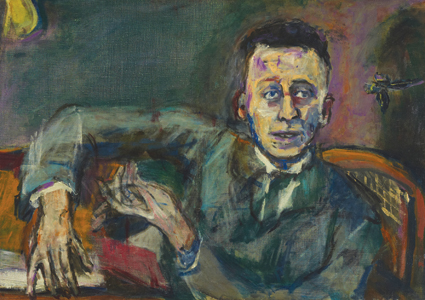
 'Karl Krauss II' (1925) by Oskar Kokoschka: The dark red volumes of 'Die Fackel', which Kraus edited and largely wrote, are as fresh today as when they were first published in Vienna from 1899 to 1936
And it did not entirely cease to exist after 1945. The last embers still glowed in 1974, when I first spent time in Germany as a schoolboy. Heidegger, Ernst Jünger and Carl Schmitt, three of the leading intellectuals of the Third Reich, were still alive and their books were undergoing a renaissance. In 1979-80, I spent time in West Berlin at the Free University, where I heard lectures on fascism by Ernst Nolte, who had been Heidegger's student and had helped to conceal him from the invading French army in 1945. Nolte was a cold fish and his then much admired Der Faschismus in seiner Epoche (translated as Three Faces of Fascism) revealed more than a hint of sympathy for its subject. In the Noltean narrative, demagogues such as Charles Maurras of the Action Française, Benito Mussolini and Adolf Hitler were the inevitable response of a bourgeois society that perceived Lenin's Bolshevism and Stalin's Terror as an existential threat. French anti-Semitic nationalism, Italian Fascism and German National Socialism were elevated on to an abstract, philosophical plane; Auschwitz was seldom mentioned. It did not surprise me when Nolte later unmasked himself as the most sinister of all the revisionist historians. One of his more outrageous canards claimed that a letter from the Zionist leader Chaim Weizmann to Neville Chamberlain in 1939 amounted to a "Jewish declaration of war" against Germany, that justified Hitler in "interning" the Jews of Europe, and the Einsatzgruppen of the SS in carrying out "counter-insurgency" measures against the Jews of the Soviet Union. It is no surprise that Nolte's study of his master, Heidegger, is admiring to the point of hagiography.
Much more important for me than Nolte were the seminars of Jacob Taubes, a Viennese Jew and a Holocaust survivor who built a brilliant career on his doctoral dissertation, Occidental Eschatology, but never published another book in his lifetime. My encounter with Taubes took place in Jerusalem in 1977 at the flat of two philosophers at the Hebrew University, Avishai and Edna Margalit, to whom I was introduced by the writer Naomi Shepherd, then the New Statesman's Jerusalem correspondent and a family friend. (The NS was then still broadly supportive of Israel.) Taubes was in his mid-fifties; his theatrical manner and multilingual eloquence effortlessly impressed a youth of 18. "Come to Berlin and join my seminar," he insisted. Three years later, I did. Half scholar, half seer, he was not the charlatan or "wunderrabbi" satirised by his detractors, but he was invariably attended by attractive women less than half his age. A man of the Left who had been married to Margarete von Brentano, a feminist academic of illustrious lineage, Taubes was nevertheless fascinated by Carl Schmitt, the father of "political theology" who had created the theory that legitimised the Third Reich in its early years. The two corresponded and even met. Schmitt, who was not radical enough for the Nazis, was nevertheless so compromised by association that his career was all but eclipsed after 1945, only to re-emerge in his nineties as the most fashionable political thinker of the transatlantic Left — not least thanks to Taubes.
I still have a few volumes from the 1920s of Hochland, the monthly for which Schmitt wrote during the Weimar Republic, and which under its editor Karl Muth was perhaps the finest Catholic journal in any country. Though it was rewarded for its open-minded stance by being placed on the Index by the Vatican authorities, all the leading German-speaking Catholic theologians wrote for it, including Max Scheler and Romano Guardini, who inspired John Paul II and Benedict XVI respectively. Even though Carl Schmitt later joined the Nazis, most of Hochland's contributors were vehemently anti-Nazi, and it was criticised by Heidegger for flirting with Catholic modernism. It is remarkable that Muth was able to preserve Hochland's independence until as late as 1941, when the Nazis closed it down. The Church's resistance to Hitler was vitiated by the timidity of Pius XII, but even more by the anti-Judaism that permeated Catholic theology. Yet John Connolly has shown in his brilliant study From Enemies to Brothers how Catholic attitudes to Jews were transformed between the Holocaust and the Second Vatican Council, largely thanks to Jewish and Protestant intellectuals who had converted to Catholicism. Hochland was the organ of these Judaeo-Christian circles — a magazine that had tried to defend a catholic (not necessarily Catholic) view of Western civilisation in the teeth of barbarism. Hochland failed, just as the German intelligentsia in general failed, but it paved the way for Catholic repentance after centuries of persecution of the Jews.
By 1987, I was back in Germany, this time as the Telegraph's newly appointed Bonn correspondent. I covered the death of Rudolf Hess, in the aftermath of which numerous Nazis, old and young, re-emerged. As an inexperienced correspondent, I was indebted to this canker of cranks and creeps, because their antics were an inexhaustible source of stories. My editor, Max Hastings, had brusquely dispatched me to John Le Carré's "small town in Germany" with the parting shot: "German politics is boring. Nothing ever seems to happen there of interest to our readers. So you have three months to prove that we need a bureau in Bonn. If you can't, you'll be out of a job." Hess's suicide in Spandau Prison saved my job. So I had a ringside seat for the final years of the Cold War.


- Liberty And Sovereignty
- Art And Public Culture In The 1830s And Today
- The Casanova Of LaSalle Street
- The Writer
- New Poetry
- Cartagena Poems
- A British Subject
- Travels with Betjeman
- Kizerman and Feigenbaum
- Communism’s Comeback?
- Irving Kristol on Jews and Judaism
- The State of Charity
- Teeth
- La Buena Muerte
- Judaeophobia
- Cool It
- Rachmones
- From 'Russia'
- 'Going Out' and Five Other Poems
- 'The Ship of Endurance' And Three More New Poems

3:12 PM