


In the end, Moulin prevailed because the Resistance leaders were even more suspicious of each other than of London. The first meeting of the CNR took place on 23 May with Cordier waiting outside in the street. But the Resistance leaders had not given up their hostility to Moulin, and in his final pages Cordier depicts an increasingly exhausted and isolated Moulin. Cordier last saw him on 15 June, and a week later he heard of his arrest. The book ends there — with a post-war coda when Cordier discovers to his amazement that the man for whom he had worked had been a "mere" prefect, not a minister, ambassador-or painter.
Cordier's book is a remarkable achievement, but it is not without problems. It is inconceivable that anyone could remember in such detail what he was doing and thinking almost every day. There are long conversations which can only be-as he admits-approximate reconstructions. Sometimes he reports people conveying to each other pieces of information they would simply not have needed to tell each other-but which are necessary for the comprehension of the modern reader. The words put in the mouths of the main protagonists are clearly reconstructions in dramatic form of the arguments they might have used. The book would make a wonderful film.
Of course, all memoirs contain a dose of artistry and reconstruction, but Cordier as an historian has made it his mission to prioritise the veracity of the written archive over the frailties of memory. Cordier's rigour regarding historical evidence was most in evidence during a painful affair that exploded regarding the resisters Lucie and Raymond Aubrac. Raymond had been arrested along with Moulin, but because the Germans never discovered his true identity he was sprung from prison in a daring plot hatched by his wife. When Klaus Barbie, the Gestapo chief in Lyons, was put on trial in 1987, he threatened to reveal all kinds of betrayals in the Resistance. In particular, Barbie suggested that Raymond Aubrac might have betrayed Moulin. Nothing came of this, and the consensus among historians (including Cordier) remains that Moulin was betrayed by a resister named René Hardy, even if this could never be proved. Lucie Aubrac certainly believed it, as she tried to have Hardy poisoned in 1944. The matter seemed to be concluded, until a French journalist, Gérard Chauvy, wrote Aubrac: Lyon 1943 (Albin Michel, 1997), in which he suggests that in their various versions of their story the Aubracs had never told the whole truth. To clear their name, they asked to testify before a panel of historians-among them Cordier. To their consternation, this confrontation turned into something approaching a trial. The historians, while not accrediting the idea the Aubracs had betrayed anyone, mercilessly dissected the inconsistencies contained in Lucie Aubrac's memoirs. No one was more severe than Cordier. He commented that he was reminded of Zola's comment on Dreyfus, who so disappointed his supporters when they actually met him: "It is enough to make you despair of the innocent."
Yet now Cordier has produced a memoir that certainly contains considerable imaginative reconstruction. On what is this based? Sometimes, evidently, his own memory, but sometimes presumably he uses the historical record (as established often by him) to recall exactly where he was on a particular day. This raises the question whether his own massively researched history was not itself already affected by his negative personal memories of the Resistance leaders. Was Cordier the historian affected by Cordier the member of the Resistance? Is Cordier the memorialist remembering the events or, at least partly, his history of the events? None of this is to discredit the remarkable historical work that Cordier has achieved. But we must not assume that his savage portrait of the Resistance leaders — either in his history or in his memoirs — is the last word on the subject.
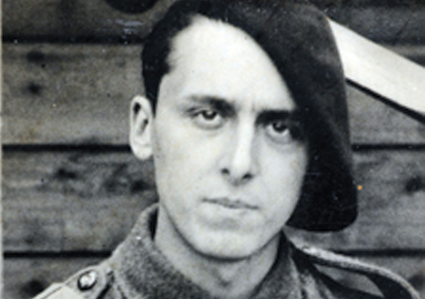
Jean Moulin's Resistance aide: Daniel Cordier in England (July 1940)


- Online Only: Heirs to the Left
- ONLINE ONLY: The Hayward Gallery's Fashionable Primitives
- ONLINE ONLY: A Spiritual Corner of Southwark
- ONLINE ONLY: Castles in Spain
- Time to Wise Up to the Muslim Brotherhood
- The BBC’s Groupthink on Immigration Stinks
- Decline and Fall of the History Men
- The Banality of Hannah Arendt
- Banging On About Europe is a Winner
- Britain Will Leave the European Union — Hélas!
- The Flawed Logic Of Our Abortion Laws
- We Owe Tom Sharpe a Thousand Laughs
- Midfield Virtuoso Finds His Perfect Pitch
- ONLINE ONLY: Overpopulation and the Reality of Grandchildren
- ONLINE ONLY: Sharia Threatens All Women, Muslim and Non-Muslim
- ONLINE ONLY: The Last Days of the Divvy
- A Party Overrun by Lads and Libertines
- The Myth of Cameron's Etonian 'Chumocracy'
- Here Lie the Remains of Tory Modernisation
- Forget 'Islamophobia'. Let's Tackle Islamism

- The Zombie Argument that Refuses to Die
- Overrated: Dan Brown
- Forget 'Islamophobia'. Let's Tackle Islamism
- Decline and Fall of the History Men
- Time to Wise Up to the Muslim Brotherhood
- ONLINE ONLY: Academic Boycotts Teach Us Nothing
- The Banality of Hannah Arendt
- Britain Will Leave the European Union — Hélas!
- The Zombie Argument that Refuses to Die
- Overrated: Dan Brown
- Forget 'Islamophobia'. Let's Tackle Islamism
- Decline and Fall of the History Men
- Time to Wise Up to the Muslim Brotherhood
- ONLINE ONLY: Academic Boycotts Teach Us Nothing
- The Banality of Hannah Arendt
- Britain Will Leave the European Union — Hélas!
1:04 PM
8:02 AM
11:02 AM
5:01 PM
10:01 AM
10:01 PM
4:01 AM
1:12 AM
9:12 PM
8:12 PM