


As we approach the 70th anniversary of Charles de Gaulle's historic broadcast from London on 18 June 1940 that inaugurated the French Resistance, interest in the story remains undiminished. It is, though, increasingly difficult for the French to fit the Resistance into their collective memory of this difficult period. There is a prevalent British misconception that the French exaggerate their glorious Resistance exploits-everyone claiming a "resister" in the family-in order to gloss over the darker aspects of the Occupation. In truth, those darker aspects are as present in public discussion today as the Resistance. Every school in Paris has a plaque reminding people of the role played by the Vichy state in the deportation of the Jews.
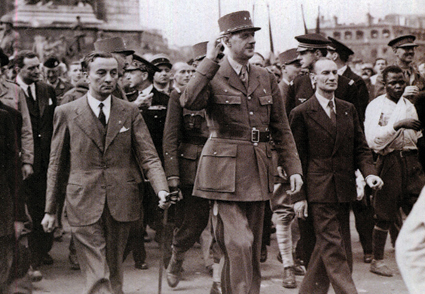
General de Gaulle and Georges Bidault (left) stride down the Champs Elysées after Paris's liberation on 26 August 1944
The French President, Nicolas Sarkozy, on the other hand, has attempted to refocus attention on the Resistance. His first presidential decision was to instruct teachers to read to their junior classes every year a letter written from prison by the 17-year-old Resistance fighter Guy Môquet on the eve of his execution. Soon afterwards, Sarkozy visited the Plateau of Glières, site of a major Resistance uprising in 1944. This has led to accusations that Sarkozy is shamelessly annexing the Resistance to his cause. A film has just opened in Paris telling the story of Walter Bassan, a communist fighter at Glières, who was deported to Dachau. Now aged 82 and as vigorous as ever, Bassan argues in the film that Sarkozy's policies, especially its attacks on illegal immigrants, are a betrayal of the values he had joined the Resistance to defend.
The Resistance continues to excite the imagination because of its sheer drama and mystery. Nowhere are all these elements more perfectly encapsulated than in the story of Jean Moulin. As Prefect of Chartres in 1940, Moulin attempted suicide rather than sign a German document blaming Wehrmacht atrocities on black French troops. In October 1941, Moulin arrived in London-the most senior official to have joined de Gaulle up to that date-and returned to France as de Gaulle's representative to the Resistance movements. He was captured by the Germans on 21 June 1943 and died after atrocious torture. Moulin's emblematic status was consecrated in 1966 when de Gaulle's government transferred his remains to the Pantheon. On the day of his Presidential inauguration in 1981, François Mitterrand paid homage to the tomb of Moulin. In doing so, Mitterrand, who had himself been a Resistance member (after first supporting Vichy), sought to reclaim Moulin from Gaullism. Yet Moulin remains a controversial figure. Some former fighters accuse him of emasculating the "true" Resistance for de Gaulle's purposes. Others claim he was a crypto-communist, even a Soviet agent, and one recent book argues that on the eve of his capture he was about to desert de Gaulle and go over to the Americans.
Last summer saw the publication of the memoirs of Moulin's former secretary in the Resistance, Daniel Cordier. It is not the first time that Cordier has written on Moulin. After 1945, Cordier put his Resistance years behind him to become a modern art dealer-a passion he learnt from Moulin. In 1977, when participating in a television debate, he found himself confronted with the former Resistance leader Henri Frenay, who accused Moulin of crypto-communism. Lacking arguments to counter this accusation, Cordier embarked on a quest to determine the truth about the man he had served. Twenty years of indefatigable research produced four volumes on Moulin's life, running to almost 4,000 pages. Now, however, Cordier has moved from the register of history to that of memory: he tells his own story. His memoir has been a bestseller as well as winning literary prizes. It is one of the most brilliant memoirs of the Resistance ever written, offering us innumerable insights — but it also raises problems about the relationship between history and memory.


- Admit It, Mr Kerry: You Blundered
- Bismarck Versus Blair — A Foreign Policy Crossroads
- Arab Spring, Islamist Summer — What Next?
- The Diplomat the Whole World Ignores
- The Blob Has Run Schools For Decades. Not Any More
- Would You Intervene — Or Pass On The Other Side?
- He Died That Others Might Live In Peace
- The Hero's Journey is Hollywood's McMyth
- Online Only: Countering the Counter-Jihadists
- Online Only: The Price Paid for Criticising Islam
- 'Please Sir, I Just Want to Learn More'
- Why Students Should Be Glad To Pay Tuition Fees
- A 'Liberal Racist'? Me? I Felt Like a Heretic
- Demolish the Relics of Yesterday's Future
- Was Britain Right To Go To War In 1914?
- German Victorians Who Helped Transform Britain
- The Alternative History of an Undivided India
- Online Only: Heirs to the Left
- ONLINE ONLY: The Hayward Gallery's Fashionable Primitives
- ONLINE ONLY: A Spiritual Corner of Southwark

- The Zombie Argument that Refuses to Die
- Online Only: The Price Paid for Criticising Islam
- Overrated: Dan Brown
- Overrated: George Monbiot
- Is the Brain the Key to Understanding Religion?
- 'Please Sir, I Just Want to Learn More'
- An Assault on Free Speech at the LSE
- The Alternative History of an Undivided India
- The Zombie Argument that Refuses to Die
- Online Only: The Price Paid for Criticising Islam
- Overrated: Dan Brown
- Overrated: George Monbiot
- Is the Brain the Key to Understanding Religion?
- 'Please Sir, I Just Want to Learn More'
- An Assault on Free Speech at the LSE
- The Alternative History of an Undivided India
- Decline and Fall of the History Men
- Uncritical Theorists Who Misread the Nazis
- The Zombie Argument that Refuses to Die
- The Banality of Hannah Arendt
- From Kitsch to Cool: Picasso and Modern Art
- Is the Brain the Key to Understanding Religion?
- Time to Wise Up to the Muslim Brotherhood
- Midfield Virtuoso Finds His Perfect Pitch
- Online Only: The Price Paid for Criticising Islam
- Overrated: George Monbiot
- Letter from Ukraine: Reviving Lost Literature
- On Pilgrimage with the Hasids
- The Blob Has Run Schools For Decades. Not Any More
- Tsar Of The Holy Land
- Bismarck Versus Blair — A Foreign Policy Crossroads
- My Dieting Guide: Listen To Mother
1:04 PM
8:02 AM
11:02 AM
5:01 PM
10:01 AM
10:01 PM
4:01 AM
1:12 AM
9:12 PM
8:12 PM