


At this point, though, we cannot dodge the question that keeps recurring. I looked up the whole text of Collins's speech on Google, ditto "The Way through the Woods", though we have a Collected Kipling upstairs. A couple of weeks ago, when I wanted to check Bagehot's remark that "banking is a watchful but not a laborious trade", I could not find it in any edition of the ODQ, or in any other dictionary of quotations, but found it instantly on the net, plus the entire text of Lombard Street, in which the phrase appears. Is it any coincidence that the quotation the publisher chose for the front of the dust-jacket should be "A glorious treasure house for browsers"? Browsing for pleasure rather than checking for reference does seem destined to be the future of this magnificent volume.
If the net unmistakably poses a threat to the ODQ, what does it do to the Oxford Companion to English Literature? The new Companion, edited by the literary critic and Ruskin expert Dinah Birch, is an equally sumptuous volume, worthy to stand beside Sir Paul Harvey's first edition of 1932 and Dame Margaret Drabble's fifth and sixth editions of 1985 and 2000. The new edition is notable for including every modern English writer that you might wish to know about and a few that you might not. Birch signals recent alterations and additions to the literary scene by prefacing her volumes with four competent and informative essays by Hermione Lee and others on the novel, black British literature, children's literature, and cultures of reading. And she ends it with a huge chronology of literary events and publications from 1000AD to 2008. The whole enterprise is so skilfully managed that I could not really detect what had been removed to make room for all this. The entries on literary movements and technical terms are certainly not skimped. I found the entries on foreign writers and movements — always one of the Companion's strong points — as abundant and authoritative as ever. But again we have to ask: how do they compare with Wikipedia? Are they more accurate, fuller, better written, more insightful?
I took half-a-dozen sample entries to compare with their counterparts on Wikipedia: the Victorian periodical The Academy, Kathy Acker, J. R. Ackerley, Rodney Ackland, once known as "the English Chekhov", Peter Ackroyd and anacoluthon. In each case, the conclusion was unmistakable: whether dealing with the now obscure Ackland, the cult figure Acker or the celebrated Ackroyd, Wikipedia provided a great deal more information of every kind: biographical details, dates, lists of works, critical verdicts etc. In the case of The Academy and of anacoluthon, the history and derivation were spelled out at far greater length than the Companion had room for. Only when it came to literary judgments did the Companion sneak back into contention. If you want facts, go to Wikipedia. If you want to know what someone's writing is actually like, then the Companion may well be better, as well as crisper. But even this slender literary lead, will, I suspect, melt away as Wikipedia's entries are refined and reinforced. As for the famous unreliability of Wikipedia entries, I could see little sign of it — and have not for some time now in other fields as well.
The ODQ and the Companion each weigh in at 4lbs 12oz. I am delighted to have both of them on my shelves alongside their predecessors, but how many yards will I walk to lift them up, when the answer I am looking for is more likely to lie at my fingertips?
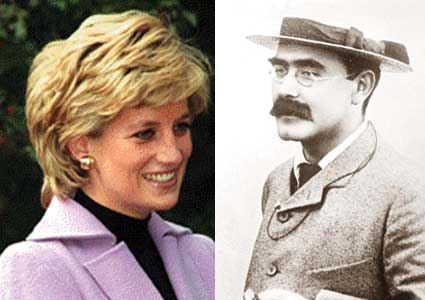
Newcomer Diana; Kipling downgraded


