



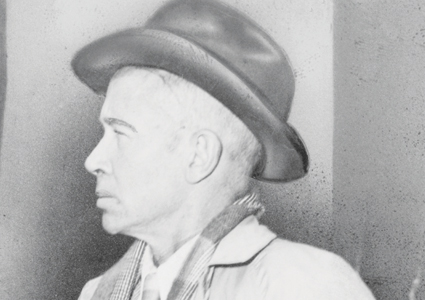
 E.E. Cummings: Part modernist, part traditionalist
A terrible crisis has overwhelmed poetry — but before we come to that, a clarification about typography. It's E.E. Cummings, and not ee cummings. Cummings preferred the conventional spelling of his name, which reminds us that his experiments with language were more than gimmicks. The lower-case i, for instance, was his way to become like a little child, as he implied in one of his last poems:
who are you,little i
(five or six years old)peering from some highwindow;at the goldof november sunset(and feeling:that if dayhas to become nightthis is a beautiful way)
What happens next, though, is truly exciting. Cummings begins to put the two ways of writing together. A good modernist, he carries on breaking up language to make it new: not just showing the reader that "loneliness", for instance, is composed of the word "one", the quality of "iness", and two lonely l's, but making the reader feel that this matters. A good traditionalist, he carries on using rhyme and metre, knowing that some things just cannot be said without them. And bringing together the ancient and the avant-garde, he converges on a style as natural sounding as ordinary language, but able to express what ordinary language falls short of:
somewhere i have never travelled, gladly beyondany experience,your eyes have their silence:
Anyone who recalls Michael Caine's character embarrassing himself in Hannah and Her Sisters will also remember this poem's closing line, one of the sweetest and strangest compliments in all poetry: "nobody,not even the rain,has such small hands". Cummings had an unusual gift for love poems, and a near unheard — of gift for happy poems. "Happiness writes white," said Montherlant, an axiom quoted with predictable approval by Philip Larkin. Yet Cummings's best-loved lines, frequently as memorable as Larkin's, have a gravity-defying carefreeness about them: "wholly to be a fool / while Spring is in the world / my blood approves"; "the thing perhaps is / to eat flowers and not to be afraid"; "I'd rather learn from one bird how to sing / than teach ten thousand stars how not to dance".


Post your comment

- Islam and the French Republic
- Why On Earth Should Anyone Study Philosophy?
- The Dying Days Of Zuma's South Africa
- His Master's Voice: Scruton On Wagner
- Why The Most Civilised Of Men Felt Like A Fraud
- Political Misconduct
- Cicero's Analysis Of Decline Offers Lessons For The West
- Trump's Appeal Is More Roosevelt Than Reagan