


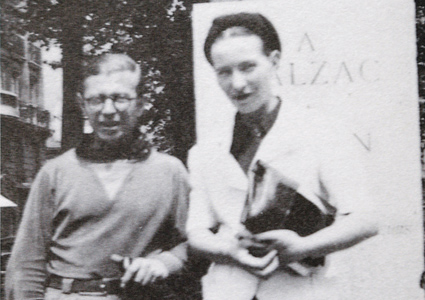
 I think, therefore I am left-wing: Jean-Paul Sartre and Simone de Beauvoir in the 1930s
How the British Think would make a strange title for a book — at least that is what my friends in Britain tell me. But when it comes to investigating the French way of life, an exploration of French thought is more justified. Thinking, it seems, is part of France’s history and one of the characteristics the French are famous for.
In his latest book, How the French Think, Sudhir Hazareesingh, Tutorial Fellow of Balliol College, Oxford, and a fin connaisseur of French politics, shares his deep knowledge of the French passion for the intellectual quest. In exploring with sharpness and humour the patterns of thought the French have developed over the centuries, he finds some interesting and unexpected relationships between eras and personalities, and explains France’s intellectual evolution. The book is rich in information and anecdotes and easy to read, and it shows a love of France — it is subtitled “An affectionate portrait of an intellectual people” — which is rare today.
The French are rationalists, and like abstraction; they divide the world into right and wrong, and of course between Left and Right; they are fond of utopianism and believe — or believed — in progress and science. Hazareesingh shows how the main channels of French thought — for example, the revolutionary and the republican — have always coexisted with their opposite creeds — the reactionary and the religious — and share with them the same faults and qualities. Inevitably, a significant part of the book is devoted to the “intellectual”, the famous scholar, preferably living in Paris, who regularly intervenes in public matters because his quasi-spiritual position gives him the right, and even the duty, he thinks, to do so.
But today, according to Hazareesingh, because of the end of Communism, which was deeply rooted among French intellectuals, the fading of structuralism, and anxiety about France’s identity in a globalised world, the French have come to doubt themselves and their intellectual destiny. This can be seen in the decline of France’s intellectual life and in its fading intellectual influence in the world.
I think that the situation is even more depressing than that. Although Hazareesingh recognises that French intellectuals have lost some of their past lustre, he still reckons that “French culture is in many respects more open and transnational than ever” and states that creative fiction is thriving. It is true that there are still great French writers and thinkers, and that newer disciplines like economics offer new kinds of talents. But as a cultural phenomenon, I don’t think that French thought has survived.
France was never such a thing as an entire nation of thinkers; it would be absurd to say that. But there was a deep respect among ordinary people for the cultivated elite, which included politicians and teachers. Now a large part of this elite pays no attention to culture any more, as is shown by the poverty of their language. One cannot help comparing the eloquence of, say, Charles de Gaulle, and the spiritual vacuum that someone like François Hollande represents. De Gaulle said, “Hardship attracts the man of character, as it is in grasping it that he fulfils himself”; and “As for power, I couldn’t leave it before it leaves me.” Hollande says, “There will be a support that will be made” or “Soldiers, they undertake perilous missions”. (Hollande is very fond of repeating the subject of a sentence, as three-year-olds do; I hope my translation conveys its full infantile flavour.) Or open any recent fiction or non-fiction publication in French: the vocabulary range is shrinking, the sentences are three words long and the form is always fashionably deconstructed — but not à la Derrida.


4:06 PM
3:06 PM
3:06 PM
12:06 PM
10:06 AM