


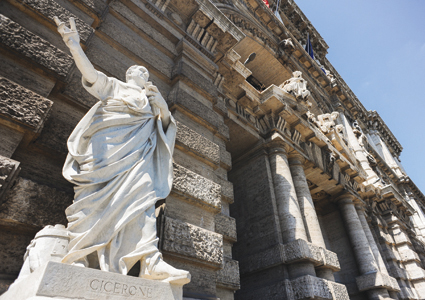
 A statue of Cicero outside the Palace of Justice in Rome: Can the US avoid the fate of the republic he defended? (Mstyslav Chernov CC BY-SA 3.0)
Rome’s greatest statesman, a man deeply admired by the American Founders for his insights into morality, law, and politics, drew his last breath in Formia. Marcus Tullius Cicero was at his seaside villa, north of Naples, along the old Appian Way, when soldiers sent by Mark Anthony arrived on December 7, 43 B.C. At the age of 64, he was retired from politics but continued to denounce the forces tearing apart Rome’s political and civic life. As the assassins approached him with swords drawn, Cicero reportedly displayed a calm defiance, born of his Stoic philosophy: “There is nothing proper about what you are doing, soldier, but try to kill me properly.” They cut his throat.
Thus Cicero’s decades-long struggle to preserve Rome’s republic — with its “mixed” or “balanced” constitution — came to an end. The advocates of oppression and terror had triumphed. For all practical purposes, when Cicero fell the republic fell with him. “Cicero came to stand for future generations as a model of defiance against tyranny,” writes Anthony Everitt in Cicero: The Life and Times of Rome’s Greatest Politician. “For the Christian Fathers he was a model of the good pagan.”
Of course, the decay of Rome’s political institutions — what Cicero called “the enemy within” — had been raging for many years. When he wrote his seminal works, The Republic and The Laws, the age of the Caesars was already upon him. What strikes the modern reader is how Cicero’s analysis of Rome’s decline — the betrayal of its republican constitution, the rampant corruption, the partisan divisions — offers the West some profoundly disturbing lessons.
Rome initially managed to absorb and tolerate a great diversity of cultures, and gradually expanded its offer of citizenship to conquered peoples. But by the time Cicero drafted The Republic (54-52 BC), Rome’s political institutions were ineffective. Worldly senators blocked economic reforms being demanded by an urban proletariat alienated from the political system. There were deep economic disparities, worsened by a tax system that crippled private initiative. There were massive public works programmes, with no sensible scheme to finance them. Mob violence was on the rise. An over-extended military, dominated by ambitious generals, struggled to maintain discipline. In the city of Rome — a cosmopolitan centre of roughly a million people — everybody complained about the traffic.
Historians observe that Cicero failed to take account of Rome’s structural failings, focusing instead on its cultural problems. Rome’s institutional weaknesses were real enough: it was not a city-state, as Cicero sometimes imagined it, but rather a vast and multicultural empire built upon slave labour. In his fierce attachment to Rome’s constitution, Cicero neglected its shortcomings.
Nevertheless, the political maelstroms of his day did not occur in a moral vacuum, and no ancient pagan author wrote with greater clarity about the link between cultural rot and political decline: “For it is not by some accident — no, it is because of our own moral failings — that we are left with the name of the Republic, having long since lost its substance.”
Like this article? Share, save or print using the icons below:


Post your comment
More Features
- Race To The White House Through The Looking-Glass
- Brexit Gives Us A Historic Opportunity
- American Conservatives Must Stand Up To Trump
- Deepdene: Rise and Fall of the House of Hope
- Debunking the EU Referendum Myths
- Britain's Opportunity Is Europe's Warning
- Controlling Immigration Is Good For Democracy
- The Pied Piper of Islington
- The West Cannot Afford To Ditch Nato
- End Of History — Or Clash Of Civilisations?
- We Can Defeat Islamist Terror — But Not On Our Own
- Without the Emperor, What is Left of Old Japan?
- Now Or Never
- Who Will Heal This Divided Country?
- What Made The West Great Is What Will Save Us
- Shock And Awe: Tales Of A Washington Insider
- We Shouldn't Let Old Men Rot Away In Jail
- Arnold Wesker’s Bid To Build A New Jerusalem
- Our EU Deal Gives Us The Best Of Both Worlds
- Brexit Would Save Us And Set Europe An Example
Popular Standpoint topics
