



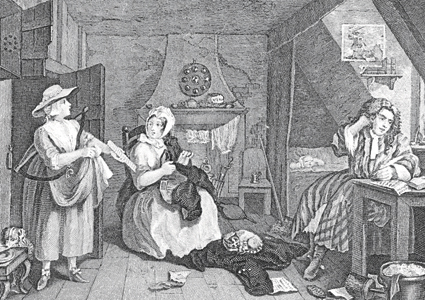
 Pennies for his verse: “The Distressed Poet” (1736) by William Hogarth
The Distressed Poet of William Hogarth’s popular print is a sorry figure. The bill for the milk is unpaid, the baby grizzles for want of a fire, the dog is about to make off with the joint, and his wife is mending already much-mended trousers. He should be industriously scribbling — a penny ballad, a pamphlet — and earning enough to see off the milkmaid brandishing her bill at the garret door. But here he is scratching his head and frowning out of the window, while scrap paper piles up under the table. The engraving appeared with verses from Alexander Pope:
Studious he sate, with all his books around,
Sinking from thought to thought, a vast profund!
Plung’d for his sense but found no bottom there,
Then writ, and flounder’d on, in mere despair.
The Distressed Poet made his appearance in print in 1736. He was still there, in the same attitude and in want of money and inspiration, in 1836. By 1936 his quill pen had become a typewriter. In 2016, it is a MacBook.
The precarious business of making a living from one’s pen is the subject of D.J. Taylor’s The Prose Factory: Literary Life in England since 1918. Taylor sets out to answer a series of questions: “What is ‘literary culture’?”; “What is taste?”; “Why in the English 20th century did certain kinds of writing prosper only for others to fall by the wayside?”; “Why did certain critics succeed in forming or altering the opinions of the literary public and others fail?” The most engaging question — though Taylor doesn’t put it in quite such vulgar terms — is: “How much?”
How much for a book review? How much for a first novel? How much for the film rights? How much for a man of letters to sacrifice his dignity — as Kingsley Amis did — to advertise wallpapers and home furnishings?
The question “How much?” is of particular interest to me a year after leaving a well-paid newspaper job with prospects, pension and private medical insurance, for freelance writing. As I sat down to write this review, an email arrived from an editor on a woman’s glossy magazine apologising for the “genuinely pathetic amount of money” they were able to pay.
The question posed by Taylor after “How much?” is “For how much longer?” With rates for journalism so low (£100 for a 700- word review in the Independent, according to Taylor — and the print edition of that newspaper has folded since The Prose Factory was published) and getting lower (one broadsheet has cut its rate from 45p a word to 35p in the last six months, according to my payment slips) and with the average professional author earning £11,000 a year, according to the Author’s Licensing and Collecting Society, how sustainable is it to flounder on with a career in writing?
Like this article? Share, save or print using the icons below:


5:03 PM
8:03 PM
3:03 PM
11:03 AM